

Arthritis in the Hand: Gentle Ways to Keep Fingers Moving
What arthritis in the hand feels like, how osteoarthritis differs from rheumatoid arthritis, and how slow, attentive movement can make daily hand use easier.
In short
Arthritis in the hand is most often osteoarthritis at the thumb base and finger joints, with stiffness that eases as you move. Gentle, attentive movement cannot reverse joint change, yet it can soften guarding and make everyday hand use easier. Prolonged morning stiffness with swelling deserves prompt assessment.

Prefer to ease in gently?
See a few gentle exercises for body awareness to try.
Before you begin. General information, not medical advice. A clear diagnosis matters here, because inflammatory arthritis such as rheumatoid arthritis responds far better when medical treatment begins early, and gentle movement is no substitute for that care. If your hands stay stiff for over an hour each morning, if joints are swollen or warm, or if deep tiredness comes with the aching, please see a doctor promptly.
If your thumb aches when you open a jar, or your fingers feel thick and reluctant in the morning, you are likely wondering what arthritis in the hand means for the years ahead. Joint changes are real and deserve respect. At the same time, much of what limits an arthritic hand is not the joint itself but the extra tension gathering around it, and that part can change. This is where the Feldenkrais Method®, a practice of slow and attentive movement, has something genuine to offer.
Among the joints osteoarthritis reaches, the hand ranks third: knees lead at 365 million people, hips come next, then hands, out of roughly 528 million people who were living with the condition worldwide as of 2019 (WHO, 2023). A stiff, aching hand has plenty of company, and our Feldypedia entry on osteoarthritis and joint discomfort sketches the wider picture.
What arthritis in the hand usually looks like
The most common form by far is osteoarthritis, the wear-related kind. In the hand it favors the base of the thumb and the small joints of the fingers. Mornings tend to start stiff and improve within half an hour or so of ordinary use. Over years, firm little knobs called Heberden nodes can appear at the end joints of the fingers. Grip may feel less trustworthy, and precise tasks like buttons, coins, and keys ask for more concentration than they used to.
None of this means the hand is failing. It means the joints have less cushioning than before, and how you use them now matters more than it once did.
Osteoarthritis or something more inflammatory
Inflammatory arthritis is a different family, and rheumatoid arthritis is its best known member. It tends to arrive symmetrically, in both hands at once, and prefers the large knuckles and the wrists rather than the fingertip joints. Morning stiffness lasts long, often well over an hour, and there may be soft, warm swelling, deep fatigue, or a general feeling of being unwell. This pattern deserves a prompt appointment, because rheumatology has disease-modifying treatments that protect joints best when started early.
This page cannot tell you which kind you have. What it can say is that lasting morning stiffness, symmetrical swelling, and fatigue are the signals worth taking to a doctor soon rather than someday.
What gentle movement offers arthritis in the hand
First, the limits: slow, attentive movement does not regrow cartilage, shrink nodes, or cure anything.
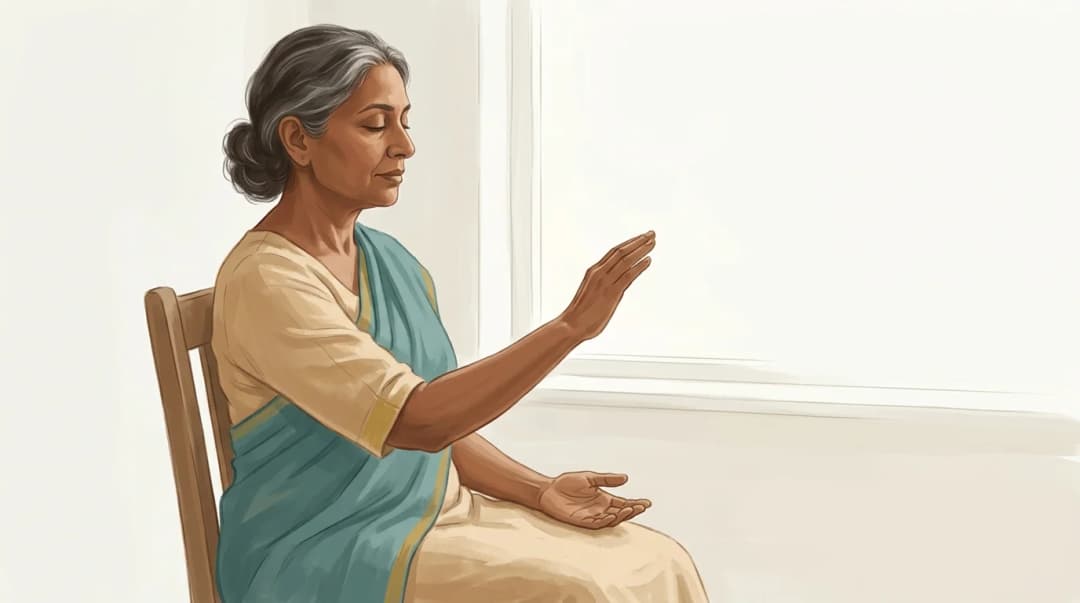
What it can do rests on a quieter observation: a sore hand is almost never used softly. Someone protecting an aching thumb usually squeezes harder with the other fingers, stiffens the wrist, and braces the forearm and shoulder without noticing. The hand occupies an enormous share of the brain's sensory and motor maps, so it repays attention unusually well. Slow down enough to feel how much force a task truly needs, and the over-gripping starts to unwind, so everyday actions cost less. Stiffness rarely vanishes, but it stops running the whole arm.
Clinical care keeps its own seat at this table: rheumatology, hand therapy, occupational therapy, medication, and decisions about splinting belong with your medical team, and the attention work described here takes its place beside them. Hand exercise and grip strengthening programs work through a different mechanism, building muscle capacity, and many people pair that training with awareness practice.
A hand never works alone
Grip a stubborn lid and you may notice your jaw and shoulder joining in. Effort in the hand travels up through the forearm, the elbow, the shoulder, and the neck, and an arthritic joint tends to recruit that whole chain into a low, constant guard. Letting the elbow rest, the shoulder hang, and the breath continue while the fingers work is a skill worth learning at any age. If your hands spend hours at a keyboard, our Feldypedia entry on repetitive strain from keyboard use looks at the same chain from the desk's point of view.
Feldy carries this same unhurried pace into its guided lessons, and the program for body awareness is where this way of sensing effort becomes a daily practice. For neighboring reading, our explainer on why your hands may be stiff untangles stiffness that is not arthritis, and there is a short morning routine for stiff hands for the first minutes of the day.
Living well beside it
The joints have changed, and the hand is still yours: still capable of writing, cooking, gardening, and holding the people you love, usually with some adjustment in pace and pressure. Curiosity serves better than vigilance. Noticing which tasks invite clenching, trying lighter grips and larger handles, and giving the hand warm, easy movement most days adds up.
Learn to listen to your body
Now for the practice that trains it. The Feldy program sharpens your attention through slow, attentive Feldenkrais® lessons, so everyday movement feels lighter and more your own. Gentle, guided, and self-paced.
Start my free 7-day trialNo credit card needed.
Common Questions about arthritis in the hand (FAQ)
Is it safe to move a hand with arthritis, and who should hold off?
Slow, comfortable movement within an easy range suits most arthritic hands, and pain is the boundary to respect: stay below it rather than pushing through. Check with a doctor first if a joint is hot, swollen, or newly painful, after recent hand surgery or a suspected fracture, or while an inflammatory condition is flaring; in a flare, rest and medical guidance come first.
How often should an arthritic hand get this gentle practice?
Brief and frequent is the pattern that suits arthritic hands: a few unhurried minutes most days, woven into moments you already have, warming your hands around a mug, waiting for a kettle, settling into bed. Stiff joints respond to being visited gently and regularly, far more than to one long weekly effort.
How long until gentle movement helps arthritis in the hand?
Softer grip and a calmer forearm can show up within a session or two, since guarding is a habit that shifts once noticed. Easier mornings and more comfortable everyday use tend to build over several weeks of regular attention. The joint changes are not being undone in that time; what eases is the extra effort surrounding them, often a surprising share of the discomfort.
How is this different from a hand exercise or strengthening program?
A hand exercise program loads the muscles of the hand and forearm so they can produce more force, which is a different mechanism with its own value. Awareness work is about quality rather than capacity: how much pressure a task actually needs, where effort creeps in beyond the fingers, and how the whole arm shares the work. Many people use both, and neither replaces the other.
Can moving my hand make the arthritis worse?
Comfortable movement does not accelerate osteoarthritis; joints are built to move, and motion helps circulate the fluid that nourishes cartilage. What can stir a joint up is force: sustained hard gripping, wringing, or working deep into pain. If an activity leaves the joint noticeably more sore for hours afterward, that dose was too large, so make the movement smaller and lighter rather than giving it up.
When should I see a professional about arthritis in my hand?
Make an appointment if morning stiffness regularly lasts beyond an hour, if knuckles or wrists on both hands are swollen or tender, if joints feel warm, if unexplained fatigue or fevers accompany the aching, or if pain keeps climbing despite rest. These patterns can point toward inflammatory arthritis, which is treated most effectively when caught early. A doctor, rheumatologist, or hand therapist can also advise on splints and daily strategies for wear-related arthritis.
Learn to listen to your body
See the programRelated resources
What Does Feldenkrais® Feel Like? A Practitioner Explains
A sensory tour of your first lesson: the floor, the voice, the tiny movements, the long rests, and the light, tall feeling many people stand up with.
Is Feldenkrais® Safe? What to Know Before Your First Lesson
Why this slow, gentle method asks less of your body than almost any other practice, and the few situations where a doctor should weigh in first.
Your balance got better, but did your sense of where your body is get better too
Ready to start moving better?
Gentle, guided lessons for your body. Try your first one free, no credit card required.