
Hypermobility Spectrum Disorder Criteria: A Plain Guide
How hypermobility spectrum disorder is defined, how it differs from hypermobile EDS, and what a clinician looks at before using either label.
In short
The hypermobility spectrum disorder criteria are not a checklist. HSD is diagnosed when joint hypermobility causes symptoms, the criteria for hypermobile EDS are not met, and other causes are ruled out. Only a qualified clinician can make that diagnosis.

Prefer to ease in gently?
See a few gentle exercises for hypermobility to try.
Before you begin. This page explains published criteria. It is not a diagnosis, and it should not be used to diagnose yourself or anyone else. Only a qualified clinician, such as a GP, rheumatologist or geneticist, can diagnose hypermobility spectrum disorder or hypermobile EDS. See your doctor about any dislocation, fainting, a racing heart when you stand up, or new symptoms. Get urgent care for a joint that dislocates and will not go back, or for fainting with chest pain or a pounding heart. Movement on this page sits alongside medical care and focuses on stability and awareness, not on flexibility.
The hypermobility spectrum disorder criteria surprise many people, because there is no checklist to tick. Anyone who has read the long list for hypermobile EDS may expect a similar list here. There is not one. This guide explains how the diagnosis works, in plain words.
Please read the safety note at the top first. This page explains published criteria. It cannot tell you whether you have HSD. Only a clinician can.
What hypermobility spectrum disorder means
Hypermobility spectrum disorder, or HSD, is a name for people whose joints move further than usual and who have symptoms because of it. Those symptoms can include pain, joints that feel unstable, and other muscle and joint problems.
The name came from an international classification published in 2017 (Castori and colleagues, 2017). HSD replaced the older term "joint hypermobility syndrome". The change was meant to give clearer labels for people with symptomatic hypermobility who do not fit hypermobile EDS or another named condition. Our Feldypedia article on hypermobility and joint instability explains the body side of this in more depth.
The hypermobility spectrum disorder criteria in plain words
Because there is no single list, a clinician reasons it through in three steps.
- Is there joint hypermobility that causes symptoms, such as pain, instability or other musculoskeletal problems?
- Are the criteria for hypermobile EDS not met?
- Have other causes of the symptoms been ruled out?
If all three answers fit, HSD may be diagnosed. In medical terms it is a diagnosis of exclusion: it is only given once hEDS and other causes have been ruled out. The Ehlers-Danlos Society describes it as symptomatic joint hypermobility that cannot be explained by other conditions. That last part matters. Many illnesses can cause joint pain, so a good assessment looks for them first.
The four types of HSD
The 2017 classification describes four types, based on where the hypermobility is.
- Generalized HSD (G-HSD): hypermobility throughout the body.
- Peripheral HSD (P-HSD): hypermobility mainly in the hands and feet.
- Localized HSD (L-HSD): hypermobility in one joint or one group of joints in the same area.
- Historical HSD (H-HSD): a history of generalized hypermobility, for example in childhood, that is less obvious now.
The types are a way to describe a pattern. They are not steps on a ladder, and they do not predict how you will feel.
Where the Beighton score fits
The Beighton score is a nine point screen for generalized hypermobility. A clinician asks you to do a few simple movements, such as bending your thumb back to your forearm or placing your palms flat on the floor with straight knees. Our guide to the hypermobility Beighton scale explains each point.
The cutoffs depend on age. In the 2017 criteria, the cutoff is 6 or more for children and adolescents before puberty, 5 or more from puberty up to age 50, and 4 or more over 50. The score is a screen, not a verdict. Many people score high with no symptoms, and generalized hypermobility is fairly common. In one sample of university students, roughly one in eight met the cutoff of 5 or more (PeerJ, 2019). Being hypermobile is not the same as having HSD. The symptoms are what turn it into a diagnosis.
How HSD differs from hypermobile EDS
Hypermobile EDS, or hEDS, has a detailed 2017 checklist. It looks at several areas, including joint hypermobility, other body features, family history, and the exclusion of other conditions. HSD is what clinicians use when someone has symptomatic hypermobility but does not meet that checklist.
This is a boundary on paper, and the experience can feel much the same. Our comparison of hypermobility vs hEDS sets the two side by side. Some people are reassessed over the years as new information appears, so a label is not always permanent.
Why HSD can be as troublesome as hEDS
A lower label does not mean lighter symptoms. People with HSD can have daily joint pain, joints that slip, tiredness and trouble with sport or work. Some also report dizziness on standing or a racing heart, which is why those need a doctor's attention.
Many people wait a long time for an answer. If that is you, you are not imagining it. A clear picture of what you notice makes the appointment more useful.
Who diagnoses HSD
Usually a GP is the first step. They may refer you to a rheumatologist, who looks at joints and connective tissue, or to a geneticist, who helps decide about hEDS and other related conditions. The assessment uses your history, a physical examination, and sometimes tests to rule out other causes.
Living well with it
Medical care comes first, and it can include physiotherapy. Alongside it, many people explore movement that builds a sense of control rather than reaching further.
With loose joints, the aim is often stability. That can mean moving slowly, noticing where a joint stops feeling supported, and choosing smaller ranges. This is where the Feldenkrais Method® can fit. In Awareness Through Movement® lessons, you move gently and pay attention, with no need to push to an end point. Many people say they feel steadier and more aware of how they use their joints afterwards.
For a first practical step, see our page on exercises for hypermobility. If you want to try guided lessons at home, Feldy's free 7 day trial is one place to start.
One thing to bring to your doctor
Write a short list before the appointment. Include which joints bother you, which symptoms you notice, and how long they have been there. Add anything that makes them better or worse, and any dislocations or fainting. A clinician can do far more with a clear list than with a general sense that "I am bendy and sore".
Stability without gripping
Now for stability that does not rely on gripping. The Feldy program builds a clearer sense of where the body rests, so steadiness grows from awareness, through Feldenkrais® lessons. Gentle, guided, and self-paced.
Start my free 7-day trialNo credit card needed.
Common Questions about hypermobility spectrum disorder criteria (FAQ)
Is hypermobility spectrum disorder serious?
It can be troublesome, and it deserves proper medical attention. Some people have mild symptoms, and others have daily pain, unstable joints or fatigue. HSD is not a lesser condition than hypermobile EDS in how it can feel. Dislocations, fainting, a racing heart on standing or new symptoms should be checked by a doctor.
How often should I move if I have HSD?
There is no single right amount, so ask your own clinician. Many people find short, gentle, regular sessions easier to live with than rare long ones. Slow movement with attention to control and stability tends to suit loose joints better than chasing end range.
How long until movement helps with HSD?
It varies a lot from person to person, and nothing here is promised. Some people notice small changes in how steady a joint feels within a few weeks of gentle practice. Others take longer. Keeping a simple note of what you notice helps you and your clinician see the pattern.
What is the difference between HSD and hypermobile EDS?
Hypermobile EDS has a specific 2017 checklist with several parts, covering joint, skin and family features and the exclusion of other conditions. HSD is diagnosed when symptomatic hypermobility is present but that checklist is not met. The symptoms can feel similar. The label differs because of what the clinician finds.
When should I get medical help for HSD symptoms?
Book an appointment if a joint dislocates or partly slips, if you faint or feel your heart race when you stand, or if pain or fatigue interfere with daily life. Also go for any new symptom. A GP can examine you and refer you on to a rheumatologist or a geneticist if needed.
Does a high Beighton score mean I have HSD?
No. The Beighton score is a quick screen for generalized joint hypermobility. Many people score high and have no symptoms at all. HSD needs symptoms too, plus a clinician's assessment that rules out other causes and checks the hEDS criteria.
Stability without gripping
See the programRelated resources
Hypermobility Without EDS: What Bendy Joints Usually Mean
Hypermobility without EDS is the most common way to be hypermobile: what separates the everyday trait from HSD and hypermobile Ehlers Danlos syndrome.
What Does Hypermobility Mean? A Plain Guide
The word covers a lot of ground, from a harmless bendy trait to a diagnosis made by a doctor. Here is what it really describes, and what it can mean for you.
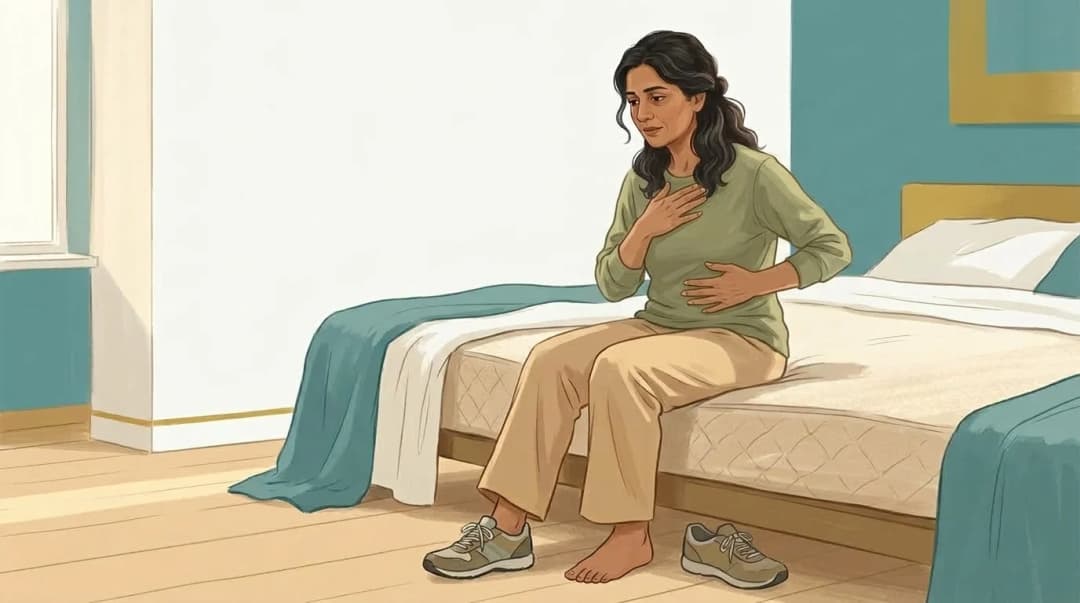
Getting out of breath may be the hypermobility symptom that quietly shrinks your day
Ready to start moving better?
Gentle, guided lessons for your body. Try your first one free, no credit card required.