
How to Fix Posture in Sleep: What Actually Helps
There is no single correct way to lie at night. What changes how you wake is support, how long you stay in one arrangement, and how settled you were when you got in.
In short
There is no single posture to fix in sleep, because a healthy sleeper changes position many times a night. What helps is filling the gaps between you and the mattress so no joint is held at its end range, and making it easy to turn over.

Prefer to ease in gently?
See a few gentle exercises for stress and sleep to try.
Before you begin. This is general education about sleeping comfort, not medical advice. If you are pregnant, recovering from surgery, or living with a condition such as sciatica, arthritis, osteoporosis, or sleep apnoea, ask your doctor or midwife which positions suit you before changing anything. Pain that wakes you regularly, or that arrives with numbness, weakness, or fever, needs assessment rather than a new pillow.
If you are looking for how to fix posture in sleep, the honest starting point is that there is nothing to fix, because there is no single position to hold. A sleeper who is doing well turns over roughly ten to twenty times a night without waking. That movement is not a failure of discipline. It is the thing that keeps joints comfortable, and it is worth protecting rather than training out of yourself.
That said, the question behind the question is usually a real one. People search for this because they wake sore, or stiff, or with one shoulder complaining, and they suspect the night had something to do with it. Often it did, just not in the way they imagine.
How to fix posture in sleep, in practice
Stop aiming at a position and start looking at support. Lie down as you normally would and see where there is a gap between you and the mattress. On your side, the gap is usually under the waist and between the knees. On your back, it is under the neck and, for many people, a small one under the lower back. Every unfilled gap is a joint hanging at or near the end of its range, and a joint left there for six hours is the one that talks to you in the morning.
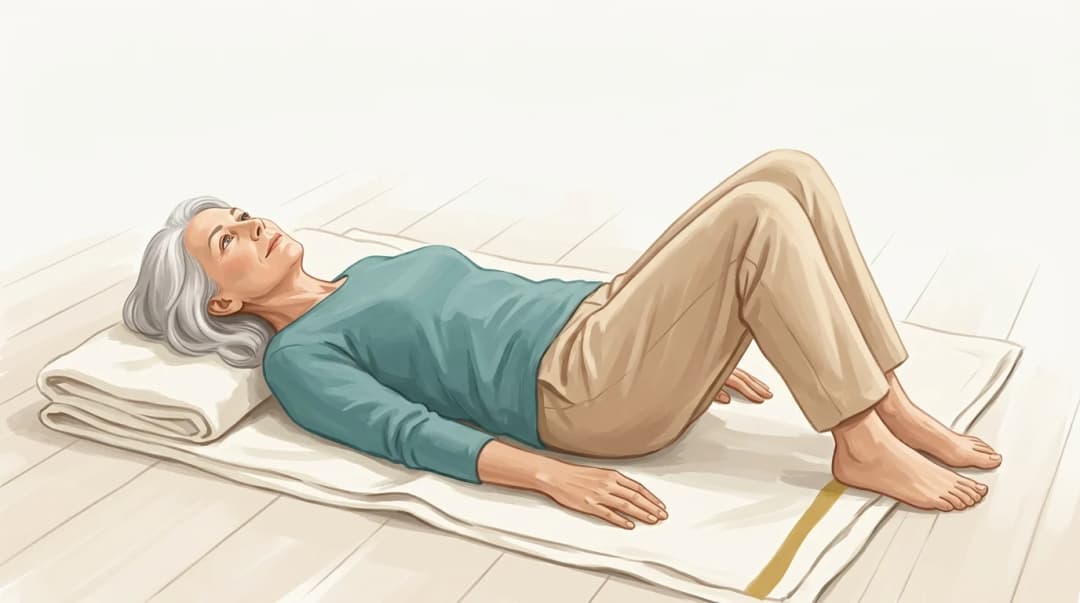
Filling those gaps takes very little. A pillow between the knees keeps the top hip from dropping across the body. A folded towel at the waist stops the side of the trunk sagging. Under the neck, the aim is simply that your head is neither propped up nor tilted down: roughly in line with your spine, whichever way you are facing. A small support under the knees when you lie on your back lets the lower back settle instead of arching.
The second half is making it easy to turn over. Heavy blankets tucked in tight, a mattress with a deep dip, or a wall of pillows will all hold you in one arrangement longer than your body wants. Ease of turning matters more than the arrangement you started in.
Why the stiffness is usually about stillness
Low back pain affected 619 million people in 2020 (WHO, 2023), and a great many of them have been told at some point that their sleeping position is at fault. It rarely is, on its own.
Joints do not have much of a blood supply. They rely on movement to move fluid around, so a long stretch without motion leaves them feeling thick and reluctant. Muscles that have been holding one shape gently for hours behave the same way. This is why morning stiffness that fades in ten or twenty minutes of ordinary pottering is so common and so unalarming, and why it is not evidence that you slept wrong. Stiffness that lasts well over an hour every morning is a different pattern and worth mentioning to a doctor.
The part that happens before you lie down
How settled you are when you get into bed shapes the whole night. A body that arrives already braced, from a hard day, a late screen, or a long drive, does not simply switch that off because the light went out. It carries the holding into the night, and holding plus stillness is the recipe for a stiff morning.
This is where slow movement earns its place. A few minutes of unhurried, small movement before bed gives the nervous system something other than the day to attend to. The Feldenkrais Method® is built for exactly this kind of winding down: the movements are small enough to do lying in bed, and the point is attention rather than effort. Our Feldypedia entry on sleep disruption and physical tension sets out why a braced body sleeps worse, and the somatic exercises for sleep lesson is a practical place to start tonight. Feldy runs a free 7 day trial if you would like the guided version.
What to change first, and what to leave alone
Change one thing at a time and give it a week. Pillow height is the highest yield change for anyone waking with a sore neck, and it is nearly free. A knee pillow is next if you sleep on your side and wake with a low back or hip that is unhappy. After that, look at the mattress, which is the expensive option and rarely the first answer.
Leave your favourite side alone. There is a good deal of advice about which side is better, and for most healthy people the difference is not worth the lost sleep of trying to enforce it. Reflux and late pregnancy are the clear exceptions, and both are questions for your own clinician rather than for a general article. If your neck is the loud part, our guide to sleeping with a stiff neck goes into the pillow question in more detail, and sleeping positions for mid back pain covers the ribs and upper back.
The first two minutes of the morning
Most people go from completely still to fully vertical in about four seconds, which is a lot to ask of a body that has not moved since three in the morning. Before you stand, give yourself a few small movements while still lying down: bend and straighten the knees a couple of times, roll the pelvis a little, turn the head gently side to side, and let a yawn and a stretch arrive if they want to. It takes under two minutes and it changes how the first hour feels far more reliably than any sleeping position ever will.
A calmer body, easier nights
Understanding it is calming, moving with it more so. The Feldy program is meditation in movement, slow Feldenkrais® lessons that help a busy body settle so sleep can arrive on its own. Gentle, guided, and self-paced.
Start my free 7-day trialNo credit card needed.
Common Questions about fixing posture in sleep (FAQ)
What is the best sleeping position for posture?
The one you can leave easily. Side lying with a pillow between the knees and back lying with a small support under the knees are both kind to most bodies, but neither is a rule. The better question is whether any joint is being parked at the very end of its range for hours, because that is what tends to ache by morning.
Can you actually fix your posture while you sleep?
Not directly. Posture is not a shape stored overnight, it is how you organise yourself moment to moment while awake. What sleep can do is give you a less irritated starting point, which makes the daytime habits easier to notice and easier to change.
Does my mattress or pillow change my posture in sleep?
They change how well you are supported, which is the part that matters. A pillow that is too flat or too tall holds the neck at an angle for hours, and a mattress that lets the hips sink much lower than the ribs does something similar to the lower back. Aim for the head and the spine being roughly in line, whichever way you are facing.
Why do I wake up stiff even in a good position?
Because stillness itself is most of the cause. Joints rely on movement to circulate fluid, and several hours without much of it leaves things feeling gluey for the first ten or twenty minutes of the day. Stiffness that eases as you move about is usually this rather than a sign of harm.
Is sleeping on your stomach bad for you?
It is the least forgiving option, mainly because your neck spends the whole night rotated to one side. If you sleep that way and wake comfortable, there is no need to change. If you wake with a sore neck, try a very thin pillow, or a pillow under one hip and shoulder so you are turned slightly toward your side.
When should I see a professional about pain that wakes me?
See a doctor if pain wakes you most nights, is worse at rest than with activity, or comes with numbness, pins and needles, weakness, unexplained weight loss, or fever. The same applies if stiffness lasts well over an hour each morning. Those patterns need a proper look, and professional care sits alongside anything you practise at home.
A calmer body, easier nights
See the programRelated resources
How to Sleep With a Stiff Neck: Positions and Wind Down
How to sleep with a stiff neck: kinder positions, simple pillow tips, and a short gentle wind down that helps a held neck settle so you can rest more comfortably.
Sleeping Positions for Mid Back Pain: What Truly Helps
How to arrange side, back and front lying so a sore thoracic spine can rest, what the thin research supports, and which night symptoms need a clinician.
Lying down is not the same as resting, and researchers have now measured the difference
Ready to start moving better?
Gentle, guided lessons for your body. Try your first one free, no credit card required.