
Older adults slept better with exercise, and one kind ranked first
Balance training came out on top in a review of 39 studies. A second review put programs mixing several kinds first.
Sleeping poorly lately, and wondering which kind of exercise is worth your time? The usual answer is a brisk walk. But when five kinds of exercise were set side by side for older adults, the one that ranked first for sleep quality was one you might not expect: balance training.
The walk still counts. Aerobic exercise helped, and so did strength training and programs that mixed several kinds. So here is the practical news for you: four of the five kinds tested helped people rate their sleep better, so the one you'll keep doing is a fair place to start, and balance training, which you might not even think of as exercise, came out on top.
Balance first, then the rest
The review, out this week, brought together 39 studies of people aged sixty and over (Journal of Physical Activity and Health, 2026). The review compared sleep on one standard questionnaire in which people rate their own sleep, so this is sleep as it felt to people like you, rather than sleep measured in a lab.
Balance training showed the largest average gain on that questionnaire, ahead of aerobic exercise, with mixed programs and strength training a little further back. All four did better than the control groups. Flexibility work came out in a similar range, but only two studies tested it and the result could be chance.
A second review, another winner
Out on the same day, a second review brought together 32 trials in older adults (European Geriatric Medicine, 2026) and sorted the exercise into different groups; its summary lists no separate balance category. Its first place went to combined programs, which mix more than one kind of exercise. Aerobic and strength training came next, then mind body practices, then dance.
Its authors are careful about their own ranking. They note the order might change with how long each session lasts, how often people train, for how many weeks, how hard, and who is taking part, and they call the result provisional, meaning it still needs to be confirmed.
Two careful reviews, two different winners. My own reading of them together, and it is a reading rather than a finding: for sleep after sixty, doing some kind of regular movement seems to matter more than picking the one that tops a table.
What the headline will miss
Rankings like these are fragile. They depend on which trials happen to exist and how the authors group them.
The summary of the first review doesn't say how many of its 39 studies tested balance training, so how firm that first place is can't be judged from the summary alone. It doesn't describe what the balance programs involved either, so the few minutes at the counter I suggest below may be quite different from what the trials tested. In exercise trials people usually know which exercise they're doing, and here they rated their own sleep, which leaves room for expectation to colour the result. Neither review tested the Feldenkrais Method®.
And if poor sleep has gone on for months, or comes with loud snoring, gasping at night or heavy daytime sleepiness, that is worth raising with your doctor. Exercise doesn't replace that conversation.
Who each tends to suit
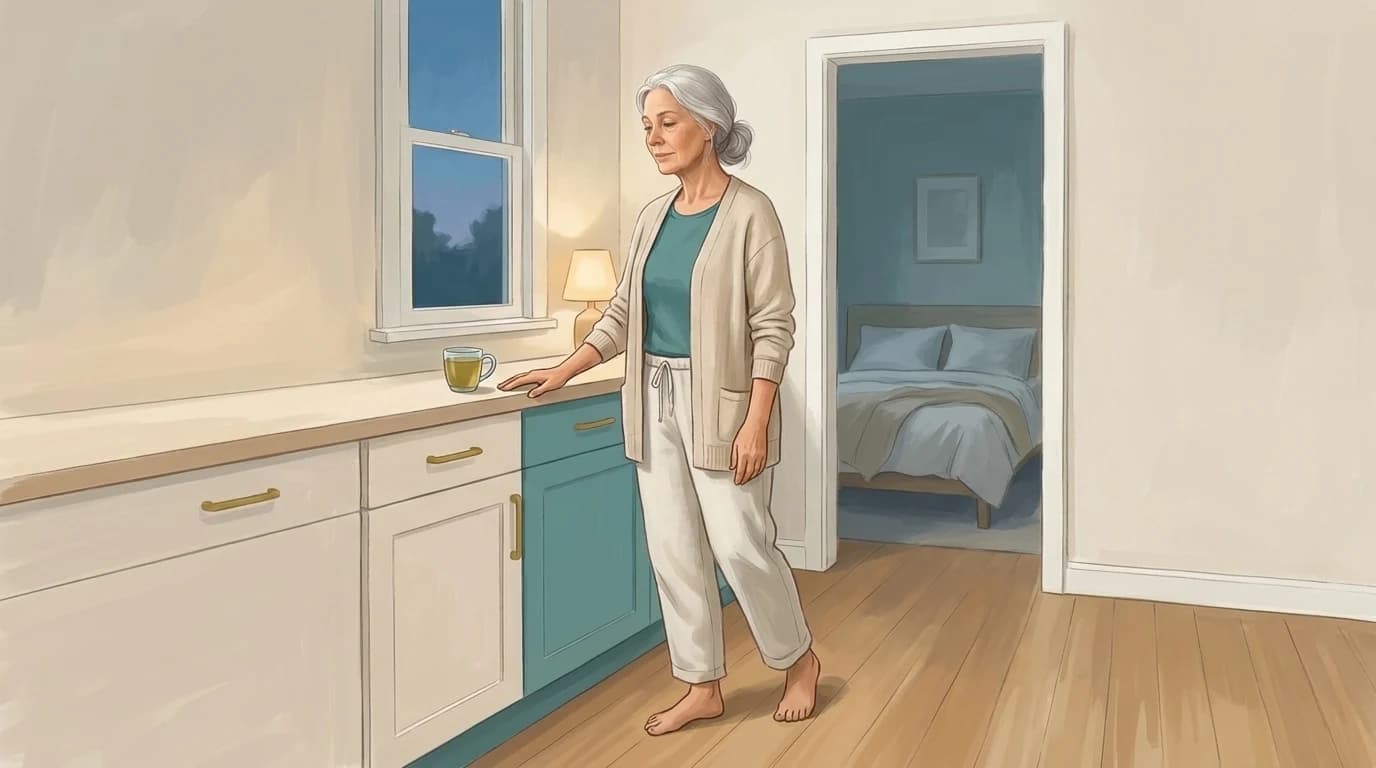
These are different ways of working with the body, each with its own strengths. Walking is easy to start and gets you outside in daylight. Strength training builds the muscle that keeps getting up from a chair easy. Tai chi is slow, continuous weight shifting, so it carries plenty of balance work inside it. Yoga ranges from very soft to quite demanding. Balance practice on its own can be as plain as standing near a kitchen counter and shifting your weight, which makes it the easiest of all to fit into an evening. Some people would rather wind down lying on the floor; I've looked separately at which legs up the wall before bed benefits hold up.
So choose by what your body allows, what you enjoy and what you'll keep doing. If feeling unsteady is part of your picture, start beside something sturdy you can hold. If you're seeing a physiotherapist, whatever you pick sits alongside what your physiotherapist gave you, and it's worth telling them.
Try it now
From a Feldenkrais® point of view, balance is less a test you pass than something you listen to. Stand beside a counter with your feet a comfortable width apart, and let your weight drift slowly towards your heels, then towards the front of your feet, so slowly you can feel the floor change under you. While you do it, notice whether your jaw or your breath has tightened.
What I see again and again in my classes is that people tense up when they work on balance, almost as if someone were grading them. Done this way, small and slow, you only go where it feels easy, pleasant, and comfortable, and the movement becomes a way of noticing rather than a way of trying. Whether that quieter quality has anything to do with sleep, these reviews didn't test.
One small experiment
If you already walk, keep walking. If you'd like to add one thing, try a few minutes of that slow weight shifting beside the counter on most evenings, and notice over the next few weeks whether your nights feel any different to you.
Let Feldy guide you, eyes closed
A calm voice walks you through gentle moves so your attention stays in your body, not on the screen.
Try Feldy Free for 7 daysNo credit card needed.
Sources
- Effectiveness of Different Types of Physical Activity Interventions for Enhancing Sleep Quality in Older Adults: A Systematic Review and Network Meta-Analysis— Journal of Physical Activity and Health, 2026
- Same paper, publisher record (DOI 10.1123/jpah.2026-0106)— Journal of Physical Activity and Health
- What exercise regimen is most effective for improving sleep quality in older adults? A systematic review and network meta-analysis— European Geriatric Medicine, 2026
- Same paper, publisher record (DOI 10.1007/s41999-026-01586-9)— European Geriatric Medicine
Movement Pulse is informational, not medical advice. See our editorial policy.
Move better with Feldy
See the programMovement Pulse Weekly
The week's best research, in your inbox Tuesday.
Movement science, gentle-practice ideas, and a practitioner's read on what's new. Free.
More from Movement Pulse
After 60, some of what movement does for your memory may happen while you sleep
Eight trials, 841 adults over 60: roughly half of the gain in thinking that came with exercise seemed to travel through better sleep.
Oct 14, 2026
Why more exercise can stop helping your sleep, and what the curve actually shows
Researchers mapped exercise dose against sleep quality and found a peak, not a ladder. Three questions worth bringing to your next appointment.
Aug 2, 2026
Yoga, tai chi, walking: movement and insomnia
A 2026 network meta analysis compared yoga, tai chi, and walking for insomnia. Different mechanisms, but a shared thread matters more than the ranking.
Jul 11, 2026Ready to start moving better?
Gentle, guided lessons for your body. Try your first one free, no credit card required.