

5 Stretches to Do Every Morning, Done the Gentle Way
Five small morning movements you can do before you are properly awake, closer to slow exploring than to held stretching, and short enough to keep up on a rushed day.
The lesson
About 5-10 minutes. Move slowly, do less than you can, and stay well below any pain. Rest whenever you need to.
Prefer to listen than read?
Feldy voices gentle lessons like this for body awareness, so you can close your eyes and follow along.
- 1
Arriving before anything moves. Lie on your back with your knees bent and your feet standing, in bed or on the floor. Spend a few breaths feeling which parts of you press down and which parts hover.
- 2
One: rocking the pelvis. Let your pelvis roll a tiny amount, so your lower back comes nearer the surface and then eases away again. Keep it small enough that it stays pleasant.
- 3
Two: knees leaning side to side. Let both knees tip slowly toward one side, only as far as is comfortable, then toward the other. Then stop, and rest with both feet standing.
- 4
Three: a heel sliding out. Slide one heel slowly away until the leg is long, then draw it back to standing. Swap sides, and notice whether the two legs travel the same way.
- 5
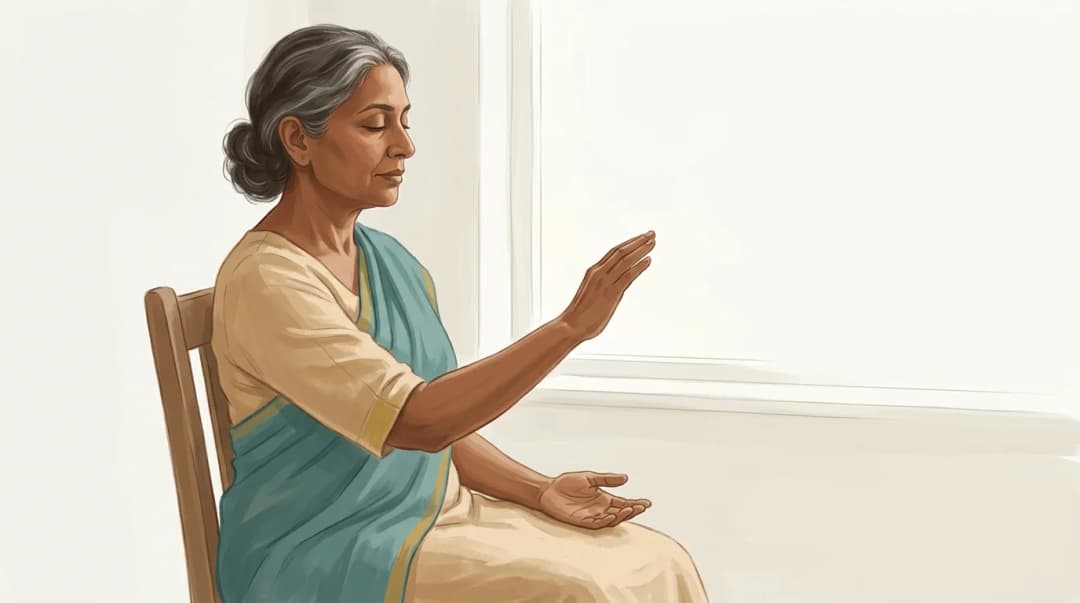
Four: an arm drawing an arc. Let one arm travel slowly along the surface from beside your hip toward above your head, going only as far as stays easy, then back. Does the shoulder blade join in anywhere?
- 6
Five: the head turning. Turn your head slowly to one side and back to the middle, then the other way, as if following something moving across the ceiling. Small and unhurried.
- 7
Lying still, taking stock. Let everything settle for a moment and feel the whole length of yourself on the bed. What, if anything, feels different from the way you began?
Let Feldy guide you, eyes closed
You just read these steps. In the Feldy program, a calm voice guides you through each gentle move, so your attention can stay in your body instead of on the screen.
Try Feldy Free for 7 daysNo credit card needed.
Almost every list of 5 stretches to do every morning asks you to pull something and hold it for thirty seconds, which is a strange request to make of a body that has been motionless for eight hours. The five movements above ask for something else. They are slow, they are small, and not one of them is held. You can do the whole set before you are properly awake, still lying in bed, and it takes about five minutes if you let it.
There is a reason for the change. When twelve trials of post exercise stretching were pooled, the effect on next day soreness came out at roughly one point on a hundred point scale (Cochrane, 2011). Stretching is pleasant and it is not a lever. What a stiff morning body responds to is movement, repeated gently, in directions it has not visited since the night before.
The 5 stretches to do every morning, and why they are movements
Each of the five visits a different region: the pelvis, the knees and lower back together, one leg at a time, a shoulder, and the neck. Between them they cover most of what goes quiet overnight. The order runs from the middle of you outward, which matters more than it sounds, because a shoulder is much easier to move once the ribs underneath it have woken up.
Stiffness in the morning is ordinary and usually brief. Fluid settles while you sleep, joints rest at one angle, and muscles cool slightly, so the first minutes of standing feel thick until circulation catches up. Our Feldypedia article on waking with stiffness and pain explains what is happening in more detail, and if you want the pleasure side of the question, our explainer on why morning stretches feel so good covers that too.
How to get the most from 5 stretches every morning
Slow is the only technical instruction. If somebody watching could describe the movement easily, it is probably twice as big as it needs to be. Rest between each one, even for three or four breaths, because those gaps are where the nervous system does its filing. Comfort decides everything. Should one side object, stay with the side that does not, and let the other one happen in your imagination.
The routine comes out of the Feldenkrais Method®, a movement education approach built on slow attention rather than effort, and it works the same way whether you are twenty five or seventy five. If following a warm voice suits you better than reading a list, the Feldy free trial gives you a week of guided audio lessons at home at no cost, and our routine of morning stretches in bed is a slower cousin of this one.
When morning stiffness is worth a conversation
A stiff half hour that loosens once you are up and about is the common pattern and nothing to worry about. Stiffness that lasts well beyond an hour most mornings, or arrives with joints that look swollen, feel warm, or turn red, is a different signal and belongs with a doctor, since inflammatory conditions respond much better when they are caught early. The same goes for pain that wakes you, or that is worse in the morning week after week. Gentle movement sits alongside that kind of care rather than standing in for it. Other approaches to the morning, like yoga or a short walk, work through their own mechanisms and are perfectly good company for this.
Find where to start
If mornings are the hardest part of your day, the most useful next step is a practice that begins before you stand up rather than after. The Feldy program for body awareness is built from short lessons of this size, done at home whenever suits you.
Which method would actually suit your mornings? Take the 60-second Movement Match quiz and get one matched approach plus a complementary one.
Common Questions about morning stretches (FAQ)
Are these 5 stretches safe to do every morning?
They are about as gentle as movement gets, since nothing is held, loaded or taken near an end range, and every part is optional. Anyone with a recent fracture, a new joint replacement, or a condition with movement restrictions from a surgeon should check those rules first. A movement that hurts is a movement to make smaller or skip that day.
What are the best morning stretches for stiffness?
For plain morning stiffness, small repeated movement beats long holds almost every time. Rocking the pelvis, swaying the knees and sliding a heel give the joints fluid and information within the first minute, which is what stiffness is actually short of. Save any long hold for later in the day when you are warmer.
What should I avoid stretching first thing in the morning?
Avoid deep forward bends over straight legs, hard neck pulls, forcing a shoulder overhead, and anything with a bounce at the end. First thing, tissue is cool and the nervous system is only half awake, so end range work has the highest cost and the lowest return. Nothing here should feel like effort.
How long should a morning routine take?
Five minutes is plenty, and two is better than none. The point is the regularity rather than the duration, because the body reads a short daily signal far more clearly than an occasional long session. On a rushed day, do three of the five movements in bed and get up.
How soon will I feel a difference?
Most people feel something within the first session, usually a sense of being more present in the body rather than looser. Changes that carry into the rest of the day tend to arrive after two or three weeks of most mornings. If your mornings involve pain that lasts well past an hour, that is a question for a doctor rather than a routine.
How is this different from ordinary morning stretching?
Ordinary stretching asks tissue to tolerate length and rewards you with a familiar pulling sensation. This does something quieter, moving each area slowly through comfortable range so the nervous system gets fresh information about where everything is. The sensation is smaller, and for a lot of people it lasts longer into the day.
Learn to listen to your body
See the programRelated resources
Feldenkrais® vs MELT Method: The Gentler Pick for Stiff Bodies
Both are kind to a 50 plus body. Feldenkrais changes the stiffness itself, MELT changes how tissue feels for a while. Here is how to choose between them.
Feldenkrais® vs Vinyasa: The Better Choice When You Want Ease, Not Effort
Vinyasa offers heat, strength, and flowing rhythm. Feldenkrais offers slow, voice guided awareness. Which one fits depends on which of those you actually want.
Your balance got better, but did your sense of where your body is get better too
Ready to start moving better?
Gentle, guided lessons for your body. Try your first one free, no credit card required.