
For steadier balance after 60, balance games helped but never beat plain exercise
Steadiness is part of staying independent. Sixty trials with about 3,500 older adults suggest you can build it with a game, a screen, or neither.
As a Feldenkrais® practitioner who works mostly with people in their sixties and seventies, I get asked about balance gadgets more every year. A board that beeps when you lean. A game on the television. A tablet program with a coach guiding you from a distance. Underneath, the question is always the same: is the screen what will keep me upright?
A review published this week in JMIR Aging gives the clearest answer I've seen. Researchers at South China Normal University in Guangzhou pooled 60 randomized trials with about 3,500 older adults, average age 73, and found that several kinds of technology improved balance compared with doing nothing at all. None of them did better than ordinary exercise (Li and colleagues, JMIR Aging, 2026).
Every route beat sitting still
The team sorted the technology into five groups: games played standing on a board that reads your weight, games where a camera follows your body, other training games, wearable sensors, and telerehabilitation, meaning exercise coached remotely by a person over a screen. Each was set against conventional exercise (the kind done in a class or at home with no device) and against no training.
Three of the technologies came out ahead of doing nothing: the board games, the camera games and remote coaching. So did conventional exercise. The same pattern held on a simple test many clinics use, where you rise from a chair, walk a few metres, turn, walk back and sit down. People also dropped out of the technology programmes at about the same rate as the plain ones, so the screens didn't seem to make practice harder to stick with.
The plain option held its place
This is the part I'd want a reader to keep. In no comparison did a game, a sensor or a remote session do better than conventional exercise. An earlier analysis from 2023 had found only the camera games clearly better than nothing; three years and many more trials later, the list of things that help has grown, and the plain option is still on it.
Remote coaching sat at the top of the ranking, which is tempting to read as a win for online practice, including the kind I teach. The authors don't read it that way, and neither do I. That place rests on five trials and 198 people, and its chance of truly being the best was well under half.
A learning problem
A balance board does one useful thing: it shows you, on a screen, where your weight is. In my classes I see again and again that people can't say this from the inside at first. Ask someone standing whether their weight is more on the heels or the toes, and there's a pause. Usually a guess. That pause interests me more than any score, because balance is not only strength in the legs but the nervous system reading pressure through the soles of the feet and answering in time, and that reading is a skill it can go on refining, quietly, long after the legs have stopped getting any stronger. The screen lends you the reading from the outside. A Feldenkrais lesson asks you to find it in your own feet, slowly and with less effort, so it's still there when you step off the board and onto a wet pavement.
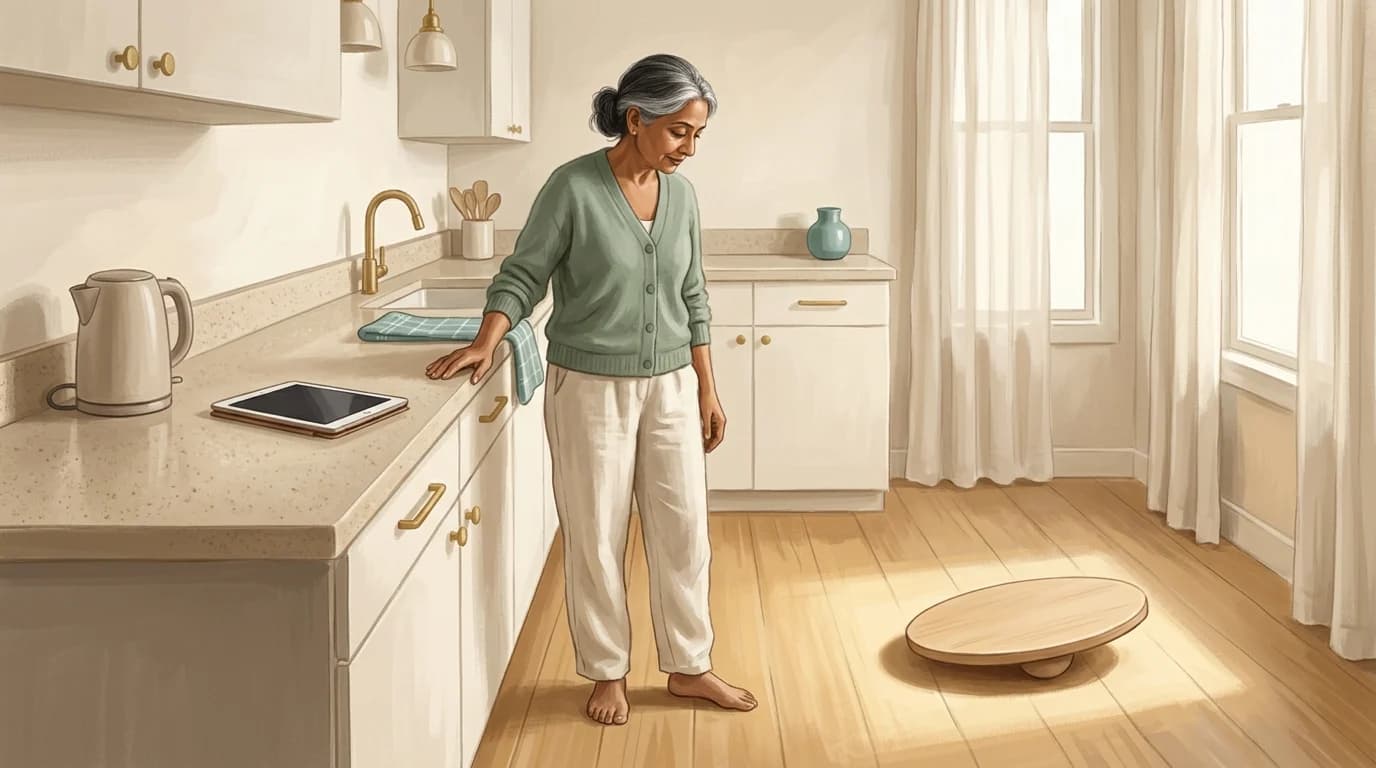
Here's a short version to try at your kitchen counter. You only go where it feels easy, pleasant and comfortable.
Your feet as the balance board
About 5 minutes. Move slowly, do less than you can, and stay well below any pain. Rest whenever you need to.
- 1
Stand by a kitchen counter or behind a sturdy chair, one hand resting on it. Feet a comfortable width apart.
- 2
Notice your feet on the floor. Where is the pressure: heels, toes, inner or outer edges?
- 3
Shift your weight slowly a little toward your toes, then back toward your heels. Small is fine.
- 4
Do it a few more times, smaller each time. Can you feel the moment your toes begin to press?
- 5
Now shift slowly a little onto your right foot and back to the middle. Then the left. Rest.
- 6
Draw a slow, small circle with your weight: toes, right, heels, left. Then the other way. Rest.
- 7
Stand quietly again. Where is the pressure in your feet now? What has changed?
Let Feldy guide you, eyes closed
A calm voice walks you through gentle moves so your attention stays in your body, not on the screen.
Try Feldy Free for 7 daysNo credit card needed.
What the headline will miss
Most of this evidence is thin. The authors rated their confidence as moderate for only two comparisons, the board games and the camera games against no training on the chair test, and as low or very low for the other 37. What counted as conventional exercise, and how hard it was, varied from trial to trial.
And none of the 60 trials counted falls. Better scores on a balance test are encouraging, but they aren't the same as fewer falls, and the review can't say whether any of these routes kept someone off the floor. If falling is the worry underneath, unsteadiness and the fear of falling tend to feed each other, and the quieter change behind both is often how well the body senses itself.
The board you already stand on
Whether you practise with a game, a coach on a tablet or nothing but a counter to rest a hand on, the review found no route that beat plain practice. That leaves the choice to the one you'll enjoy enough to keep doing, and to the attention you bring while you do it.
Next time you wait for the kettle, notice where your weight is. Heels or toes? No screen will ask you that while the water boils.
Sources
- Comparative Effectiveness of Digital Exercise-Based Interventions for Improving Balance in Older Adults: Systematic Review and Network Meta-Analysis With GRADE Certainty of Evidence— JMIR Aging, 2026
- Comparative Effectiveness of Digital Exercise-Based Interventions for Improving Balance in Older Adults (publisher record)— JMIR Aging
Movement Pulse is informational, not medical advice. See our editorial policy.
Move better with Feldy
See the programMovement Pulse Weekly
The week's best research, in your inbox Tuesday.
Movement science, gentle-practice ideas, and a practitioner's read on what's new. Free.
More from Movement Pulse
Why the balance exercise that works in a class may not be the one that works at home
A new analysis pooled 423 trials and nearly 34,000 older adults to compare 19 ways of training balance. The ranking changed depending on which kind of balance was being measured.
Aug 16, 2026
The strongest predictor of falls is not strength
A new 2026 study put proprioception, vibration sense, and muscle strength head to head against fall frequency in older women. The sensing variable won.
Jun 20, 2026Ready to start moving better?
Gentle, guided lessons for your body. Try your first one free, no credit card required.