
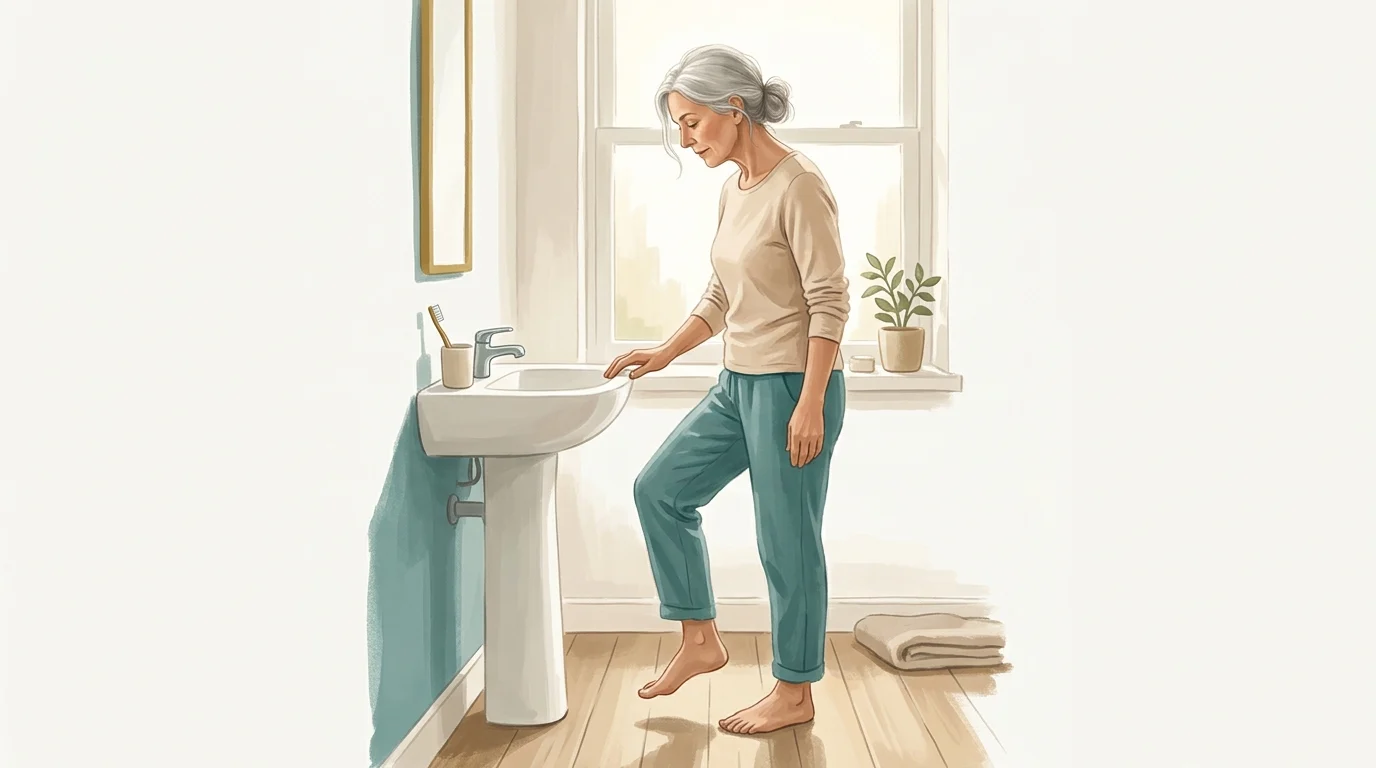
Why balance practice may work better at first when it is the only thing you are doing
In a small study from Türkiye, counting backward while learning a balance board slowed one part of the learning. A case for giving a new balance practice your whole attention first, and adding the rest of life later.
As a Feldenkrais® practitioner who works mostly with people over sixty, I hear one balance tip more often than any other. Stand on one leg while you brush your teeth. It's a kind idea, because it hides practice inside a habit you already have, and a study published this week raises a quiet question about when in the learning that hiding works best.
What the study did
The work comes from the physiotherapy department at Balıkesir University in Türkiye, where Ömer Burak Tor, Utku Berberoğlu and Serdar Demirci asked whether learning to balance needs the thinking parts of the brain, or whether it happens somewhere more automatic (European Journal of Neuroscience, 2026). Their way of testing it was simple. Give the brain something else to do, and see whether the learning slows.
Twenty five healthy young adults, average age about 21, stood on a wobbling balance board for one short session: five sets of three trials, each 40 seconds long. Thirteen of them simply stood. The other twelve counted backward in threes from a random number the whole time, the kind of task that keeps you busy without asking you to move. A small sensor on the board recorded how far it tilted and how quickly it rocked, side to side and front to back.
What changed, and what didn't
Both groups got steadier. Within one session the wobble narrowed in every direction, and side to side the two groups improved in much the same way. Counting did not stop anyone from learning.
The difference showed up front to back. Only the people who weren't counting learned to slow the board's forward and back rocking (slower rocking usually means smaller, smoother corrections), and in the third set their rocking was measurably slower than the counters'. The authors read this as a sign that early balance learning draws on attention, and that a mental task competes for the same resources.
Keep it in proportion. This was 25 students, one session, one measure out of several, and nobody was tested a day later to see what stayed. It says nothing directly about people in their sixties or seventies, and nobody brushed their teeth.
It also sits next to a larger body of work pointing the other way, and both can be true. A 2024 review pooled 14 studies with 691 healthy older adults and found that dual task training (balance practice combined on purpose with a thinking task) improved balance compared with no training, and a little more than other kinds of training (Archives of Gerontology and Geriatrics, 2024). Real life asks you to balance while you talk, carry things and think about dinner, so practising that has value. The new study adds a question about order.
The Feldenkrais angle
In the Feldenkrais Method® we treat balance as something the nervous system learns, not a strength you either have or lack. Awareness Through Movement® lessons are slow and quiet for a reason: a difference has to be felt before it can be chosen, and feeling takes attention. Once your system has found an easier way to stand, it no longer needs you watching, and that's the moment when it can share you with a toothbrush or a conversation.
So the question isn't whether to combine. It's when. First the standing, alone. Then the rest of life.
Standing with your whole attention
About 5 minutes. Move slowly, do less than you can, and stay well below any pain. Rest whenever you need to.
- 1
Stand facing your kitchen counter with your fingertips resting lightly on its edge and your feet about as wide as your hips. Keep the fingertips there for the whole practice. Before you do anything, notice how your weight spreads through your feet: more on the heels or the front of the foot, more on the inner or the outer edges. There is nothing to change yet.
- 2
Slowly let a little more of your weight travel toward your right foot, then come back to the middle. Do this five or six times, smaller than you could. Notice where in the right foot the pressure arrives first, and what your ankle, knee and hip do to make room for it. Go only where it feels easy, pleasant and comfortable.
- 3
Now rock a very small way forward toward your toes and back toward your heels, the same direction the balance board rocked in the study. How small can the movement become and still be felt? Notice whether your breath carries on, or waits.
- 4
If it feels easy, let your left heel lift a little so that most of your weight rests on the right foot, fingertips still on the counter. Stay for three or four breaths and sense the tiny adjustments the standing foot keeps making on its own. Lower the heel and rest. Then try it with the other foot.
- 5
For curiosity only: go back to the small rocking from step 3, and this time count backward out loud from 100 in threes. Does your sense of your feet change? Does the rocking? There is no right result here, only a comparison. Then stop counting, rock a few more times in silence, and take a few slow steps away from the counter.
Let Feldy guide you, eyes closed
A calm voice walks you through gentle moves so your attention stays in your body, not on the screen.
Try Feldy Free for 7 daysNo credit card needed.
If a physiotherapist has given you a balance programme, this sits alongside it, not in place of it, and the order you do things in is a good thing to ask them about. People who feel unsteady or wary of falling often try to practise balance in the least noticeable way, in the middle of something else, partly so it doesn't feel like a big deal. I understand that completely. What I see again and again in classes, though, is that the first change comes when someone stops doing three things and simply stands; it shows up in the feet, in how much detail they can feel there, which is also what tends to fade as our sense of position changes with age.
The toothbrush tip still has its place. It may simply work better as the second chapter than the first.
Somewhere around the third set, the students who were only standing found something in the front and back of their feet. The others were busy with the next number, eighty one, seventy eight, seventy five, and the board kept rocking.
Sources
- Dual-Task Interference Impairs the Acquisition of Standing Balance Skills— European Journal of Neuroscience, 2026
- Effect of dual-task training on balance in older adults: A systematic review and meta-analysis— Archives of Gerontology and Geriatrics, 2024
Movement Pulse is informational, not medical advice. See our editorial policy.
Move better with Feldy
See the programMovement Pulse Weekly
The week's best research, in your inbox Tuesday.
Movement science, gentle-practice ideas, and a practitioner's read on what's new. Free.
More from Movement Pulse
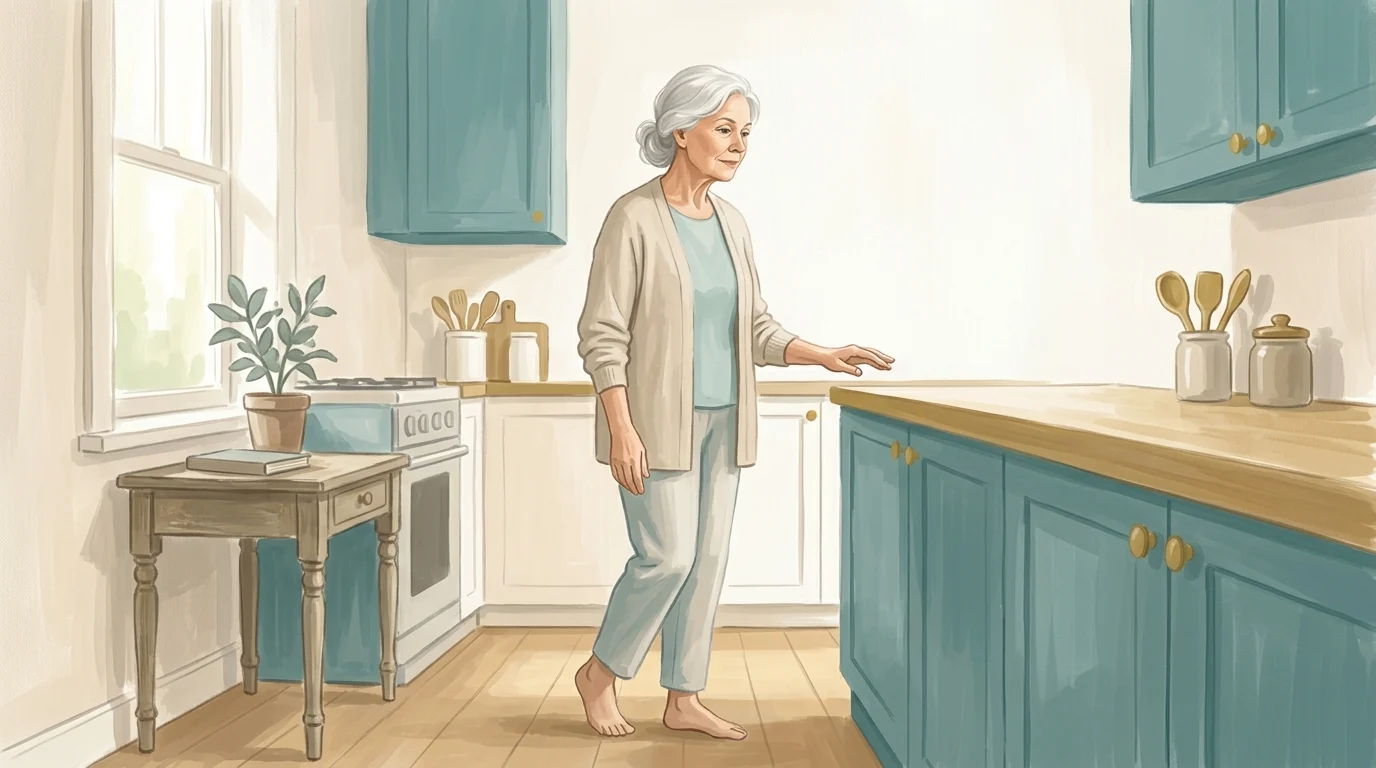
The best time to start gentle balance practice may be before you feel you need it
Ten trials of Tai Chi, Baduanjin and yoga in older adults who were frail or edging toward it. Balance improved in both groups, and most clearly in people who had not yet crossed the line.
Sep 28, 2026
The clinic that watches your bones and the one that watches your balance rarely talk
Seven international organizations published a joint position paper on 10 September saying fall prevention and fracture prevention are still built as separate services. Three questions worth taking to your next appointment.
Sep 14, 2026
Why the balance exercise that works in a class may not be the one that works at home
A new analysis pooled 423 trials and nearly 34,000 older adults to compare 19 ways of training balance. The ranking changed depending on which kind of balance was being measured.
Aug 16, 2026Ready to start moving better?
Gentle, guided lessons for your body. Try your first one free, no credit card required.