

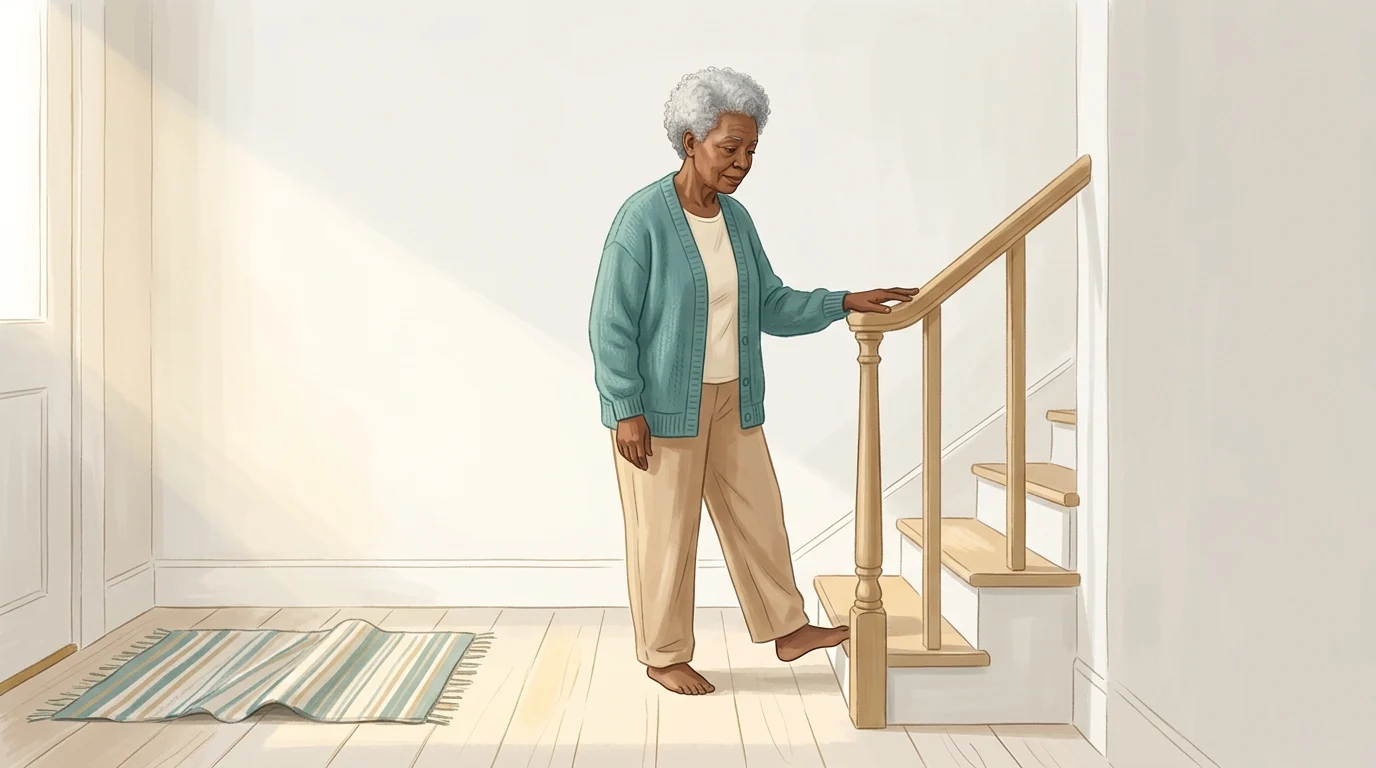
The clinic that watches your bones and the one that watches your balance rarely talk
Seven international organizations published a joint position paper on 10 September saying fall prevention and fracture prevention are still built as separate services. Three questions worth taking to your next appointment.
Two appointments, two corridors, two sets of notes. One service measures how strong your bones are. Another, if you were referred at all, asks why you went down in the first place. They rarely read each other's letters.
On 10 September, seven international organizations said so in the same document.
What they actually said
The position paper appeared in European Geriatric Medicine, signed by the European Geriatric Medicine Society, the Fragility Fracture Network, the World Falls Prevention Society, the European Society for Clinical and Economic Aspects of Osteoporosis, Osteoarthritis and Musculoskeletal Diseases, the International Osteoporosis Foundation, the geriatric medicine section of the European Union of Medical Specialists, and the European region of the International Association of Gerontology and Geriatrics (European Geriatric Medicine, 2026). Getting seven bodies of that size to agree on a single paragraph is most of the story.
Their finding is administrative rather than biological, which is probably why it took this long to write down. Clinical care for fragility fractures, they say, is currently organized separately from fall prevention services, and that separation leaves gaps in how care actually gets delivered. A fragility fracture, the kind that arrives from going down at standing height rather than from a car, takes two things happening in the same second: a bone that will break under that load, and a load that arrives because the body met the floor. Scans cover the first ingredient. Falls services, where they exist, cover the second. The person who owns both ingredients walks between the two buildings alone.
What the group asks for is unglamorous and specific. Put fracture risk assessment inside fall prevention services. Put falls assessment inside fracture prevention services. Train the two workforces to talk to each other, recognize integrated prevention as a public health priority, and write it into national healthy ageing strategies with real money behind it, including money for evidence based exercise provision.
That last phrase is doing quiet work. Exercise is not a footnote in falls prevention, it is the intervention with the strongest evidence behind it: a Cochrane review pooled 108 trials and 23,407 people living in the community and found roughly a quarter fewer falls in the exercise groups, graded as high certainty, which is rare in this literature. The detail that matters more than the headline is what those programmes contained. The ones that worked were built primarily on balance and functional movement. Resistance work on its own did not carry it (Cochrane, 2019).
Three questions worth taking to your next appointment
I'm a Feldenkrais® practitioner and not a physician, and nothing below is a reason to change a medication or skip a scan. These are the three things a fifteen minute appointment tends not to reach on its own, and a paper signed by seven organizations is a reasonable excuse to raise them.
"Has anyone assessed my falls risk, or only my bone density?" If you have had a scan and a conversation about bone medication and nothing at all about how you walk, how you get out of a low chair, or what the stairs are like at night, then one half of your fracture risk has never been looked at by anybody. The paper's whole argument is that this is normal and shouldn't be.
"Which of my medications could be making me unsteady?" Blood pressure drugs, sedatives, some antidepressants, anything that drops your pressure when you stand up quickly. A medication review is a standard part of a falls assessment. It is not a standard part of a bone clinic visit. Asking isn't second guessing anyone; it's making sure the question got said out loud once, by somebody in the room.
"What exercise, specifically, and who is going to teach me?" Being told to exercise is not a referral. The evidence points at balance and functional work, done regularly and kept up, and what most people are handed instead is a photocopied sheet of three exercises with no follow up. Ask what the local option is. Sometimes there is one and nobody mentioned it.
What this changes in my lane, and what it does not
The limit first, because everything else depends on it. Gentle movement does not build bone. Loading builds bone, a separate mechanism with its own literature, and we have written about loading and bone density before. Work based on the Feldenkrais Method® sits alongside what your physiotherapist gave you, never in place of it. Yoga, Pilates and tai chi each work through their own mechanism, and each has its own strengths.
What I see again and again in my classes lives on the other ingredient entirely. Someone arrives a few months after a stumble that frightened them more than it hurt, and the walking has already quietly reorganized itself around the memory of it: shorter steps, the weight held back over the heels, the eyes down on the floor instead of out at the room, one arm half reaching for a wall that isn't there. The body braces against a fall that has not happened. Braced is stiff, and stiff has fewer options left when the rug edge finally comes.
The part that attention can reach is the sensing. Where your weight actually is. How it travels from one foot to the other, what the head does when you turn to look behind you, how much of the floor comes up through your shoes. That is not fracture prevention and I won't dress it up as one. It is the fear that outlasts the stumble and the slow dulling of position sense that attention can get underneath, and between them those two shape a person's week more than any scan result does. You can try that inside the Feldy online movement program with a free 7 day trial, no credit card needed.
Seven organizations wrote a paper because the bone and the balance are kept in different filing cabinets. In the body they were never separate for a second.
Let Feldy guide you, eyes closed
A calm voice walks you through gentle moves so your attention stays in your body, not on the screen.
Try Feldy Free for 7 daysNo credit card needed.
Sources
- Position paper: a coordinated approach to fracture and fall prevention from seven international organizations— European Geriatric Medicine
- Exercise for preventing falls in older people living in the community— Cochrane Database of Systematic Reviews
Movement Pulse is informational, not medical advice. See our editorial policy.
Move better with Feldy
See the programMovement Pulse Weekly
The week's best research, in your inbox Tuesday.
Movement science, gentle-practice ideas, and a practitioner's read on what's new. Free.
More from Movement Pulse
Why the balance exercise that works in a class may not be the one that works at home
A new analysis pooled 423 trials and nearly 34,000 older adults to compare 19 ways of training balance. The ranking changed depending on which kind of balance was being measured.
Aug 16, 2026
Tai chi walking is the balance trend of the summer. What the research actually shows
Tai chi walking is everywhere this summer. The evidence on balance and falls is encouraging, and it comes from classical tai chi, not the viral version.
Jul 29, 2026
The strongest predictor of falls is not strength
A new 2026 study put proprioception, vibration sense, and muscle strength head to head against fall frequency in older women. The sensing variable won.
Jun 20, 2026Ready to start moving better?
Gentle, guided lessons for your body. Try your first one free, no credit card required.