
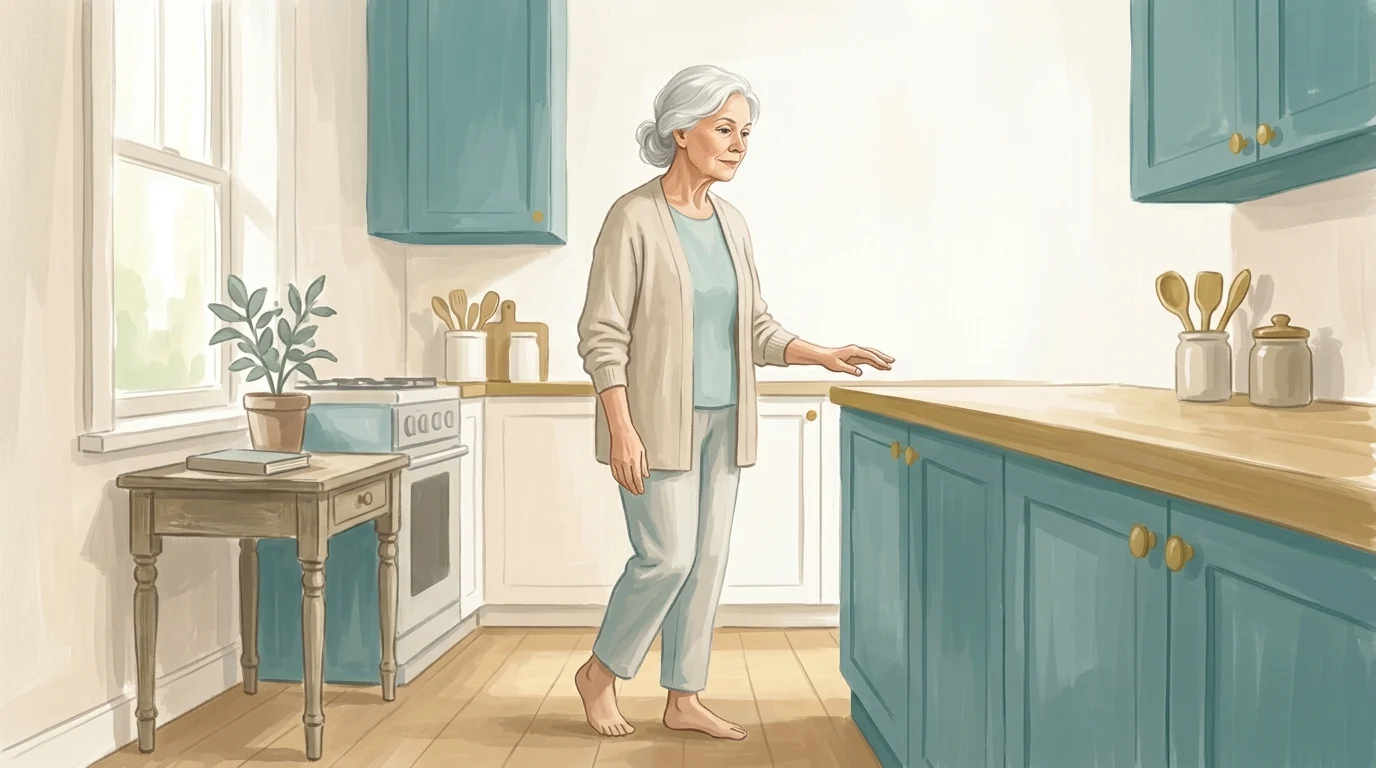
The best time to start gentle balance practice may be before you feel you need it
Ten trials of Tai Chi, Baduanjin and yoga in older adults who were frail or edging toward it. Balance improved in both groups, and most clearly in people who had not yet crossed the line.
There's a stage of getting older that has a name most people never hear said to them. It comes before frailty: walking has slowed a little, the grip on a jar lid has softened, the stairs take more thought than they used to, and yet nothing has actually gone wrong. Clinicians call it prefrailty. A review published this month in Frontiers in Aging suggests it may be the stage where slow, attentive practice does the most for balance.
What the review found
A team at the Shanghai University of Traditional Chinese Medicine searched seven databases, screened 577 records, and kept ten randomized trials of slow mind and body practice in older adults who were frail or prefrail (Frontiers in Aging, 2026). Tai Chi made up most of them. Baduanjin, a slow qigong sequence of eight movements, and yoga made up the rest. Average ages in the trials ran from 64 to nearly 89, and the largest one, in the United States, followed about 190 people for close to a year. In every trial the comparison group got usual care, health education, or nothing at all, which matters later.
Balance improved in the practice groups on every kind of test: the general balance scales, the tests of getting up from a chair and walking and turning, and standing on one leg. The general balance result was moderate in size, and the authors rated their confidence in it as moderate certainty. The walking and turning result was larger but rated low certainty, because the trials disagreed with each other so much. The one leg result looked largest of all and earned the lowest rating, very low certainty, from only four trials.
Here is the part I keep coming back to. When the team split the trials by frailty stage, the average gain in the prefrail groups was roughly three and a half times the size of the gain in the frail groups, a difference they rated moderate certainty, with the caveat that it comes from comparing different trials rather than from any single trial that tested both stages side by side. The smaller frail result had its own quiet strength, though: those trials pointed the same way almost exactly, while the prefrail trials were scattered, some showing large gains and some modest ones.
What the numbers can't tell you
Three limits are worth holding onto. Because the comparison groups did no structured movement, the review can say slow practice did better than carrying on as usual; it can't say Tai Chi beats walking or yoga beats a strength class, and the authors write plainly that there were too few yoga and Baduanjin trials to compare the methods at all. Most of the trials came from China, and nobody can be kept unaware of whether they are doing Tai Chi, so expectations may have played a part. And the dose pattern (two to four sessions a week, 31 to 60 minutes each, kept up for at least 13 weeks) came from looking across trials, which the authors themselves call exploratory rather than a prescription.
Still. Ten trials, four countries, people in their sixties through their late eighties, and the direction never flipped.
Earlier this month we covered two reviews in which yoga and qigong in older adults generally showed balance results that wobbled once missing studies were accounted for. The difference here may be the people. Someone with plenty of reserve has less room to improve on a balance test; someone whose movement has started to narrow has more.
Three questions worth taking to your next appointment
I'm a Feldenkrais® practitioner, not a physician, and nothing here replaces clinical care; slow practice sits alongside what your doctor or physiotherapist gives you. These are the questions a short appointment rarely reaches unprompted.
"Would you describe me as prefrail, and what is that based on?" Frailty is usually judged from a handful of signs: walking speed, grip strength, exhaustion, weight loss you didn't intend, and how active you are (Journal of Gerontology, 2001). Plenty of people have never had any of them checked, even after someone at home has mentioned a slower walk or a shuffling gait. If the review is right that the earlier stage responds more, knowing which side of the line you are on is the first useful fact.
"Is there a slow practice class near me that meets two or three times a week, and could I keep going for three months?" The steadiest results in the review came from programmes that ran 13 to 24 weeks. That is a question about what actually exists on your street, and your doctor or practice nurse may know of a community Tai Chi group or a falls prevention class you haven't heard about.
"Is there anything the teacher should know before I start?" Dizziness when you stand up, a medication that lowers your blood pressure, a recent fall, a new hip or knee. Slow practice is low load, which is much of why it suits people with less reserve, and a teacher can adapt it far better with that information in hand.
Doing less
What Tai Chi, Baduanjin and yoga share with the Feldenkrais Method® is not a set of shapes but slowness and attention: weight travels from one foot to the other slowly enough to be felt. Again and again, people arrive in my classes after the first time they caught themselves reaching for the kitchen counter while turning around, and what they need first is usually less effort, not more. In an Awareness Through Movement® lesson you only go where it feels easy, pleasant, and comfortable, often making a movement smaller than you could, because the smaller version is the one you can sense from the inside. A different mechanism from Tai Chi, very gentle and soft. You can explore it inside the Feldy online movement program with a free 7 day trial, no credit card needed.
Most people go looking for a balance class after the first fall, or after the first near one. This review points somewhere earlier, to the season when your hand starts drifting toward the counter as you turn, before it has ever needed to hold on.
Let Feldy guide you, eyes closed
A calm voice walks you through gentle moves so your attention stays in your body, not on the screen.
Try Feldy Free for 7 daysNo credit card needed.
Sources
- Effects of mind-body exercise on balance function in pre-frail and frail older adults: a systematic review and meta-analysis— Frontiers in Aging
- Full text (open access): Frontiers in Aging, PMC13595580— Frontiers in Aging
- Frailty in older adults: evidence for a phenotype— The Journals of Gerontology, Series A
Movement Pulse is informational, not medical advice. See our editorial policy.
Move better with Feldy
See the programMovement Pulse Weekly
The week's best research, in your inbox Tuesday.
Movement science, gentle-practice ideas, and a practitioner's read on what's new. Free.
More from Movement Pulse
Tai chi walking is the balance trend of the summer. What the research actually shows
Tai chi walking is everywhere this summer. The evidence on balance and falls is encouraging, and it comes from classical tai chi, not the viral version.
Jul 29, 2026
The clinic that watches your bones and the one that watches your balance rarely talk
Seven international organizations published a joint position paper on 10 September saying fall prevention and fracture prevention are still built as separate services. Three questions worth taking to your next appointment.
Sep 14, 2026
Why the balance exercise that works in a class may not be the one that works at home
A new analysis pooled 423 trials and nearly 34,000 older adults to compare 19 ways of training balance. The ranking changed depending on which kind of balance was being measured.
Aug 16, 2026Ready to start moving better?
Gentle, guided lessons for your body. Try your first one free, no credit card required.