

Fifteen thousand people did the same digital knee program and went four different ways
A Lund University registry study tracked quality of life through a digital education and exercise program for knee and hip osteoarthritis. About half improved. A fifth got worse. The paper cannot say why, and says so.
Half is a strange number to sit with.
On 19 September a team at Lund University published what happened to people who enrolled in a digital education and exercise therapy program for knee and hip osteoarthritis. Fifteen thousand one hundred and forty seven of them answered a quality of life questionnaire at three months. By twelve months only four thousand five hundred and eighty six were still answering, fewer than a third of the group that started (Health and Quality of Life Outcomes, 2026). It is one of the largest looks anyone has taken at what happens when a structured movement program arrives through a phone instead of through a clinic door.
The program is the kind you've probably seen advertised. You enrol, you are assigned a physiotherapist, you get daily exercises and short education modules, and you report back. Everyone in the study was 40 or older. The questionnaire asks about five plain things: getting around, looking after yourself, doing your usual activities, pain and discomfort, and anxiety or low mood. The researchers then sorted each person by whether their answers as a whole got better, got worse, went in both directions at once, or stayed where they were.
At three months, 46.9% had improved overall. At twelve months, 50.4% had. Pain and discomfort was the area that moved most, with a third of people reporting improvement by three months and closer to four in ten by a year. Looking after yourself moved least, which tracks, since it was also where the fewest people had trouble to begin with.
Then the part that tends to fall out of the summary.
About one in five got worse. 19.5% at three months, 20.1% at a year. Another one in five went both ways at once, better in one part of life and worse in another. The remainder were unchanged.
What the study can and cannot tell you
There is no comparison group. Everyone in the registry did the program, which means we can't say the program produced the improvements, and by precisely the same logic we can't say it produced the worsening either. Osteoarthritis fluctuates on its own. People get a year older during a twelve month study, and some of them get a year older in the hard way. Three of the five authors disclose paid roles with the company that runs the platform, which the paper states plainly in its declarations and which belongs alongside the numbers rather than instead of them. And the twelve month figures rest on a much smaller group: roughly seven in ten people had stopped answering by then, so what reads as a year of results is really a year of results among the ones who kept going.
The conclusion the authors reach themselves is the one I keep turning over. They describe the trajectories as heterogeneous and call for tailored participant support. Said less carefully: one program handed to fifteen thousand different people produced four different stories, and the study could not say, in advance, which story a given person would land in.
Four stories, one set of exercises
This is what I run into again and again in my classes. People come in doing the movements they were given, faithfully, yet unable to say whether any one of them still suits the knee they have this week. The doing they have. What they were never handed is a way to ask, in the ten seconds before they start, whether this particular movement is helping today or quietly stopped helping a while ago. So a movement that has turned unhelpful keeps getting done, not out of stubbornness but because no one, including the person doing it, has a moment set aside to check (knee stiffness after 60 settles into routines like that).
What follows is small. It is not a treatment, it will not change a cartilage surface, and it is not a substitute for the program your clinician built for you. It is a way of noticing what changes in you, before and after something, so that you are the one holding the information instead of waiting three months for it to arrive in a questionnaire.
Something to notice, before and after
About 6 minutes. Move slowly, do less than you can, and stay well below any pain. Rest whenever you need to.
- 1
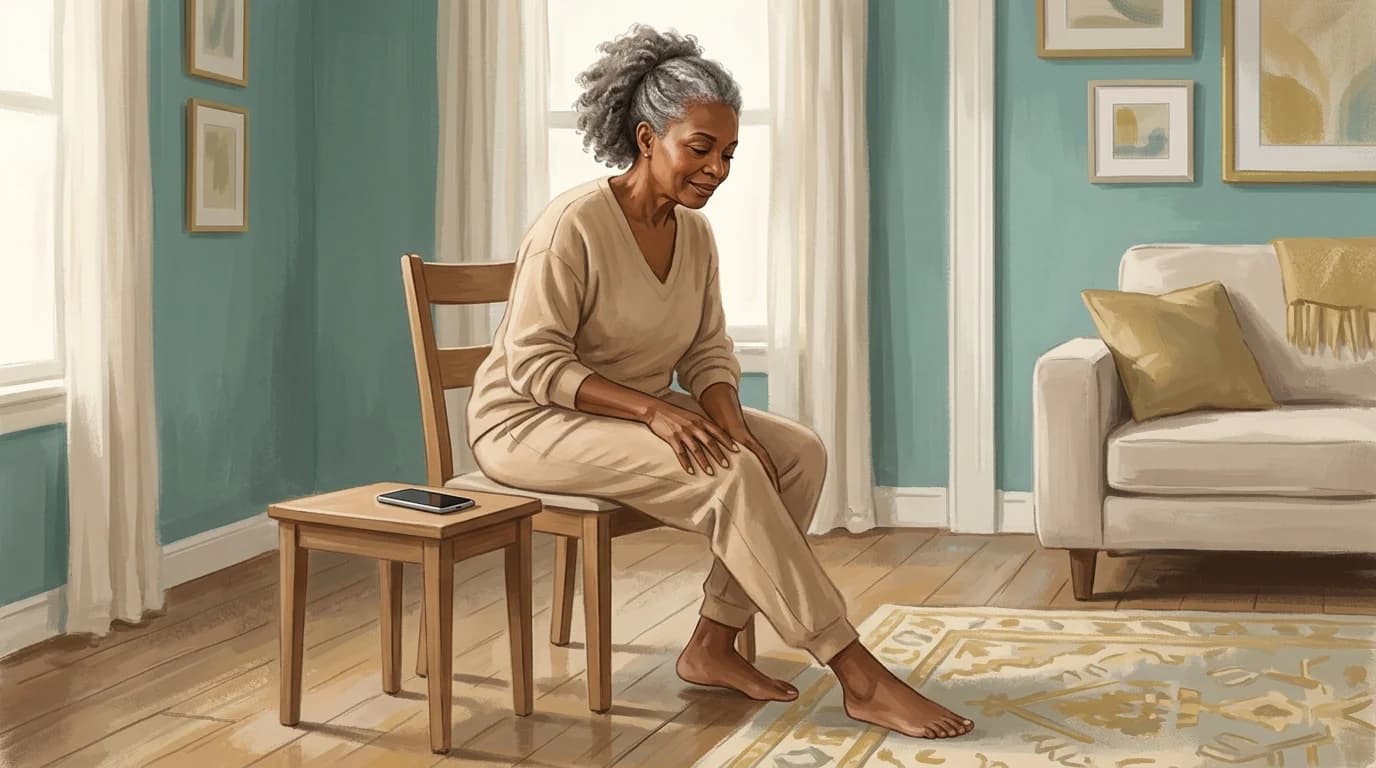
Sit toward the front of a firm chair, both feet flat and comfortable. Before you move anything, stand up once at your ordinary speed and sit back down, and notice where the effort lived. Not how much it hurt. Just where. Keep that in mind.
- 2
Sit again and let one foot slide slowly forward along the floor and back, ten or twelve times, slowly enough that it is almost boring. You are not stretching and not trying to get anywhere. Go only where it feels easy, pleasant and comfortable, and if that is very little, let it be very little.
- 3
Stop and rest, both feet flat. Notice whether the two legs feel like they press the same weight down into the floor. After one side has moved slowly and the other has not, they usually do not match, and simply feeling that difference is the point.
- 4
Now let the other foot slide the same slow way, fewer times, six or so. Rest again with both feet flat and let the difference settle.
- 5
Stand up once more and ask again: where did the effort live this time? If it has moved, you have noticed something about your own knees that no questionnaire could. If it has not, that is worth noticing too, on another morning.
Let Feldy guide you, eyes closed
A calm voice walks you through gentle moves so your attention stays in your body, not on the screen.
Try Feldy Free for 7 daysNo credit card needed.
That comparing is most of what an Awareness Through Movement® lesson actually does. The Feldenkrais Method® builds each lesson around a before and an after, on the working assumption that a person who can feel a change is a person who can steer, and the lessons in the Feldy online movement program are sequenced that way for the same reason. A digital program, ours included, sits alongside what your physiotherapist has given you rather than standing in for it. Yoga, Pilates and Tai Chi work through a different mechanism, gentle and slow in their own ways, and each has its own strengths. If you want somewhere plainer to begin than any of that, we keep a list of low impact exercises for arthritis that asks very little of a sore knee.
A study can only ever hand you a number. 46.9% improved, 20.1% got worse, and no figure can tell you which one is yours. But you were never a figure. You are a story, and unlike the people in the registry you do not have to wait three months to find out how it is going. You can ask this week, about this knee, in the ten seconds before you move. The exercises may come from your clinician and the program may reach you through a phone, but the noticing is yours, and the noticing is where the steering begins.
Sources
- Changes in health-related quality of life: a longitudinal registry study among over 15,000 participants of a digital education and exercise therapy for knee and hip osteoarthritis using EQ-5D-5L— Health and Quality of Life Outcomes, 2026
- Publisher record, Health and Quality of Life Outcomes (2026), doi 10.1186/s12955-026-02634-5— BioMed Central
Movement Pulse is informational, not medical advice. See our editorial policy.
Move better with Feldy
See the programMovement Pulse Weekly
The week's best research, in your inbox Tuesday.
Movement science, gentle-practice ideas, and a practitioner's read on what's new. Free.
More from Movement Pulse
What held up in two new reviews of yoga and qigong was not balance or strength
Twenty one yoga trials and twenty two qigong trials, published ten days apart. The physical scores wobbled once the missing studies were accounted for. Quality of life did not.
Sep 7, 2026
The kind of exercise that helped attention most was the slowest one in the set
One hundred and ten trials, 8,130 people over sixty. No exercise type won across the board. The winner changed with the mental skill being measured.
Sep 10, 2026
Why walking feels heavier at 70 than at 40 is not weaker calves, it is quiet gripping
A recent gait study across 107 adults ages 26 to 86 reveals a change in ankle coordination most people never notice, and points to attention as the intervention.
Aug 19, 2026Ready to start moving better?
Gentle, guided lessons for your body. Try your first one free, no credit card required.