
What 70 older adults with memory concerns gained from a video program
Thinking scores rose, and about half the gain held six months later. Strength tests didn't pull ahead, and daily protein was included.
If your memory isn't as good as it used to be and getting out to a class is hard, you might guess that exercising along with a trainer on a phone is too thin to help. One new trial suggests a package built around it can. Live video classes, taken with a daily protein supplement and dietary advice, lifted thinking scores by about two points on a 30 point test in six months, while a comparison group stayed where it started.
The trial ran in South Korea, with people in their mid seventies on average (Age and Ageing, 2026). Strength and walking tests were no better than in the group without classes. So a package like this can show up in thinking scores even when strength tests don't pull ahead, at least in people who start with low scores but are fairly capable day to day.
Two points, half still there
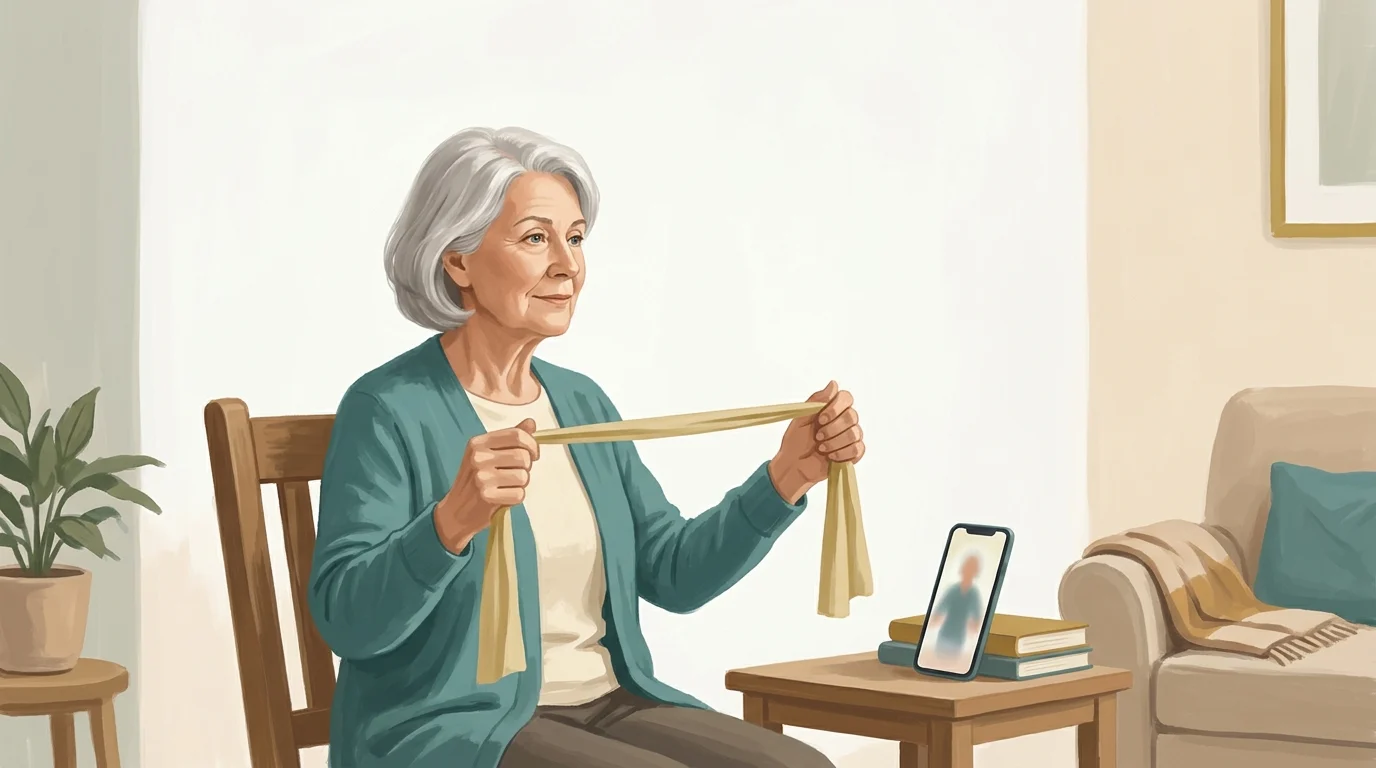
Twice a week for an hour, the class group opened Zoom on their own smartphones and joined a trainer who could see them, for aerobic exercise, elastic bands and balance. Nobody among the 140 had a dementia diagnosis and everyone was managing daily life without help, but all had scored in the lower range on a short thinking test at their local public health centre. The other half carried on with the usual health centre services.
At six months the gap between the groups was just over two points. The authors consider that big enough to matter, and daily life points the same way: on a questionnaire about everyday activities, people in the classes held steady while the others slipped a little. A test score can't tell you everything, least of all where you left your glasses.
The program stopped at six months. Six months after that, the gap in thinking scores had shrunk by about half, and daily tasks still favoured the people who had taken part. So the gain on the thinking test may shrink after a program like this ends, though nobody here tested carrying on. If you try something similar, think about how you'd keep it going, not only how to begin.
Thinking pulled ahead, strength tests did not
Grip strength, mood, and a short test of balance, walking and rising from a chair came out no better in the program than in the comparison group. At six months, walking speed had actually risen more in the people who took no classes.
The authors point out that these people started out fairly capable, and that such tests may miss small changes. This was exercise plus protein and diet advice, so it can't say what movement alone does. Still, if you've ever lost interest in a practice because your legs felt no different after a few months, it's a reason to look past your legs. Thinking and physical tests didn't respond in step here, so how your movement changes with age may be only part of the picture.
Eleven years of trials, some now at home
If getting out is what stops you, it helps to see where some of this research has gone. In 2015, the FINGER trial in Finland suggested a package of diet, exercise, brain training and health monitoring could help older people at risk keep their thinking. In 2023, every class in a tai chi trial was taken at home, live on video. In 2025, Korea's SUPERBRAIN-MEET trial mixed face to face visits with tablet video sessions.
Now this one: every class by video, with protein and diet advice added, in people such studies often miss. Most lived in relative poverty, with little schooling on average.
Same hours, different task
Trials count hours. This one didn't ask what people's minds were doing during them. I would, because a strength test can't see that. In that tai chi trial, every group exercised for the same time, yet the version that folded thinking tasks into the movements beat plain tai chi and stretching on a thinking test.
That makes me think of a Feldenkrais® lesson, although nobody here tested Feldenkrais, the mental tasks in that trial were different, and I'm reading across studies. In Awareness Through Movement® you aren't counting repetitions; you're noticing how a small movement travels through you. What I see again and again in my classes is people arriving who measure a lesson by effort, then leaving to talk about what they noticed.
What this trial can't tell you
Before you take this to heart, here's what it can't say. Exercise, protein and dietary advice came as one package, so nobody can say how much each one did, and how much of the supplement people took rests on their own reports. Regular contact with other people on the calls wasn't measured and may have helped too. People can also score higher simply from taking a test again, though the group without classes didn't. Maeil Dairies donated the supplement and, the authors say, had no role in the study; one author has consulted part time for the company since May 2025, on work they call unrelated, and co-founded a digital healthcare company in June 2026.
Everyone here started with low scores, so if yours would be normal, this trial doesn't say what you'd gain. The classes were live with a trainer watching, so the result doesn't automatically carry over to recordings or an app. Anyone who couldn't use a smartphone was left out, about three in ten of those screened. There were no brain scans or full memory assessments, so people may have had different kinds of memory difficulty, and a low screening score can reflect fewer years of schooling. Participants knew they were in the classes, though the people giving the tests didn't know who was. And it ran during the pandemic years in two Korean communities, which may not look like yours, and differences between the two places or the years may have coloured the results.
If you've noticed changes in your memory, mention them to your doctor, because some causes can be treated. Ask before adding a supplement or a new exercise, and keep a sturdy chair close for any balance work at home.
Then, after your next class or lesson of any kind, don't only ask how your legs feel. Ask yourself one thing: where was my attention while I moved?
Let Feldy guide you, eyes closed
A calm voice walks you through gentle moves so your attention stays in your body, not on the screen.
Try Feldy Free for 7 daysNo credit card needed.
Sources
- Remote multicomponent intervention for older adults with cognitive impairment in community settings: multisite randomised controlled trial— Age and Ageing, 2026
- Remote multicomponent intervention for older adults with cognitive impairment in community settings (PubMed record)— PubMed, 2026
- A 2 year multidomain intervention of diet, exercise, cognitive training, and vascular risk monitoring versus control to prevent cognitive decline in at-risk elderly people (FINGER)— The Lancet, 2015
- Clinical Effectiveness of Cognitively Enhanced Tai Ji Quan Training on Global Cognition and Dual-Task Performance During Walking in Older Adults With Mild Cognitive Impairment or Self-Reported Memory Concerns— Annals of Internal Medicine, 2023
- South Korean study to prevent cognitive impairment and protect brain health through multidomain interventions via face-to-face and video communication platforms in mild cognitive impairment (SUPERBRAIN-MEET)— Alzheimer's & Dementia, 2025
Movement Pulse is informational, not medical advice. See our editorial policy.
Move better with Feldy
See the programMovement Pulse Weekly
The week's best research, in your inbox Tuesday.
Movement science, gentle-practice ideas, and a practitioner's read on what's new. Free.
More from Movement Pulse
After 60, practising balance gave thinking a small lift, most clearly in mental speed
A review of 54 studies found that training to stay steady also nudged how quickly older adults think. A reason to give your balance practice your full attention.
Oct 16, 2026
For memory changes after sixty, twelve years of reviews keep pointing to slow practice
Mild memory trouble is a stage where a new practice can still be learned, and the research has moved on from asking whether slow practice is worth it to asking how many weeks it takes.
Oct 9, 2026
Brisk walking eased frailty more than strolling, and the stroll still helped nearly half
A Chicago trial in 14 retirement communities found a brisker pace moved more older adults out of frailty. Read the fine print and the casual walkers did better than the headline suggests.
Oct 5, 2026Ready to start moving better?
Gentle, guided lessons for your body. Try your first one free, no credit card required.