
Chronic conditions did not hold older adults back in a year of regular training
Researchers in Finland expected people living with more diagnoses to gain less. They gained at least as much, though nobody in the study went without the training for comparison.
Ask most people who gets the least from exercise late in life and they will point to the person with the longest list of diagnoses. The researchers behind a new Finnish study expected the same. Then they looked at 288 people aged 70 to 85 after a year of training, and those living with two or more chronic conditions were more likely than the others to improve on several measures at once (European Journal of Applied Physiology, 2026).
So if you've been wondering whether there's too much going on in your body for training to do anything, this group offers a calm answer. Having more than one condition didn't seem to get in the way.
Seven in ten had more than one
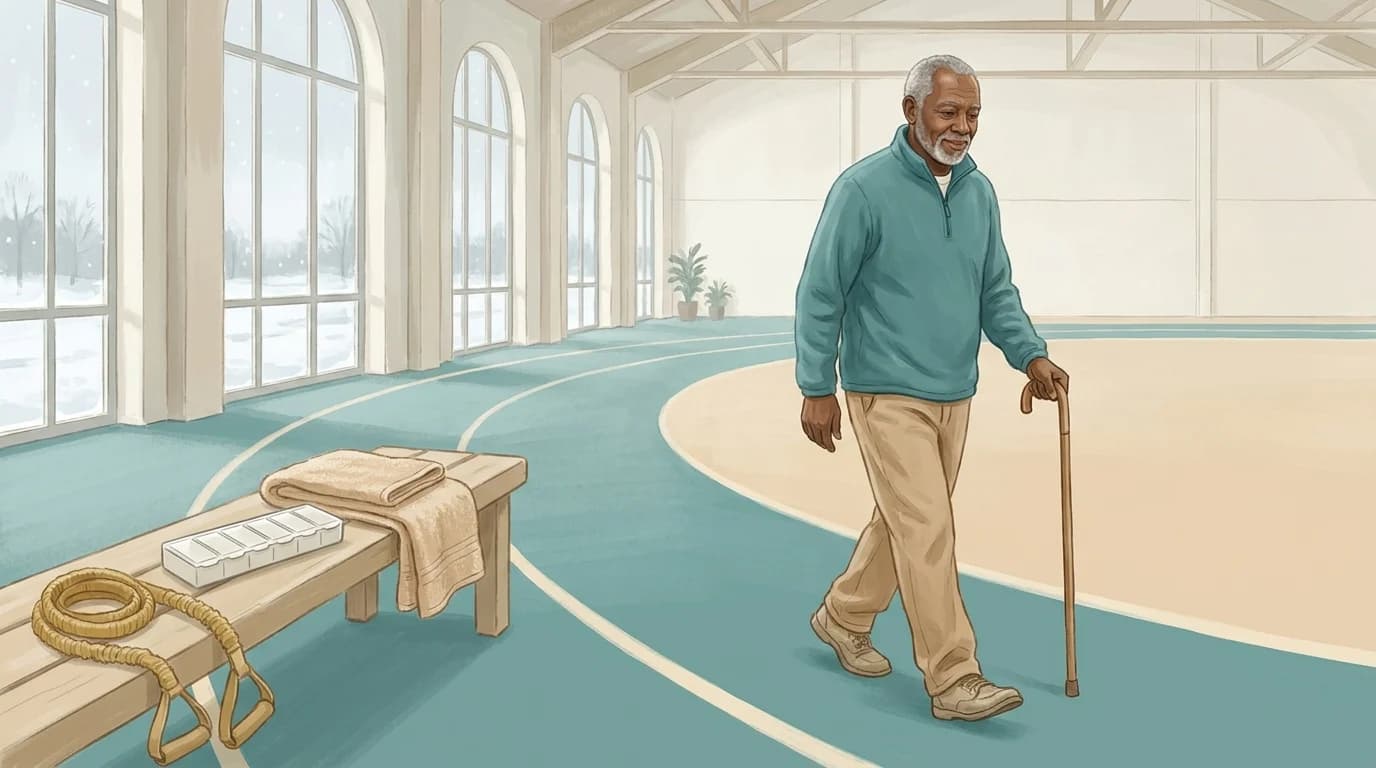
That sentence matters more once you see who was in the room. The volunteers lived at home in Jyväskylä, had no regular strength training behind them, weren't meeting the usual activity guidelines, and could walk 500 metres, with a cane if they needed one. About seven in ten of those who enrolled had at least two chronic diseases diagnosed by a physician: heart disease, osteoarthritis, diabetes, lung disease, osteoporosis, lasting musculoskeletal pain. People with more than one condition weren't a small subgroup here. They were the majority.
The year was real work. One supervised gym session a week on the machines; one supervised walking and balance session on a track, indoors through the winter; band exercises at home two or three times a week; and advice to gather 150 minutes of moderate activity on top. Some also did computer training for thinking, which made no difference to the physical results, so the team pooled everyone.
Most gained something, unevenly
On average, knee strength and grip rose and people covered about 37 metres more in a six minute walk. Muscle mass in the arms and legs, measured by scan, did not change on average.
The averages hide a wide spread. Just under half of the group made what the team counted as a worthwhile gain in knee strength or walking distance, while 30% did so in walking speed, 27% in grip and 17% in muscle mass. About half, 143 people, made that gain on two or more of the five measures. Another 62 made it on none.
The team then asked what set apart the people who improved across several measures. Those with two or more conditions had more than twice the odds of being among them, the reverse of what the researchers predicted. They checked the obvious explanation, that people with more diagnoses simply started weaker and had further to climb, and found no difference in starting strength or walking. Being younger within the age range and having a lower body weight for their height also went with a broader response, and so did turning up more often to the gym sessions.
Of those, attendance is the one a person can change. Across twelve months the group came to about two thirds of supervised sessions.
What the headline will miss
This was an exploratory look at data from a trial built to answer a different question, and everyone trained. With no group sitting the year out, the team can't fully separate the effect of training from ordinary ups and downs, and they name that as a limitation.
The conditions also need reading carefully. People whose illness was severe enough to affect safe participation were left out, so most had common, well controlled diseases. People who say yes to a year of training are not everyone, either.
And the authors don't claim that illness helps. They call the unexpected link modest and possibly explained by other factors; an earlier analysis of the same data found disease patterns accounted for at most 3% of the variation in change in walking distance and knee strength. Their own wording is careful: multimorbidity "did not appear to limit beneficial responses." That is the finding worth keeping.
The Feldenkrais angle
The quieter result interests me more. Strength and walking moved, while measured muscle, on average, did not. The paper doesn't explain that, and I hold my reading loosely, but it raises a question a Feldenkrais® practitioner keeps asking: how much of moving better comes from having more muscle, and how much from learning to use what's already there?
A list of diagnoses describes what your body has been through. It says much less about what you can still learn. In an Awareness Through Movement® lesson nobody starts from the list. You start from what moves easily today, and you only go where it feels easy, pleasant, and comfortable. That's a very different kind of work from the gym sessions in this study, and this study didn't test it.
The sentence worth checking
If you already work with a doctor or physiotherapist, what they've told you about your own body stands, and anything gentle you add sits alongside that care. This study can't tell any one person what is right for them, and movement does tend to change with age in ways nobody should wave away. If a walk is where you'd like to begin again, this lesson on walking exercise for seniors is about how you walk, not how far.
What it does put in question is a single sentence, the one that goes something like "with everything I've got going on, what's the point." Next time you hear yourself say it about a walk, a class, or the stairs, notice where it came from. Did someone who knows your body tell you that, or did you decide it on your own a few years ago, on a bad week, and stop checking?
On that indoor track in Jyväskylä, seven in ten of the people walking beside you would have had a list of their own.
Let Feldy guide you, eyes closed
A calm voice walks you through gentle moves so your attention stays in your body, not on the screen.
Try Feldy Free for 7 daysNo credit card needed.
Sources
- Individual variability and predictors of responsiveness in physical outcomes following multicomponent physical training in older adults— European Journal of Applied Physiology, 2026
- Individual variability and predictors of responsiveness in physical outcomes following multicomponent physical training in older adults (PubMed record)— PubMed, 2026
Movement Pulse is informational, not medical advice. See our editorial policy.
Move better with Feldy
See the programMovement Pulse Weekly
The week's best research, in your inbox Tuesday.
Movement science, gentle-practice ideas, and a practitioner's read on what's new. Free.
More from Movement Pulse
After 65, brain fog eased as much with slow, varied walking as with mental puzzles added
Walking sideways, backwards and in slow figure eights already asks plenty of attention, so a quieter walk may be enough to start with.
Oct 23, 2026
Brisk walking eased frailty more than strolling, and the stroll still helped nearly half
A Chicago trial in 14 retirement communities found a brisker pace moved more older adults out of frailty. Read the fine print and the casual walkers did better than the headline suggests.
Oct 5, 2026
What walking speed keeps telling us about aging
Fast walking in the 80s is tied to much lower cognitive risk. It is the latest in years of research showing gait speed reflects the whole body.
Jul 18, 2026Ready to start moving better?
Gentle, guided lessons for your body. Try your first one free, no credit card required.