
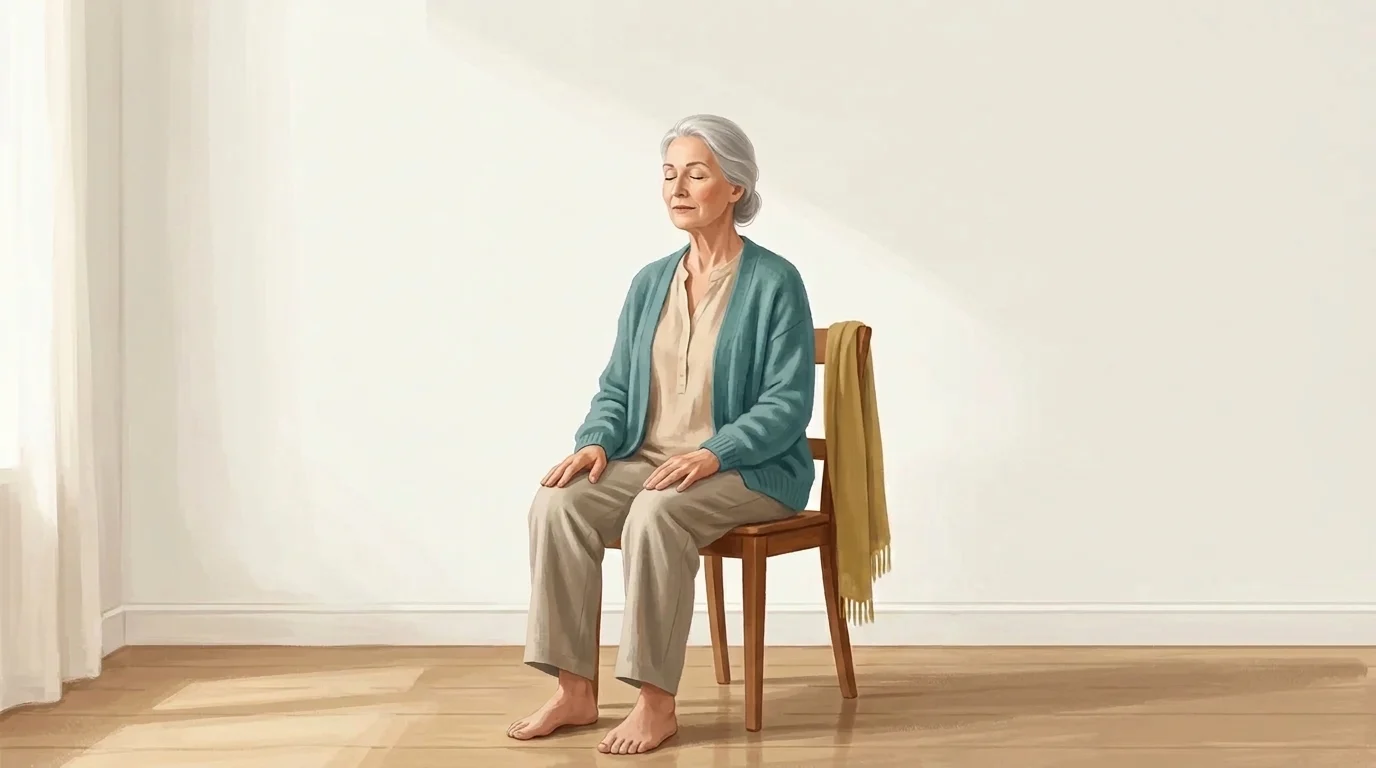
What happens to your balance when you rehearse the movement in your mind first
A new review gathered nineteen studies of older adults practicing movement only in imagination. The results were mixed, but the mechanism is one Feldenkrais has used for decades.
Here is an idea that sounds almost too easy to take seriously. You can practice a movement, and get a little better at it, without moving. A new review gathered the research on exactly that, and the people it looked at were not athletes or dancers but ordinary older adults working on their balance.
The paper, a scoping review in Experimental Gerontology, pulled together nineteen studies covering 587 adults aged sixty and older, all of them testing what researchers call action simulation. That is the family of practices where you rehearse a movement in your mind, or watch someone else perform it closely, rather than carrying it out yourself. Motor imagery, the imagined kind, was the most common approach, turning up in more than half the studies (Experimental Gerontology, 2026).
The honest summary is that the findings were mixed. The studies measured a scatter of different things, from static and dynamic balance to walking and general mobility, and the results did not line up into one clean number. Only a single study followed people long enough to say anything about lasting effects, and the authors were candid that we still know little about how readily older adults take to this kind of practice. So this is not a headline announcing that imagining movement steadies you. It is a review saying the mechanism deserves attention, and the research is still early.
Why give it attention at all. Because balance is not a minor issue as we age. The World Health Organization notes that among older people who fall, 20 to 30 percent suffer moderate to severe injuries such as bruises, hip fractures, or head trauma (WHO, 2021). And the thing that tends to fray first is not only muscle. It is the planning side of movement, the nervous system's quiet rehearsal of what it is about to do. That is precisely what action simulation seems to target. When you vividly imagine standing up from a chair, or turning to look behind you, much of the same movement map lights up in the brain as when you do it for real, without the load and without the risk.
This is familiar ground for me, because imagined movement is not a new discovery in the Feldenkrais Method®. Moshe Feldenkrais built it into the method a long time ago. In an Awareness Through Movement® lesson you will often be asked to pause, do nothing, and simply picture a movement in fine detail before returning to it, and people are frequently surprised to find the real movement has grown easier and larger in the meantime. What the new review describes in the language of motor planning, the method has quietly used as a teaching tool for decades. You can read more about how the coordinating side of movement shifts over the years in our Feldypedia entry on coordination decline with age.
Here is a short version you can try in a chair, borrowing the review's own idea. It asks you to move one thing for real, rehearse it only in imagination, and then notice what changed. Go only where it feels easy, pleasant, and comfortable.
A short imagined movement experiment
About 5 minutes. Move slowly, do less than you can, and stay well below any pain. Rest whenever you need to.
- 1
A first turn. Sit on a chair, feet flat. Turn your head slowly to the right, as if looking over your shoulder, only as far as is easy.
- 2
The wall mark. Notice a spot on the wall that marks how far you came. Come back to the middle and rest.
- 3
Imagining the turn. Close your eyes. Picture that same turn to the right, slowly and in detail, a few times. Your head stays still.
- 4
The turn again. Open your eyes and turn your head to the right once more. Where is the spot now? Stop in the middle and rest.
- 5
The other side. Now turn slowly to the left, the side you did not imagine. How does it compare with the right?
- 6
Resting and asking. Stop your head in the middle and rest for a few breaths. What has changed between the two sides, if anything?
Let Feldy guide you, eyes closed
A calm voice walks you through gentle moves so your attention stays in your body, not on the screen.
Try Feldy Free for 7 daysNo credit card needed.
Notice that the rehearsal cost you nothing and risked nothing, and yet the side you imagined often moves a little more freely than the side you left alone. That small, repeatable difference is the whole point the review is circling. This kind of gentle rehearsal sits alongside anything a physiotherapist has given you for steadiness rather than standing in for it, and if your balance feels genuinely unreliable, that is worth raising with a doctor or physiotherapist first. Tai Chi, which so many older adults find steadying, works on some of the same planning and sensing through a different mechanism, slow and gentle in its own way, and each approach has its own strengths.
What I find hopeful in a study like this is where it points. Strength you can lose. But the capacity to plan a movement, to imagine it and refine it, stays open to you at any age, and it asks only a little attention. So much of unsteadiness after sixty is not really lost movement. It is lost trust that the body will do what you ask, and lost contact with the quiet rehearsal that used to happen on its own. You can read more about that broader shift in our entry on movement decline with age. A minute of imagining a movement before you make it is a small way to begin rebuilding both, and it asks almost nothing of the body.
Sources
- Action simulation as an intervention to improve balance, mobility and gait in healthy older adults: A scoping review— Experimental Gerontology (PubMed)
- Falls fact sheet— World Health Organization
Movement Pulse is informational, not medical advice. See our editorial policy.
Move better with Feldy
See the programMovement Pulse Weekly
The week's best research, in your inbox Tuesday.
Movement science, gentle-practice ideas, and a practitioner's read on what's new. Free.
More from Movement Pulse
After 60, practising balance gave thinking a small lift, most clearly in mental speed
A review of 54 studies found that training to stay steady also nudged how quickly older adults think. A reason to give your balance practice your full attention.
Oct 16, 2026
Brisk walking eased frailty more than strolling, and the stroll still helped nearly half
A Chicago trial in 14 retirement communities found a brisker pace moved more older adults out of frailty. Read the fine print and the casual walkers did better than the headline suggests.
Oct 5, 2026
What held up in two new reviews of yoga and qigong was not balance or strength
Twenty one yoga trials and twenty two qigong trials, published ten days apart. The physical scores wobbled once the missing studies were accounted for. Quality of life did not.
Sep 7, 2026Ready to start moving better?
Gentle, guided lessons for your body. Try your first one free, no credit card required.