
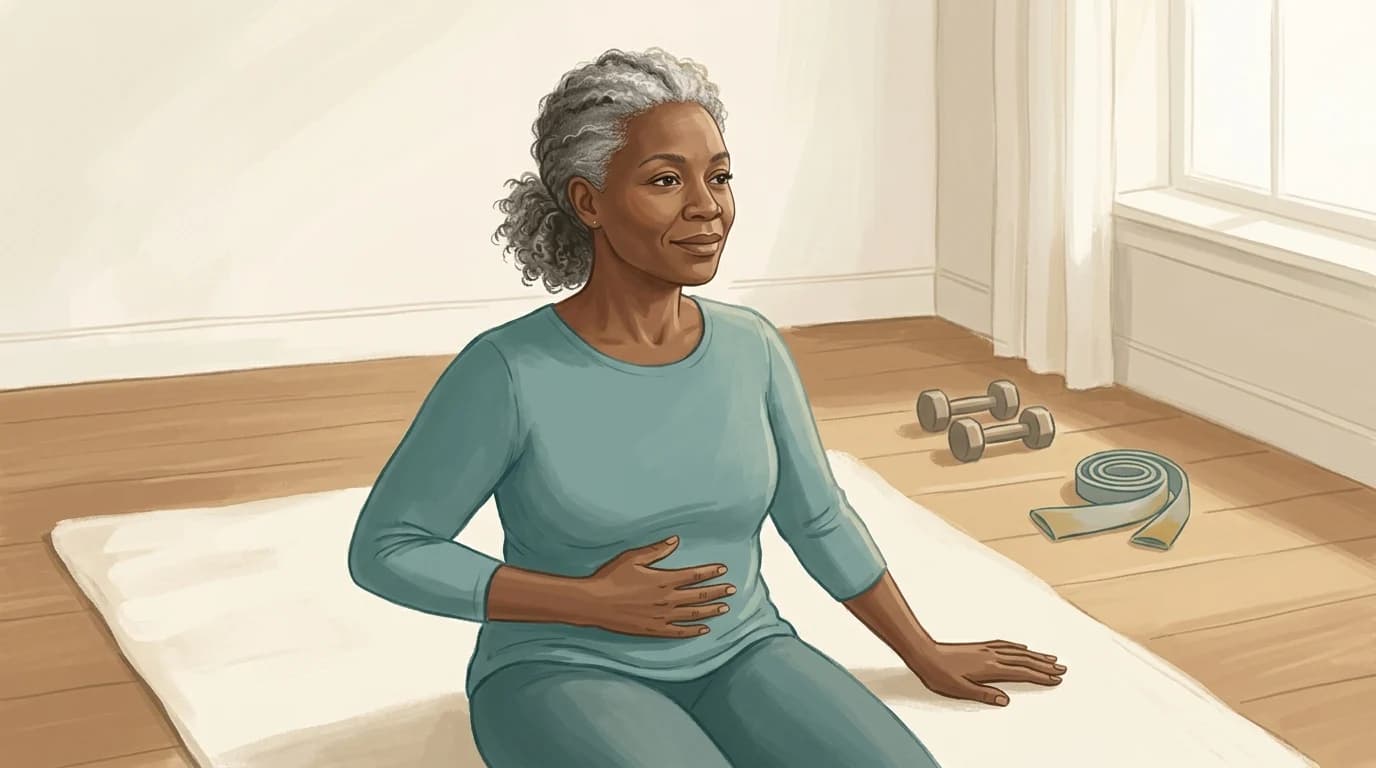
Why the movement practice you keep through menopause is usually the one you enjoy
Eighteen women aged 40 to 60 describe building their own menopause toolkits, and what decided which parts they kept was not the evidence.
Ask a woman somewhere in the middle of perimenopause what she has tried, and you rarely get one answer. You get a list, usually delivered a little apologetically, as though having a list at all were proof she hasn't found the real solution yet.
A study published online on August 30 in the Journal of Health Psychology went looking at those lists. Smyth and Cartwright interviewed 18 women in the UK, aged 40 to 60, about the body based practices they had taken up during menopause, among them strength training, yoga, and cold water immersion (Smyth and Cartwright, Journal of Health Psychology, 2026). It is qualitative work, analyzed with reflexive thematic analysis, which means it cannot tell you whether any of it works. It tells you what the women said about why they started and why they stayed.
Two things in it stopped me.
The first is that the psychological symptoms were typically the more disruptive ones. Not the aching hips, not the stiff mornings, though those were there too. The mood, the concentration, the sense of not quite recognizing yourself. Anyone following the research on menopause and the musculoskeletal system knows how thoroughly the physical side has been catalogued these past few years. The women in this study were clear that it was not the part costing them most.
The second is what they did about the gap. The authors describe UK healthcare and public conversation as framing menopause narrowly, around hormones and medical treatment, and they report that limited professional support pushed these women to assemble personal "toolkits" of their own, frequently blending hormone therapy with body based practice. Not choosing between them. Blending. And what the paper names as deciding whether a practice stayed in the toolkit was not its evidence base or its efficiency. It was enjoyment, and a growing sense that they could actually do the thing.
What this looks like from the floor
That last finding is the one I would put on a wall.
I teach the Feldenkrais Method®, and the women who reach me in perimenopause almost never arrive first. I am the fourth or fifth thing on the list, after the GP, after the supplement, after the class that turned out to be too fast. One woman who started with me in February brought a spreadsheet. An actual spreadsheet, color coded, tracking eleven things she had tried since 2024 and how long each one had lasted. The longest was seven weeks.
What she wanted from me was a ruling on which one was best. What the spreadsheet was quietly showing her, column by column, was that every practice she had dropped had been one she was enduring rather than one she looked forward to, and that the question of which was optimal had never once been the thing that decided how long she lasted.
In a Feldenkrais lesson the instruction that does the most work is also the least impressive sounding: you only go where it feels easy, pleasant, and comfortable. It's there because that is the range where the nervous system can pick up a difference at all. But it has a second effect nobody designed it for. A lesson you enjoyed is a lesson you'll consider doing again on Thursday. Awareness Through Movement® lessons are slow and small and often done lying down, and people regularly finish one feeling faintly like they got away with something. That feeling isn't decoration. Across a year it is most of the mechanism, because a practice you keep is the only kind that gets to accumulate.
None of which makes body based work a substitute for anything. Hormone therapy, and the conversation with your doctor about it, sits alongside what you do on the floor rather than competing with it, and the women in this study were largely doing both. Strength training and yoga and cold water are different mechanisms again, each with its own strengths, and none of them is trying to do the same job as the others.
The part I recognize most is what the authors call identity development. A study earlier this year found a third of women could not say for certain which stage they were in, and that the strongest driver was not missing information but not knowing what a given symptom meant. The women in this new paper describe practices that handed them back some authorship over that. Self awareness, the paper says, sitting alongside symptom relief. In a room, that looks like someone moving from "my body is doing something to me" to "I can tell what my back wants at four in the afternoon."
What to do with a finding like this
Carefully, first. Eighteen women is 18 women. They volunteered, which selects for people already persuaded by what they were doing, and the authors say plainly that their sample was relatively privileged and health literate. Nothing here measures an effect. It cannot tell you that yoga does more than walking, or that any of it touches a hot flash.
What it might reasonably change is the question you put to a practice. Most people holding a list like that spreadsheet ask which item is best. The more useful question, and the one this data actually speaks to, is which one you will still be doing in March. If an app is on your list, our comparison of the best exercise app for women is worth reading with that March question in mind.
The spreadsheet woman stopped updating hers in June. When I asked why, she said she'd noticed she was spending more time grading the practices than doing them. She still can't tell me which one is working. She's on week twenty nine.
Let Feldy guide you, eyes closed
A calm voice walks you through gentle moves so your attention stays in your body, not on the screen.
Try Feldy Free for 7 daysNo credit card needed.
Sources
- Metamorphosis: A qualitative study exploring menopause through body-based practices— Journal of Health Psychology
Movement Pulse is informational, not medical advice. See our editorial policy.
Move better with Feldy
See the programMovement Pulse Weekly
The week's best research, in your inbox Tuesday.
Movement science, gentle-practice ideas, and a practitioner's read on what's new. Free.
More from Movement Pulse
Menopause aches now have a name. What to ask your doctor
A growing wave of research is naming the joint aches and stiffness of perimenopause. A 93,000-woman analysis maps where it climbs, and what is worth asking.
Jun 24, 2026
Severe symptoms while your cycles still look normal, and what to raise with a doctor
A Climacteric analysis of 1,478 women across twelve countries finds symptom severity and job satisfaction shift before the periods stop, not after.
Sep 20, 2026
The perimenopause question a third of women can't answer
A new study of 7,640 US women finds a third are unsure of their stage. The biggest driver isn't missing information. It's not knowing what a symptom means.
Jul 16, 2026Ready to start moving better?
Gentle, guided lessons for your body. Try your first one free, no credit card required.