

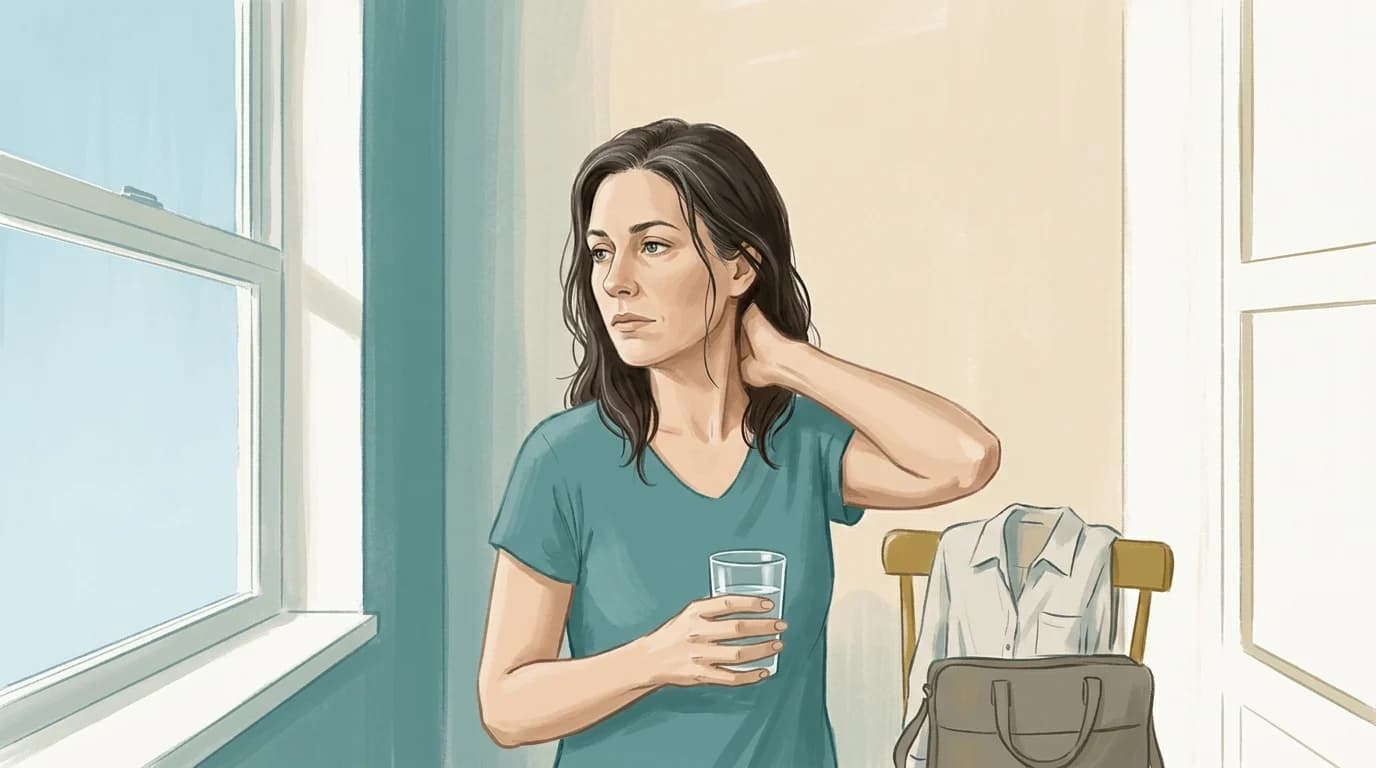
Severe symptoms while your cycles still look normal, and what to raise with a doctor
A Climacteric analysis of 1,478 women across twelve countries finds symptom severity and job satisfaction shift before the periods stop, not after.
Most clinical attention to menopause waits for the periods to stop. A study published this month in the journal of the International Menopause Society suggests the symptoms are not waiting with it.
On September 11, Climacteric published a secondary analysis of 1,478 women aged 40 to 54 living in twelve Latin American countries (Climacteric, 2026). What makes it useful is how the researchers sorted people. Not by age alone, and not by a single yes or no about menopause, but by where the cycle actually was: women aged 40 to 44 with regular cycles as the comparison group, women aged 45 to 49 with regular cycles, women aged 45 to 49 whose cycles had turned irregular, and women aged 50 to 54 whose periods had been absent for at least a year.
Severity climbed across those four groups in that order. In the youngest group, fewer than one in five described their symptoms as severe. Among the women whose periods had stopped, slightly more than half did. Women in the irregular cycle group were around three times as likely as the comparison group to report severe symptoms, and about twice as likely to report low satisfaction with their work. Those are the hot flushes, the broken sleep, the mood changes, the fatigue and the joint aches, all arriving in the years when most women are also holding down a job and, frequently, somebody else's schedule too.
The sentence I keep going back to is tucked into the plain language summary rather than the abstract, and it quietly reverses the usual order of things. Women aged 45 to 49 commonly reported severe symptoms whether or not their cycles were still regular. Irregularity raised the odds of it. Not the gate.
That matters because menstrual irregularity is the marker most people reach for, clinicians included, when deciding whether this conversation is allowed to start yet. The data says a woman can be well inside it with a calendar that still looks entirely unremarkable.
One caution before anyone carries this further than it goes. Job satisfaction did fall across the stages, but a broader measure of work related quality of life did not track menopausal stage once the researchers accounted for other factors. That is a much narrower finding than "menopause is wrecking women's careers," and the authors keep it narrow. So should we.
If some of this sounds like your last two years, here are three things worth raising at your next appointment.
Ask whether it's reasonable to treat what you're feeling as perimenopausal, even with regular cycles. You aren't asking for a diagnosis, because there is no clean test for this stage. You are asking whether your clinician is willing to work with the symptoms now rather than after the calendar catches up. This study gives you something specific to point at.
Ask which single symptom is doing the most damage to your week, and start there. Burden was measured as a cluster in this research, and clusters are not how anyone lives. For many women the load bearing one turns out to be sleep, and broken sleep changes what the body feels like the next day in ways that then get misfiled as a separate problem entirely. Naming the one that drags the others along gives the appointment somewhere to go.
Ask what should happen if nothing has shifted in three months. The most common outcome of a midlife appointment is not a bad plan. It is no plan, and no date to revisit it. A follow up already on the calendar is what turns "let's see how it goes" into something you can hold someone to.
What I see again and again in my classes is women in exactly this window who have already concluded that the stiffness is permanent. They stopped the thing they used to do, usually because it left them sorer, and the stopping quietly became the new baseline. The joint aches and stiffness that show up in this transition are real enough. So is the second layer that forms on top of them once a body starts getting braced against instead of moved.
I teach the Feldenkrais Method®, so my lane here is narrow and I would rather say so plainly. Nothing I do settles the hormone question, and none of it replaces the care a clinician gives you; it sits alongside that care while the medical conversation takes however long it takes. What gentle movement can offer in the meantime is a way of keeping something going. In an Awareness Through Movement® lesson you move slowly and only go where it feels easy, pleasant, and comfortable, which is close to the opposite of what a discouraged body usually gets told. Yoga, Pilates and tai chi each come at this through a different mechanism, each with its own strengths, and the Feldenkrais based work I teach is one option among those, not a ranking of them.
The number I would hand a woman in that 45 to 49 group is not the three times, and not the one in two. It is the finding that her cycles can look completely ordinary on paper while she carries about as much as the women whose periods stopped years ago. Nobody mentions that at the front desk.
Let Feldy guide you, eyes closed
A calm voice walks you through gentle moves so your attention stays in your body, not on the screen.
Try Feldy Free for 7 daysNo credit card needed.
Sources
- Perimenopausal symptom burden: implications for health, work and earlier clinical management— Climacteric (International Menopause Society), 2026
Movement Pulse is informational, not medical advice. See our editorial policy.
Move better with Feldy
See the programMovement Pulse Weekly
The week's best research, in your inbox Tuesday.
Movement science, gentle-practice ideas, and a practitioner's read on what's new. Free.
More from Movement Pulse
The perimenopause question a third of women can't answer
A new study of 7,640 US women finds a third are unsure of their stage. The biggest driver isn't missing information. It's not knowing what a symptom means.
Jul 16, 2026
Why the movement practice you keep through menopause is usually the one you enjoy
Eighteen women aged 40 to 60 describe building their own menopause toolkits, and what decided which parts they kept was not the evidence.
Sep 1, 2026
What a decade of menopause pain research keeps finding
A review of 115 studies finds movement offers the most consistent benefit across the many forms of menopause pain, and that sleep and stress shape it.
Jul 10, 2026Ready to start moving better?
Gentle, guided lessons for your body. Try your first one free, no credit card required.