
For memory changes after sixty, twelve years of reviews keep pointing to slow practice
Mild memory trouble is a stage where a new practice can still be learned, and the research has moved on from asking whether slow practice is worth it to asking how many weeks it takes.
Twenty one trials. 1,429 older adults living with mild cognitive impairment, the stage where memory or thinking has slipped further than ordinary aging would explain but daily life still runs on its own. A review published on 8 October pooled the randomized trials of qigong in that group, and the scores went up on nearly everything the trials measured (Applied Neuropsychology: Adult, 2026).
Overall thinking improved on both of the screening tests clinicians reach for most often. So did memory, on a standard memory battery and on a word list learning task. So did executive function, the planning and switching skill, measured here with a colour word test. By the usual yardsticks for this kind of review, the improvements were large. The authors searched ten databases, four of them Chinese, rated the overall risk of bias in the trials as low, and closed by asking for trials that follow people for longer.
On its own, that's one more encouraging review. Set beside the ones that came before it, it's something more useful: the newest point on a line that has been drawn, slowly, since 2014.
1. The direction has held for twelve years
In 2014 a team led by Peter Wayne gathered twenty studies of tai chi and thinking in 2,553 older adults (Journal of the American Geriatrics Society, 2014). Only eleven of them were randomized trials. In people who were already cognitively impaired, the effect on overall thinking was small but held up, whether tai chi was compared with no activity or with another one, and the authors called the trials modest and asked for bigger, sounder ones with longer follow up.
Five years later, a review in Archives of Physical Medicine and Rehabilitation narrowed the question to mild cognitive impairment and widened the practices to tai chi, yoga and qigong, pooling twelve trials and 1,298 people to find that attention, short term memory, executive function and overall thinking all improved while processing speed, the measure of how quickly the mind turns things over, fell just short of a clear result (Archives of Physical Medicine and Rehabilitation, 2019).
Then the reviews multiplied. PubMed now holds dozens on tai chi, qigong or Baduanjin and thinking, and the five I read closely for this piece, from 2014 to this week, all point the same way.
2. The question has moved from whether to how long
The more interesting change is in what researchers now ask. A 2025 review of nine tai chi trials in 1,066 adults with mild cognitive impairment, average age 74 and roughly seven in ten of them women, split the programmes by length (Frontiers in Physiology, 2025). The longer programmes improved overall thinking; the shorter ones didn't reach a clear result.
A September review went further, pooling 27 trials and 2,034 people over sixty to look at dose (PLOS ONE, 2026). With moderate certainty, mind body exercise improved overall thinking and processing speed. At around four hours of practice a week, the benefit to overall thinking appeared only in programmes that ran at least eleven weeks. The authors say their dose pattern needs testing in new trials before anyone prescribes from it, and the memory pattern they found carried very low certainty.
Eleven weeks is a different kind of message from "it works." It describes something learned over a season.
3. What the reviews can't tell you yet
A dozen reviews are not a dozen independent confirmations. Most of these searched Chinese language databases alongside the English ones, and reviews of the same question inevitably draw on many of the same trials, so the line looks thicker than the evidence underneath it.
The newest estimates are also larger than the 2014 one for impaired adults. That could mean the practices are being taught better. It could also be the familiar pattern in which many small trials produce bigger numbers than a few large ones would.
And none of these reviews can yet say whether anyone's path toward dementia changed. The trials mostly ran for weeks or months; the tests measure thinking on a given morning, not over the next ten years.
Doing less
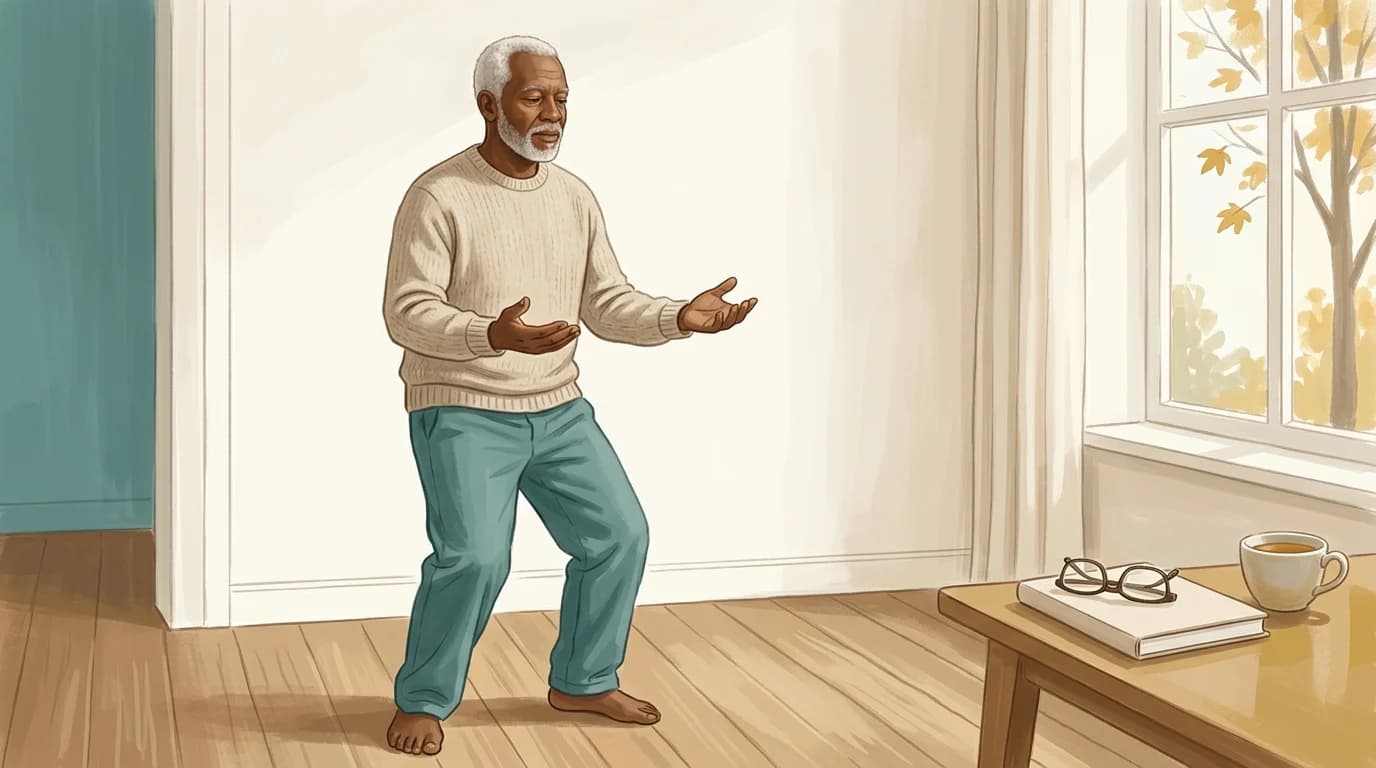
Qigong and tai chi ask for very little force. What they ask for is attention: where the weight is, what comes next in the sequence, how the breath and the arms keep time with each other. No trial here isolated which of those ingredients did the work, so I hold my own view loosely. Still, as a Feldenkrais Method® practitioner, this is the part I find most telling. When effort drops, something else gets room. In an Awareness Through Movement® lesson we make the movement smaller and slower than people expect, and what tends to fill the space is noticing (which side moved first, where the breath caught, what shifted when the head turned the other way). Holding something new, comparing, adjusting: in a small way, that is the same kind of task a memory test sets.
Where this leaves you
If you, or someone close to you, has been told memory has slipped into this middle stage, the assessment and follow up your doctor arranges come first. Gentle practice sits alongside that care, not in place of it. If your physiotherapist has you walking or doing strength work, that keeps going as it is. Coordination tends to change with age in ways a slow practice can bring back into view, and the traditions behind tai chi have long treated attention as part of the movement rather than an extra.
What twelve years of reviews do offer is a reason to choose something slow and keep it going past the point where it feels new. Eleven weeks from today, more or less, lands on the shortest days of the year. Long enough to forget how the first session felt; long enough for the sequence to start arriving on its own.
Let Feldy guide you, eyes closed
A calm voice walks you through gentle moves so your attention stays in your body, not on the screen.
Try Feldy Free for 7 daysNo credit card needed.
Sources
- Effects of qigong exercises on cognitive functioning in older adults with mild cognitive impairment: a systematic review and meta-analysis— Applied Neuropsychology: Adult
- Full text: Applied Neuropsychology: Adult, 10.1080/23279095.2026.2743827— Applied Neuropsychology: Adult
- Effect of tai chi on cognitive performance in older adults: systematic review and meta-analysis— Journal of the American Geriatrics Society
- The Beneficial Effects of Mind-Body Exercises for People With Mild Cognitive Impairment: a Systematic Review With Meta-analysis— Archives of Physical Medicine and Rehabilitation
- Effects of Tai Chi Chuan on cognitive function in adults 60 years or older with mild cognitive impairment: a systematic review and meta-analysis— Frontiers in Physiology
- Nonlinear dose-response of mind-body exercise in older adults with mild cognitive impairment: A systematic review and meta-analysis— PLOS ONE
Movement Pulse is informational, not medical advice. See our editorial policy.
Move better with Feldy
See the programMovement Pulse Weekly
The week's best research, in your inbox Tuesday.
Movement science, gentle-practice ideas, and a practitioner's read on what's new. Free.
More from Movement Pulse

What held up in two new reviews of yoga and qigong was not balance or strength
Twenty one yoga trials and twenty two qigong trials, published ten days apart. The physical scores wobbled once the missing studies were accounted for. Quality of life did not.
Sep 7, 2026
Wearables actually do nudge cardiac patients to move more
A 14-trial meta-analysis just out in JAHA found smartphone apps and wearable trackers added around 1,100 steps and 4 minutes of moderate activity per day. What that means for the rest of us.
Jun 19, 2026
Brisk walking eased frailty more than strolling, and the stroll still helped nearly half
A Chicago trial in 14 retirement communities found a brisker pace moved more older adults out of frailty. Read the fine print and the casual walkers did better than the headline suggests.
Oct 5, 2026Ready to start moving better?
Gentle, guided lessons for your body. Try your first one free, no credit card required.