
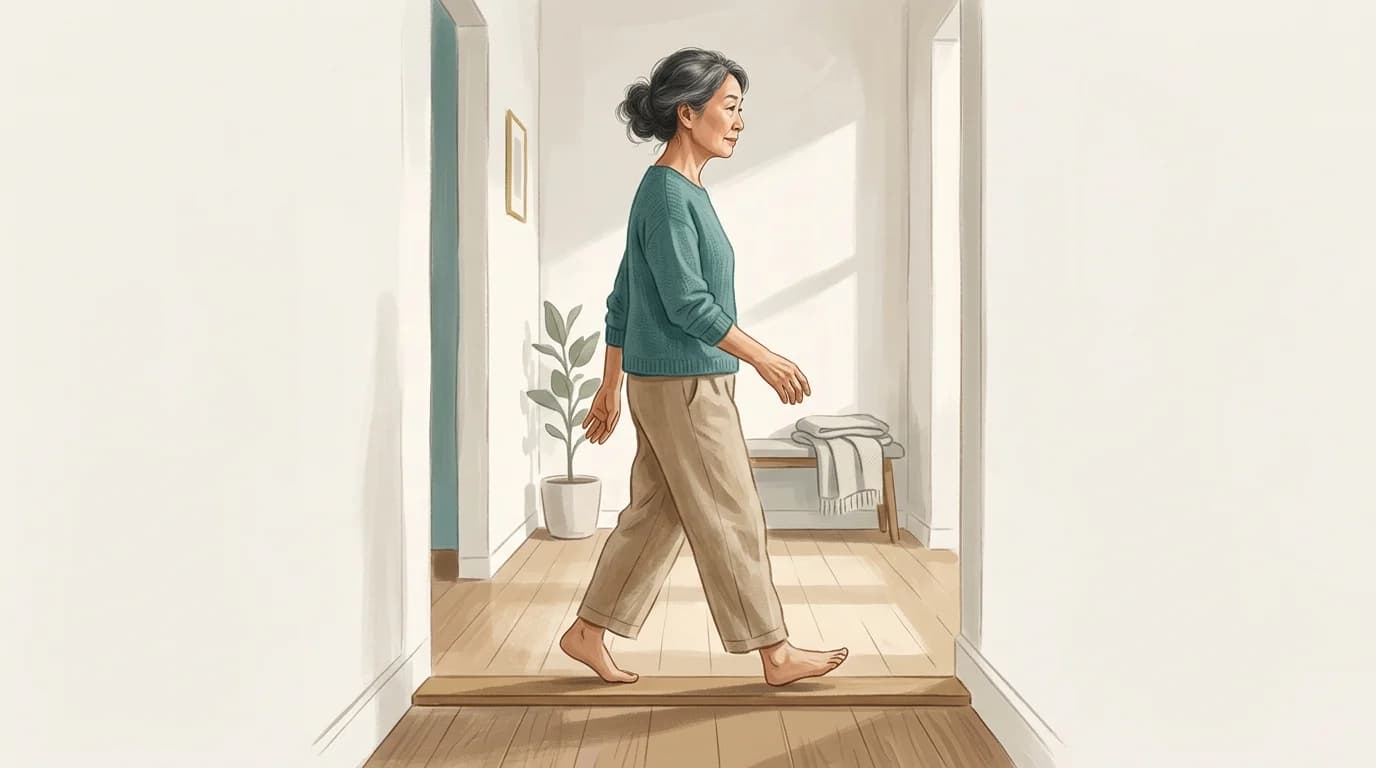
Why the foot that catches on a threshold is usually not the foot that lifted too low
In 200 older adults, those scored at higher fall risk cleared small obstacles just as high as everyone else. What differed was how fluently they got across.
The advice everyone gets is to pick the feet up. A paper published on 31 August suggests that over the obstacles people actually meet indoors, the feet were already coming up high enough, in the group at higher risk of falling as much as in the group at lower risk.
Heontae Kim at Oklahoma State University and Hyunjoo Kang at Soonchunhyang University in South Korea recruited 200 community dwelling older adults, average age 72.8, walked each of them through a gait analysis system, and asked them to step over three obstacles: five centimetres, one tenth of the person's own height, and thirty centimetres. Separately, everyone was scored on a Fall Risk Assessment battery that pulls together sensory, neurological, balance and musculoskeletal domains, then sorted into a lower risk and a higher risk group (Journal of Aging and Physical Activity, 2026).
What separated the two groups
At the two low obstacles, foot elevation did not differ between them. Everyone cleared it. What differed, at p below .05, was crossing speed: the lower risk group was over and gone sooner. Only at thirty centimetres, which is roughly knee height and not a height anybody meets by accident in a hallway, did clearance separate the groups as well, at p equal to .003.
There is a second result folded into the same dataset that I find harder to put down. Crossing speed declined with age at every obstacle height, across the four age bands the authors used, at p below .001 each time. Foot elevation declined with age only at the thirty centimetre obstacle. So the thing that changes first, in this sample, was not lift. It was the speed of the whole arrangement.
Two limits before anyone builds a philosophy on it. This is a cross sectional observation, which means it cannot say whether slower crossing helps produce falls or simply reflects the same decline that the risk battery is already detecting. And the outcome is a risk score rather than a count of people who fell. What the paper puts on the table is an association, in 200 Korean adults, between how fluently a person handles a low obstacle and how a standard assessment grades their risk.
What "speed" is actually measuring here
It isn't hurrying. Nobody in that lab was told to rush, and rushing over a threshold is its own way of ending up on the floor. Crossing speed, in a task this small, is mostly a readout of how much of the step still runs by itself. The trunk keeps travelling forward while the swing leg does its work. The eyes have already released the obstacle and moved on to the floor beyond it. The standing leg accepts full weight without asking permission first. When any one of those pieces needs conscious management, everything slows down while the management happens.
A woman in her seventies said something to me last winter that has stayed with me. Her daughter had told her to pick her feet up, so she had begun lifting her knees at every doorway in the house, carefully, like a soldier. She was picking them up. She was also coming to a small halt at each threshold to organise the lift, and that halt, repeated maybe forty times a day, was slowly teaching her body that a doorway is an event. The lifting was not the problem. The stopping to lift was.
This is where the Feldenkrais Method® works differently from a strength or balance class, which trains the components directly and does that well. Awareness Through Movement® lessons go at the sequencing instead: what happens before what, what the head does while the leg is busy, where the effort quietly went that did not need to go there. Different mechanism, very gentle and soft, and often slower than people expect on the first try.
A threshold experiment to try
About 7 minutes. Move slowly, do less than you can, and stay well below any pain. Rest whenever you need to.
- 1
Stand in a hallway with a wall close enough to touch. Lay a folded towel on the floor a few steps ahead.
- 2
Before you move, notice how you are standing. Which foot carries more weight? Where is your head?
- 3
Walk to the towel at your usual pace and step over it, left foot first. Where are your eyes as you cross?
- 4
Stop and stand still for a moment. Then cross again, slower, and notice what the back leg does.
- 5
Now cross a few times leading with the right foot. Is this side different from the left? Rest again.
- 6
Take the towel away and walk the same stretch of floor. If any of this felt unsteady, only imagine the step.
- 7
Sit down and rest. How does your walking feel now, compared with the start? What has changed?
Let Feldy guide you, eyes closed
A calm voice walks you through gentle moves so your attention stays in your body, not on the screen.
Try Feldy Free for 7 daysNo credit card needed.
What to take from this
Not a technique. A question worth carrying around the house for a week: which thresholds in your own home do you brace for, and which ones do you cross without noticing? Most people find they have two or three of the first kind, and they are usually the ones with a change of light, or a rug edge, or a step down into a room. Those are the interesting ones, and they say more about attention than about the quadriceps.
The gradual changes in gait and walking that turn up in the sixties and seventies are rarely a single failing part. They are usually a slow narrowing of options, and they run alongside the decline in proprioception with age, which is the sense that tells you where your foot is without looking at it. Both respond to practice, which is a genuinely hopeful thing about them. If you have already fallen, or you feel unsteady in a way that is new, that belongs in a conversation with your physician or physiotherapist, and gentle daily practice sits alongside what they give you rather than in place of it. In the Feldy online movement program, this is what most of the standing lessons are quietly about.
Somewhere in your home there is a strip of wood or metal where one floor becomes another. You have crossed it a few thousand times. The question the Korean data leaves open is not whether you can get over it. It is what the rest of you is doing while you do.
Sources
- Obstacle-Crossing Speed and its Association With Fall Risk in Community-Dwelling Older Adults— Journal of Aging and Physical Activity (PubMed record, PMID 42674548)
- Journal of Aging and Physical Activity, article record— Human Kinetics
Movement Pulse is informational, not medical advice. See our editorial policy.
Move better with Feldy
See the programMovement Pulse Weekly
The week's best research, in your inbox Tuesday.
Movement science, gentle-practice ideas, and a practitioner's read on what's new. Free.
More from Movement Pulse
Your balance may be listening to your nose, and pleasant scents steadied some older adults
Ten small studies of smell and standing suggest that balance draws on more than eyes, ears and feet, and that how a moment feels may change how steadily you stand in it.
Oct 15, 2026
Why balance practice may work better at first when it is the only thing you are doing
In a small study from Türkiye, counting backward while learning a balance board slowed one part of the learning. A case for giving a new balance practice your whole attention first, and adding the rest of life later.
Oct 10, 2026
Asked to picture a short walk, older adults imagined four seconds. It took them six
Picture yourself walking across the room and back. A new study timed that picture in 85 adults in their seventies, then timed the real walk.
Oct 3, 2026Ready to start moving better?
Gentle, guided lessons for your body. Try your first one free, no credit card required.