
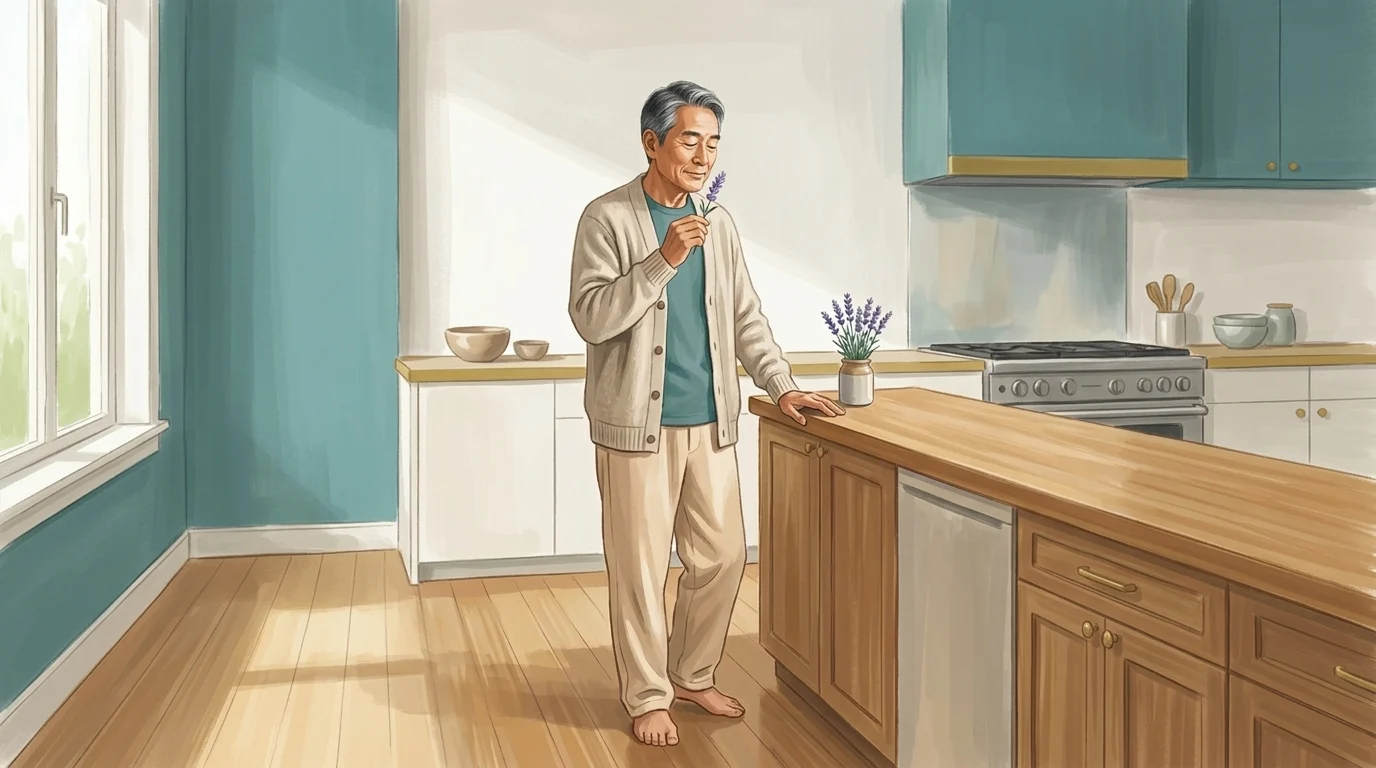
Your balance may be listening to your nose, and pleasant scents steadied some older adults
Ten small studies of smell and standing suggest that balance draws on more than eyes, ears and feet, and that how a moment feels may change how steadily you stand in it.
You close your eyes to rinse your face at the sink, and for a second the floor feels a little less sure. Most people over sixty know that second. We usually blame the legs.
A review published this week looked somewhere else: the nose.
What the review gathered
A team led by Yunus Sadir and Mojtaba Khosravi collected every study they could find in which adults smelled something while their balance was measured (PLOS ONE, 2026). Ten studies qualified, published between 2009 and 2023 in Japan, Korea, Thailand, Iran and Germany, with 365 people in total, from students in their twenties to people in their late seventies. Six were randomised trials. People sniffed lavender, black pepper, citrus, a rose scent, soy sauce and a Thai essential oil, mostly while standing on a force plate that records how far, and how quickly, the body sways.
The studies were too different from each other to pool into one number, so the authors described them side by side.
What it found
The clearest results came from older adults standing with their eyes closed. In a small Japanese study, 17 people with an average age of 78 took a brief sniff of lavender or black pepper oil; with their eyes closed, their small balancing corrections slowed and the path their body traced got shorter, while with eyes open very little changed (Gait & Posture, 2009). In Thailand, 56 older adults at risk of falling did twelve half hour balance sessions over four weeks, half of them with a scented patch on their clothing and half with an unscented one. Both groups improved. The scented group stood steadier with their eyes closed, though the two groups did not differ in fear of falling or in balance while moving (Annals of Geriatric Medicine and Research, 2023).
Then there was the question of whether people liked the smell. In a German study of 45 younger adults, an unpleasant smell made people sway more from side to side than a pleasant smell or no smell at all, and a pleasant smell reduced their largest forward and back sway compared with no smell.
Not everything pointed one way. A single session of lavender added nothing for people after a stroke, and professional golfers swayed more, not less, while putting after breathing in a scent. Most studies were small (between 10 and 72 people), few were blinded, and the authors rated their confidence in the standing results as very low; for balance while moving, the results went in different directions.
A mixing desk
The picture I find most useful for this is a sound engineer's mixing desk. Your balance takes several channels at once: the eyes, the inner ear, and the pressure and position sense coming up from your feet and joints. The brain is the engineer, constantly sliding each one up or down.
With the eyes open, vision is a loud channel, and it drowns out the quiet ones. Close the eyes and that slider drops, so the engineer listens harder to everything else, which may be why a scent showed up mostly in the eyes closed tests. Smell is a quiet channel. You only hear it when the loud one goes silent.
An unpleasant smell seems to act less like an extra channel and more like hum across the whole desk, the kind that makes the engineer tense up and turn everything toward alarm. And the golfers, whose mix is tuned for one precise task, were thrown by any new input at all.
The better question
The study asks which smell steadies people. The Feldenkrais® question is a different one: what state are you standing in?
In the Feldenkrais Method® we keep every movement inside what feels easy, pleasant, and comfortable. That isn't politeness. A nervous system braced against something it dislikes has less room to sense the tiny shifts that balance is built from, and a settled one has more. What I see again and again in Awareness Through Movement® classes is that people stand a little steadier at the end of a lesson than at the start, often after an hour without a single balance exercise, simply because the whole system has stopped bracing. Ten small smell studies are hardly proof of that, but they are a modest, slightly odd piece of evidence leaning the same way.
What to take from it
None of this is a case for any particular oil. The finding I'd carry is broader: the conditions you practise balance in may be part of what you're practising. If your balance work feels rushed, tense or faintly unpleasant, that tone travels with it. The fading sense of where your body is that often comes with age is one of the quieter channels on the desk, and it tends to be heard better in a calm room than a noisy one.
If you have a balance programme from a physiotherapist, this sits alongside it rather than changing it. And if being unsteady has made you wary of falling, it's worth knowing that steadiness isn't only stored in muscle; some of it lives in how safe and at ease the moment feels.
Next time the floor tilts for a second at the sink, notice the smell of the soap.
Let Feldy guide you, eyes closed
A calm voice walks you through gentle moves so your attention stays in your body, not on the screen.
Try Feldy Free for 7 daysNo credit card needed.
Sources
- The effects of olfactory stimulation on postural control in adults: A systematic review— PLOS ONE, 2026
- Olfactory stimuli and enhanced postural stability in older adults— Gait & Posture, 2009
- Integrated Effects of Thai Essential Oil and Balance Exercise on Parameters associated with Falls in Older Adults at Risk of Falling: A Randomized Controlled Study— Annals of Geriatric Medicine and Research, 2023
Movement Pulse is informational, not medical advice. See our editorial policy.
Move better with Feldy
See the programMovement Pulse Weekly
The week's best research, in your inbox Tuesday.
Movement science, gentle-practice ideas, and a practitioner's read on what's new. Free.
More from Movement Pulse
Why the balance exercise that works in a class may not be the one that works at home
A new analysis pooled 423 trials and nearly 34,000 older adults to compare 19 ways of training balance. The ranking changed depending on which kind of balance was being measured.
Aug 16, 2026
Tai chi walking is the balance trend of the summer. What the research actually shows
Tai chi walking is everywhere this summer. The evidence on balance and falls is encouraging, and it comes from classical tai chi, not the viral version.
Jul 29, 2026
Why balance practice may work better at first when it is the only thing you are doing
In a small study from Türkiye, counting backward while learning a balance board slowed one part of the learning. A case for giving a new balance practice your whole attention first, and adding the rest of life later.
Oct 10, 2026Ready to start moving better?
Gentle, guided lessons for your body. Try your first one free, no credit card required.