
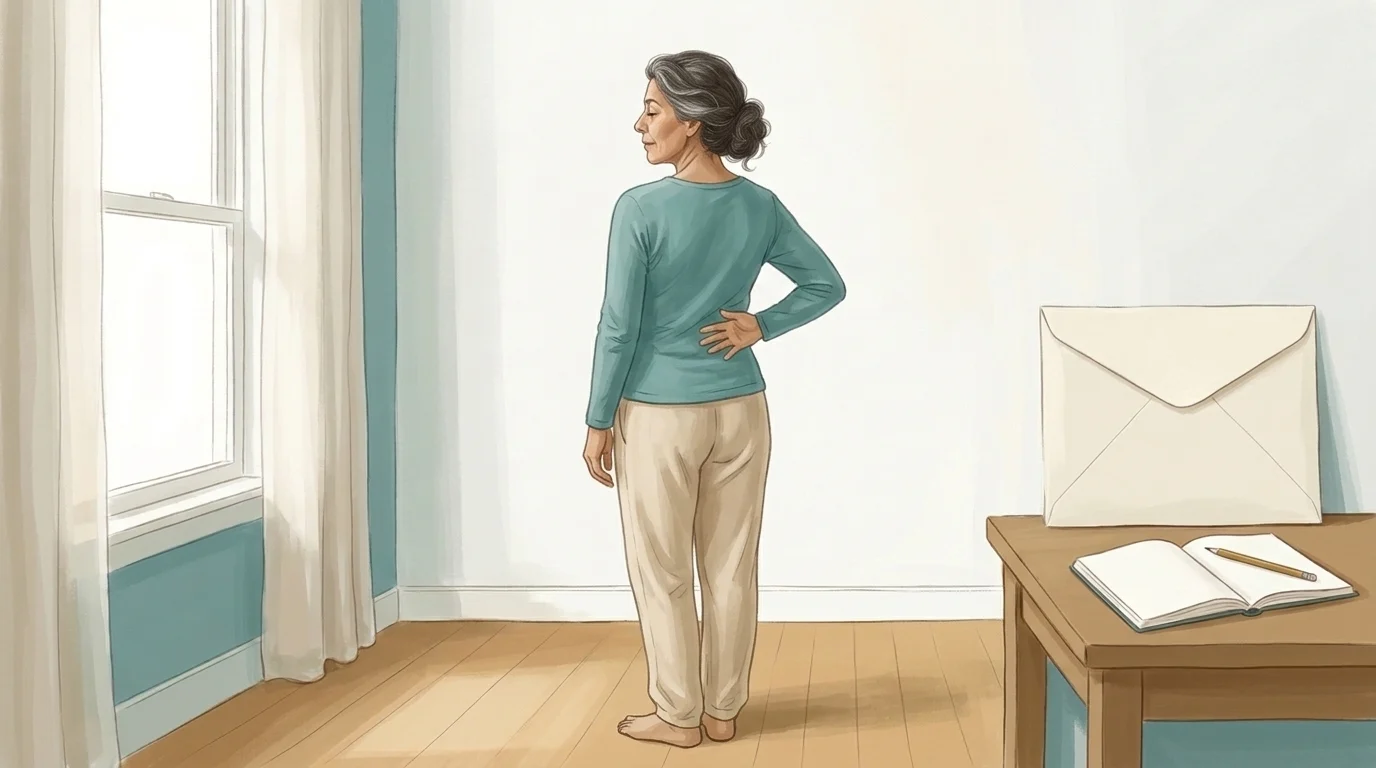
Among 474 adults with scoliosis, pain did not follow the curve
Being active went with about a point less pain out of ten. Most were young and it was one snapshot: nobody knows which came first.
Most people with scoliosis are handed a number early on: the degrees of their curve. It's easy to think that number also tells you how much you hurt. In 474 adults with scoliosis, it didn't: pain was not linked to the size of the curve, and the people who were physically active reported about one point less pain, on a scale of 0 to 10, than those who weren't.
If you've spent years worrying about your curve, this is worth knowing. Its size may tell you less about how much you hurt than you thought, and being active may matter too, though this study can't show that it does. It comes from one snapshot of mostly young adults, so it's a reason to look at your curve differently, not a promise that exercise will reduce your pain.
The degrees and the pain did not line up
Researchers went through the medical records of adults with idiopathic scoliosis, the kind with no known cause (Spine Deformity, 2026). Many of these were sizeable curves: the typical largest curve measured 39 degrees. Line up each person's pain at the time against the size of their curve and there was no clear link, so in this group someone's degrees told you little about how much they hurt.
The active group reported a point less pain
Most said they did some kind of physical activity, most often strength training, aerobic exercise or Pilates. As a group they reported about one point less pain than those who weren't active, a figure that already takes curve size, age, sex and weight for height into account.
One point out of ten is a modest gap between two groups, and it can't tell you what would change for any one person. It does give you something besides the curve to look at, how active you are, though nobody can yet say whether changing that would change your pain. The authors make a related point: pain here "may be less closely related to structural deformity and more consistent with modifiable lifestyle factors." In other words, pain may have less to do with the shape of your spine and more to do with things about how you live, which can change.
What this snapshot can't show
A photograph can't tell you what happened before it was taken. This study looked at one moment in people's lives, so nobody can say which came first. Activity may ease pain, or people in less pain may simply find it easier to stay active, or it may be some of both.
"Active" was also a simple yes or no. There's nothing here about how much, how often or which kind, so it can't tell you what to do, and it did not test Feldenkrais.
Two more gaps. The published summary doesn't say where people hurt, so "pain" here may not be the kind you have. And only each person's largest curve was counted, so a second curve wasn't part of this.
The age of the people matters too. The typical person was 28, and four in five were women. If you've had scoliosis since your teens, these findings may still apply to you, although you're at a different stage of life. If yours appeared later in life, it may be what the NHS calls degenerative scoliosis, from wear and tear of the spine with age, and this study did not look at that (NHS).
None of this means the size of your curve doesn't matter. These findings are about pain and nothing else, so your measurements stay important for your clinician to follow, and the NHS says to see your GP if your scoliosis gets worse.
Whatever your curve measures, some symptoms need urgent help. With back pain, the NHS says to call 999 or go to A&E for pain, tingling, weakness or numbness in both legs, or for changes in your bladder or bowels, such as difficulty peeing (NHS). Outside the UK, use your local emergency number. If pain is getting in the way of your everyday life, that's worth raising with your clinician too, and if it has settled in your lower back, the Feldypedia entry on chronic lower back pain is a calm place to start.
A different question
I'm a Feldenkrais® practitioner, and what I see again and again is people who know their degrees by heart but have rarely been asked how they stand at the sink. "How big is my curve?" has an answer on an X-ray. The Feldenkrais Method® asks something else: how do you move and organise your body around that curve? Where does your weight go when you stand? Does one side of your ribs move more freely when you breathe?
Those are habits, learned over years, and a habit is where learning starts. In an Awareness Through Movement® lesson you explore them with small movements, going only where it feels easy, pleasant and comfortable. That sits alongside what your physiotherapist or spine doctor gave you, not in place of it, and I've set out what it can and cannot do in Feldenkrais for scoliosis.
One thing to notice this week
You already know your degrees. So for the next seven days, leave them alone and watch something else: when a day feels easier, ask what you did the day before. A walk, less time at the desk, a slower morning. Write it down in a few words, and take that note to your next appointment.
Let Feldy guide you, eyes closed
A calm voice walks you through gentle moves so your attention stays in your body, not on the screen.
Try Feldy Free for 7 daysNo credit card needed.
Sources
Movement Pulse is informational, not medical advice. See our editorial policy.
Move better with Feldy
See the programMovement Pulse Weekly
The week's best research, in your inbox Tuesday.
Movement science, gentle-practice ideas, and a practitioner's read on what's new. Free.
More from Movement Pulse
Yoga, Pilates, tai chi or qigong for chronic back pain? 25 trials found no clear winner
All four eased pain by a similar margin. Tai chi topped the ranking, yet every tai chi trial was measured against people doing nothing at all.
Oct 26, 2026
239 back pain trials searched for the ideal exercise dose. More added surprisingly little
A new review names a best dose for chronic back pain, then says it can barely tell that dose apart from the others. That caveat is the real finding.
Sep 30, 2026
The exercise that made people feel best was not the one that calmed the inflammation
Fifty nine randomized trials, seven exercise methods, 3,404 adults with axial spondyloarthritis. Different methods moved different things, and one measure moved for nobody.
Sep 21, 2026Ready to start moving better?
Gentle, guided lessons for your body. Try your first one free, no credit card required.