
Sciatica Exercises in Bed: A Gentle Lesson for Hard Days
A short lying down lesson for mornings and nights when leg pain makes getting to the floor unrealistic. Small, slow movement, done on your back.
Before you begin. Sciatica is nerve related, so a few signs are urgent: numbness in the saddle area, any change in bladder or bowel control, or new weakness in a leg needs emergency care, not exercise. New or worsening symptoms deserve a medical review.
The lesson
About 10 minutes. Move slowly, do less than you can, and stay well below any pain. Rest whenever you need to.
Prefer to listen than read?
Feldy voices gentle lessons like this for lower back pain, so you can close your eyes and follow along.
- 1
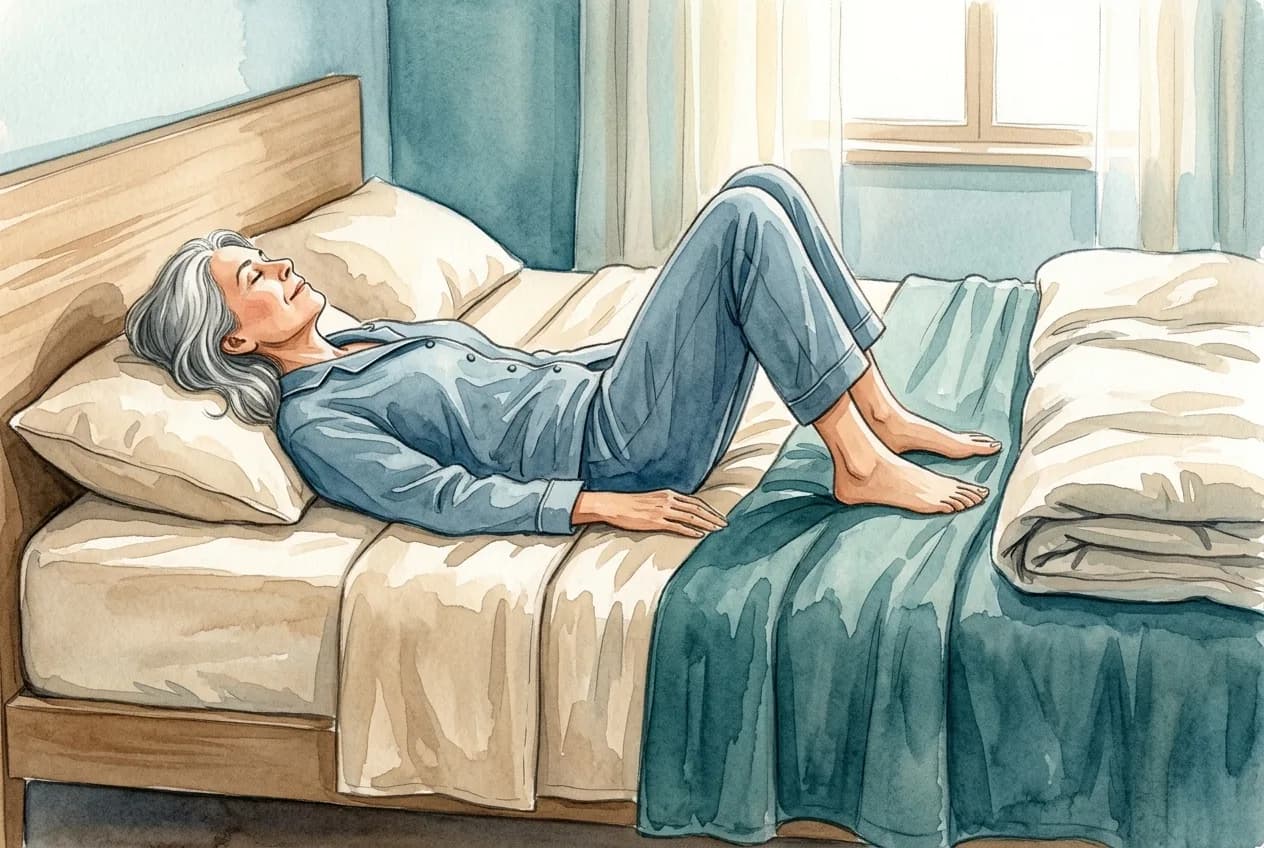
Lying in bed. Lie on your back in bed with your knees bent and your feet standing on the mattress.
- 2
Where you rest. Notice which parts of your back press into the mattress. Does the side with the sore leg rest differently?
- 3
Pelvis toward the feet. Roll your pelvis a tiny amount toward your feet, so the small of your back lifts a little. Then return and rest.
- 4
Pelvis toward the head. Now roll the pelvis a tiny amount the other way, toward your head, and back. Stop and rest.
- 5
Rocking both ways. Rock slowly between the two, so small the sheet hardly moves. If the leg says anything, make it smaller or only imagine it.
- 6
Breathing. Lie still and follow a few breaths. Does the breathing move your pelvis a little on its own?
- 7
Comparing. Notice again which parts of your back touch the mattress. What has changed since you began?
Let Feldy guide you, eyes closed
You just read these steps. In the Feldy program, a calm voice guides you through each gentle move, so your attention can stay in your body instead of on the screen.
Try Feldy Free for 7 daysNo credit card needed.
Sciatica exercises in bed exist for the days when the floor might as well be in another country. The leg is complaining, it is six in the morning or nearly midnight, and the kindest place to move is exactly where you already are. The lesson above is built for that moment: seven small movements, done lying on your back, none of them asking the sore leg to be brave.
Sciatica means pain that travels along the path of the sciatic nerve, usually down one leg. Most often the source is a disc in the lower back, or a narrowing of the space where the nerve leaves the spine. It is remarkably common: lifetime incidence is estimated at 10% to 40%, and it peaks in the fourth decade of life (StatPearls, 2024). You can read more about how nerve pain behaves in our Feldypedia article on sciatica and nerve related back pain. If your ache seems to begin deep in the buttock instead, the piriformis muscle is sometimes part of the picture, and our guide to piriformis syndrome exercises to avoid covers what to go easy on.
Why sciatica exercises in bed can help on a bad day
An irritated nerve does not respond well to force, and it does not respond well to total stillness either. Most sciatica settles over a period of weeks, and people who stay lightly active through those weeks tend to do better than people who stop moving. The NHS advice is to carry on with normal activities as far as you can and to start gentle exercise as soon as you are able, and it notes that sciatica usually gets better in a few weeks to a few months (NHS, 2024). Long bed rest, in particular, has a poor track record. So this page is not an argument for staying under the covers. It is a way to keep moving gently on a day when standing exercise feels out of reach, so the habit of movement survives the flare.
Moving in bed changes one important thing: the surface. A mattress gives softly under you, so it offers much less feedback than a floor. You feel less clearly where your weight is and how far you have moved. The answer is not to try harder. It is to make every movement smaller and slower than you would on the floor, and to lean on your attention instead of the surface. That is why the lesson keeps asking what you notice.
The lesson draws on the Feldenkrais Method®, a form of movement education that uses slow, attentive movement rather than effort or stretch. To be plain about what it offers: this is comfort and gentle movement, not a cure. It will not resolve a disc problem, and it makes no promise about your pain. What it can do is give you a way to move that stays on the friendly side of a cranky nerve.
When to try these movements, and when to skip them
Good moments: first thing in the morning, when the back is stiff and the day has not started. Last thing at night, when settling is hard. Any daytime hour when you want to move but standing up feels like too much. If you already see a physiotherapist for your sciatica, this lesson sits alongside that work, and it may be worth showing them the steps.
Skip the lesson today if pain is sharp even at rest and every position makes it worse; lying quietly and breathing is enough. And stop entirely, and seek urgent care, if you notice numbness in the saddle area, any change in bladder or bowel control, or new weakness in a leg. Those signs can point to cauda equina syndrome, a rare emergency where the nerves at the base of the spine are compressed. That situation needs a hospital, not an exercise page.
How to do sciatica exercises in bed well
Push the pillow aside if you comfortably can, or keep a low one under your head. Let the duvet go. Then follow the steps in order, resting between each one, and treat the rests as part of the lesson rather than pauses in it. If any movement wakes the leg up, make it half the size, and if that still stings, imagine the movement instead. Imagining sounds like a consolation prize, but attention is the active ingredient here, and it works surprisingly well from stillness.
There is no number of repetitions to reach. Three tiny pelvic rocks done with full attention are worth more than thirty done while planning breakfast. Many people repeat the lesson daily through a flare, then keep the pelvic rocks and knee sways as a morning habit once the leg quiets down. If nights are the hard part, our guide to sleeping positions for sciatica relief pairs naturally with this lesson, and for daytime rest there is a companion page on the best resting position for sciatica. When the floor becomes an option again, the slightly larger set of gentle sciatica exercises is a natural next step, and Feldy's guided audio lessons offer the same style of movement with a free 7 day trial.
Find where to start
A lesson in bed is one place to begin, but it is not the only slow movement approach, and different methods suit different people. A short quiz narrows the choice faster than trial and error.
Not sure which movement method fits you? Take the 60-second Movement Match quiz. Three quick questions, and it points you at the movement method most likely to suit a sore leg.
Common Questions about sciatica exercises in bed (FAQ)
Are sciatica exercises in bed safe?
For most people, yes, as long as every movement stays small, slow, and below the level of pain. If a movement sends sharp or spreading sensation down the leg, make it smaller or stop for now. Anyone with saddle numbness, bladder or bowel changes, or new leg weakness needs urgent medical care, not exercise.
What are the best sciatica exercises in bed for a flare at night?
The quietest ones. Tiny pelvic rocks and a slow breath tend to be the most tolerable when the nerve is irritated, because they ask almost nothing of the leg. During a flare, do less than you think you can, rest often, and let comfort decide how far anything goes.
What exercises to avoid with sciatica in bed?
Skip anything that pulls the knee hard toward the chest, deep hamstring stretches, big twists, and sit ups. Fast or forceful movement of any kind tends to stir an irritated nerve. If a movement increases sensation down the leg, that is your cue to shrink it or leave it out.
How often should I do this lesson in bed?
Once or twice a day is enough, perhaps on waking and again before sleep. Short and frequent suits an irritated nerve far better than long and ambitious. On a rough day, doing only the first two steps still counts.
How long until anything changes?
Comfort can shift a little within one session, though it may not. Most sciatica settles over several weeks regardless of what you do, and gentle movement tends to make those weeks more livable. If nothing has improved after a few weeks, or things worsen, ask a professional to take a look.
When should I see a professional about sciatica?
Urgently if you notice saddle numbness, changes in bladder or bowel control, or growing weakness in a leg. Book a routine review if pain is severe, has lasted more than a few weeks, keeps waking you, or follows an injury. If you already see a physiotherapist, this lesson sits alongside that work.
Is it better to stay in bed or keep moving with sciatica?
Keep moving, gently, as much as the day allows. Long bed rest has not helped people with sciatica recover faster, while staying lightly active generally has. Think of in bed movement as a soft start on a bad day, a bridge back to walking and ordinary life.
A gentler way through back pain
See the programRelated resources
Gentle Sciatica Exercises: A Soothing Daily Set
A simple set of gentle movements that ease sciatica-related discomfort. Slow, small, and beginner-friendly, so you can return to it any time.
Best Sleeping Position for Sciatica: Side or Back?
Which sciatica sleeping position brings relief through the night, how to get into bed without twisting, and what to do when the leg pain wakes you at 3am.
With knee or back pain after 65, exercise may change how you walk more than how much

Ready to start moving better?
Gentle, guided lessons for your body. Try your first one free, no credit card required.