
Stretching Exercises for Mid Back Pain You Can Do Sitting
Stretching exercises for mid back pain that stay small and slow, in a short seated lesson you can do at your desk without changing clothes or lying down.
Before you begin. This is supportive self care, not medical advice. Mid back pain that is severe, follows a fall, wakes you at night, spreads around the ribs, or comes with fever, unexplained weight loss, chest symptoms, or numbness and weakness deserves a doctor's opinion rather than a home lesson. Stop anything that hurts.
The lesson
About 6-10 minutes. Move slowly, do less than you can, and stay well below any pain. Rest whenever you need to.
Prefer to listen than read?
Feldy voices gentle lessons like this for neck and upper back, so you can close your eyes and follow along.
- 1
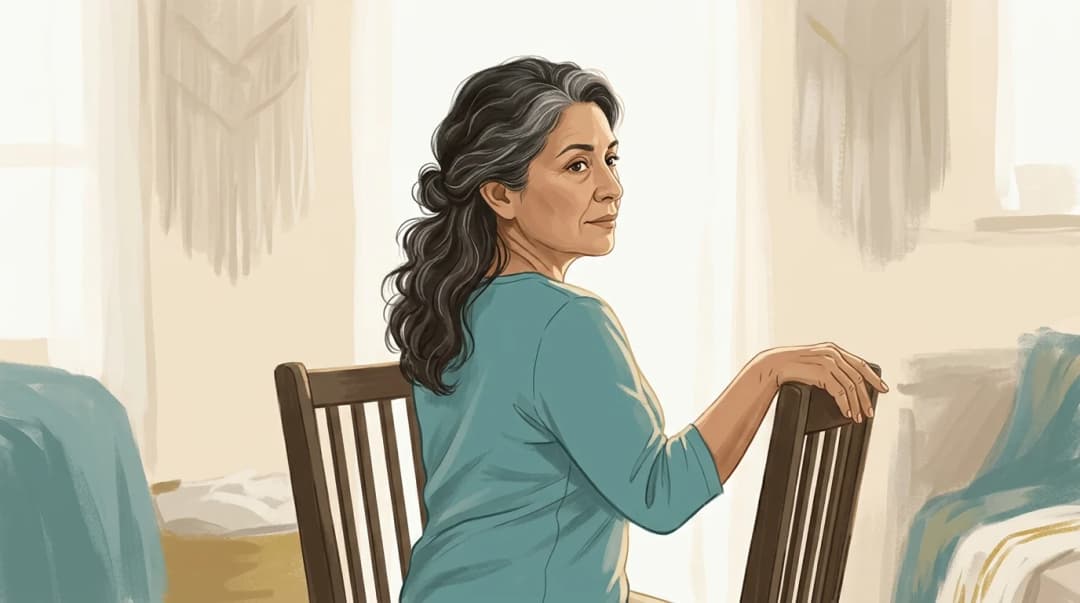
A firm seat under you. Please sit toward the front of a firm chair, feet flat, hands loose on your thighs. Feel your two sitting bones on the seat, and let the chair do the work of holding you upright.
- 2
Where the ache lives. Before anything moves, visit the tired band across the middle of your back with your attention. Is it louder on one side, or fairly even across the two?
- 3
Ribs sinking toward one hip. Slowly let the ribs on your right side sink a small way toward your right hip, so you lean gently sideways, and just as slowly come back to the middle. A few unhurried times, staying far below any pull, then pause.
- 4
The other side's turn. Now let the left ribs drift toward the left hip and return, just as small and just as slow. After a few of these, stop leaning and rest in the middle: does one side travel more willingly?
- 5
Breath in the middle. Sitting quietly, let the breath come and go on its own for a little while. Each time the air leaves, see if the middle of your back softens and your weight sinks a little further into the seat.
- 6
The band, revisited. Visit that band across your middle back one more time, and compare it with the moment you first sat down. Is it quieter, warmer, wider, or something else entirely?
Let Feldy guide you, eyes closed
You just read these steps. In the Feldy program, a calm voice guides you through each gentle move, so your attention can stay in your body instead of on the screen.
Try Feldy Free for 7 daysNo credit card needed.
These stretching exercises for mid back pain are built for the person who notices, around three in the afternoon, that a tired band has settled across the middle of their back. They stay seated, they stay small, and they take about six minutes. Mid back discomfort of this kind is rarely a sign that something has gone wrong structurally. Far more often it is what happens when the middle of the back is asked to hold one shape for hours while the arms work in front of the body. Musculoskeletal conditions of one sort or another affect roughly 1.71 billion people worldwide (WHO, 2022), and an aching thoracic spine after a long day at a screen is one of the ordinary ends of that spectrum.
The Feldenkrais Method® approaches this differently from a stretching routine. Rather than pulling the sore area toward its limit, it offers the middle of the back small, slow movement and a bit of attention, on the understanding that a muscle holding on for hours needs a reason to stop, not more force applied to it.
Why the middle of the back gets tired first
The thoracic spine has the rib cage attached to it, which makes it naturally less mobile than the neck or the lower back. When you sit at a desk, the arms reach forward, the ribs settle into one position, and the muscles between the shoulder blades take on the quiet job of holding you there. They are not built for a long shift of static work, and after a few hours they let you know.
That is why the lesson above uses slow side bending rather than a big stretch. Letting the ribs on one side sink toward that hip and come back gives the middle of the back a movement it has not had all day, in a direction it rarely goes. If you want the wider picture of what long desk hours do to the back and neck, our Feldypedia article on desk posture and chronic neck pain is the background read.
Making these stretching exercises for mid back pain part of the day
Nothing here needs a mat, a change of clothes, or a private room. Two or three quiet minutes in your chair, repeated a few times through a working day, does more for a tired mid back than one long stretch in the evening. Set the movement smaller than feels necessary and slower than feels natural. The smallness is not a compromise; it is what lets you feel what is happening.
Where to go next with a sore mid back
If you have time to lie down, the floor removes the job of staying upright and lets smaller movement register more clearly. Our mid back stretches lesson takes that route, and the thoracic spine stretches page covers turning rather than side bending. For the practical side, what to change about your chair, your screen, and how often you get up, our guide to mid back pain is the more useful read. The Feldy program for neck and upper back puts these short lessons into a sequence you can follow, and there is a free 7 day trial if you want to see whether it suits you.
A word on care
None of this replaces an assessment. Most tired mid backs settle with movement, variety, and getting out of the chair more often, but pain that is severe, that started with an injury, that wraps around the ribs, or that keeps you awake belongs with a clinician. If you already see a physiotherapist, this kind of gentle practice sits comfortably alongside what they have given you.
Find where to start
The middle of the back rarely aches on its own; the neck, the shoulders, and the way you sit are usually part of it. If you would rather not guess which end to begin from, a few questions can point you.
Looking for a starting point? The Movement Match quiz asks four quick questions in about two minutes and names your movement method.
Common Questions about stretching exercises for mid back pain (FAQ)
What are the best stretching exercises for mid back pain at a desk?
The ones you will actually do, which usually means seated and short. Slow side bending, where the ribs on one side sink toward that hip and come back, is a good first choice because it moves the middle of the back directly without asking you to leave your chair. Gentle turning of the ribs and small movements of the shoulder blades work well too. What matters more than the choice is that everything stays comfortable and unhurried.
How often should I do these stretches?
Little and often. Two or three minutes every couple of hours through a working day tends to help a tired mid back far more than twenty minutes once in the evening, because the discomfort builds from staying still rather than from a single event. Since nothing here is strenuous, there is no need to space sessions out.
How long before mid back pain eases?
Many people feel the band across the middle loosen a little within one sitting, since a good part of that ache is muscle holding rather than damage. A steadier change, where the afternoons stop being the worst part of the day, usually takes two to four weeks of returning to it regularly, alongside getting up from the chair more often.
What should I avoid with mid back pain?
Avoid deep twists you push into, hanging forward folds meant to crack something loose, and any stretch you hold while gritting your teeth. Avoid trying to force yourself into a straighter shape, which usually adds effort to a back that is already working. And avoid ignoring pain that wraps around the ribs, wakes you at night, or arrives with fever or weight loss, since those belong to a doctor.
How is this different from ordinary mid back stretching?
Ordinary stretching pulls a muscle toward its limit and waits there. This lesson keeps the movement small and comfortable and repeats it slowly, so the middle of the back gets the experience of moving easily rather than being pulled. People with a sore, tired mid back often tolerate that better, because nothing in it feels like more demand.
When should I see a professional about mid back pain?
Get an opinion if the pain is severe, if it started with a fall or a blow, if it wakes you from sleep, if it wraps around your ribs like a band, or if it arrives with fever, unexplained weight loss, chest symptoms, or numbness and weakness anywhere. Persistent pain that has not shifted in a few weeks is also worth having looked at.
A softer neck, a freer upper back
See the programRelated resources
How to Help Mid Back Pain Between the Shoulder Blades
Why mid back pain usually points to a region held still for hours, and how changing position, rib breathing, and easy rotation help more than force.
Mid Back Stiffness: Why the Middle of Your Back Feels Stuck
Mid back stiffness usually means an area that has not turned or leaned in hours. Why the middle back locks up, and the slow movement that frees it again.
Why neck pain trials keep working on the mid back, and what the pain score misses
Ready to start moving better?
Gentle, guided lessons for your body. Try your first one free, no credit card required.