
Box breathing for sleep: a gentler bedtime version
A calm bedtime lesson in box breathing for sleep: even in and out breaths, small optional pauses, and full permission to rest instead of chasing sleep.
Before you begin. Gentle breathing practice is self care, not medical care, and it is not a treatment for insomnia or any other sleep disorder. Skip the pauses, or stop altogether, if you feel dizzy, breathless or more anxious. Talk with your doctor before practising breath holds if you have asthma, COPD or another long term lung condition, a heart condition, high blood pressure, or if you are pregnant. See a doctor or a sleep service for sleep problems lasting more than a few weeks, loud snoring with pauses in breathing, or daytime sleepiness that affects your driving.
The lesson
About 8-10 minutes. Move slowly, do less than you can, and stay well below any pain. Rest whenever you need to.
Prefer to listen than read?
Feldy voices gentle lessons like this for stress and sleep, so you can close your eyes and follow along.
- 1
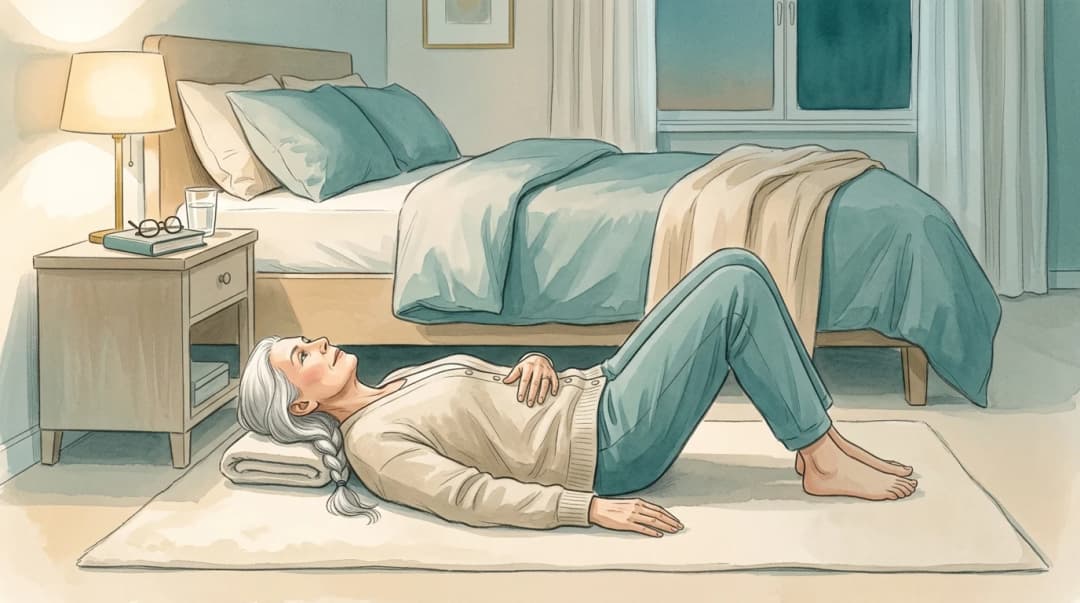
Settling into bed. Please lie in bed the way you like best. Which parts of you sink into the mattress, and which barely touch it?
- 2
Breath as it is. Without changing anything, notice your breathing. Where does it show itself tonight, the belly, the ribs, or somewhere else?
- 3
Four in, four out. Breathe in for a soft count of four, and out for four. Keep the count soft, or simply feel your way.
- 4
The pauses. Add a pause of four after breathing in, and four after breathing out. Shorter pauses, or none, if you feel dizzy or uneasy.
- 5
Letting the count go. After a few rounds, let the counting and the pauses fade. Breathe however you breathe, and rest here.
- 6
What is different. Notice how you lie in the bed now, compared with when you began. What has changed, if anything?
Let Feldy guide you, eyes closed
You just read these steps. In the Feldy program, a calm voice guides you through each gentle move, so your attention can stay in your body instead of on the screen.
Try Feldy Free for 7 daysNo credit card needed.
Box breathing for sleep is a breathing pattern with four equal parts: the air comes in, rests for a moment, flows out, and rests again, usually to a count of four. Think of the four sides of a square, each side taking the same time. The pattern was not born at bedtime. It comes from performance and military settings, where people use a crisp count to steady themselves under pressure. This page offers a gentler version, shaped for lying in bed and taught in the spirit of the Feldenkrais Method®, where attention matters more than effort. The guided lesson above takes about ten minutes, and it is allowed to end in sleep.
What box breathing is, and why an even pattern can help
In its usual form, you breathe in for four counts, let the air rest for four, breathe out for four, and rest empty for four. Divers and pilots have used it to stay steady in tense moments, and that history explains its shape: precise, symmetrical, easy to remember.
At bedtime, the value is simpler. A busy mind often does better with one small job than with none, and counting a slow, even breath is about as small as a job can get. A slow, even pattern tends to feel settling for many people. It is worth saying plainly that the evidence for any single breathing pattern beating another for sleep is limited, so there is no magic in the number four. The pattern is a quiet place to rest your attention, and that is enough.
Making box breathing for sleep softer
The military version is built for alertness under pressure, which is the opposite of what you want at eleven at night. So the bedtime version bends the rules. The counts can shrink to three, or dissolve into a felt sense of about the same length. The pauses become optional: the air can rest for a moment at the top and bottom of the breath, or you can leave the pauses out entirely. Leaving them out is not a lesser version; even, unhurried breathing with no pauses is the whole practice for many people.
Breath pauses genuinely do not suit everyone. Some people find that any pause stirs up unease rather than calm, and some chests simply prefer continuous air. If that sounds like you, let the pauses go without a second thought, or try our lesson on breathing exercises to fall asleep, which uses no counting at all. And if you want the steadier daytime form of the pattern, there is a separate lesson on box breathing for anxiety.
Why box breathing for sleep is not about falling asleep on cue
Sleep does not answer to effort. The harder you chase it, the more awake the chasing keeps you, which is why turning any technique into a test tends to backfire. So the aim of this lesson is comfort, not unconsciousness. If sleep arrives, lovely. If it does not, a stretch of quiet, even breathing is still real rest, and resting without sleeping is still worthwhile.
It also helps to know how common wakeful nights are. When strict diagnostic criteria are used, insomnia affects about 6 to 10 percent of people (StatPearls, NCBI, 2023). Many more of us simply pass through spells of poor sleep, often tangled with bodily tension, and our Feldypedia entry on sleep disruption and physical tension looks at that connection more closely. If a deep ache in the buttock and leg is what keeps you awake, our guide on how to sleep with piriformis syndrome looks at kinder ways to lie at night.
Two framings matter here. Clinical care, meaning a doctor, a sleep clinic, or CBT for insomnia, a structured talking therapy for sleeplessness, sits alongside gentle self care like this, never replaced by it. Other calming practices, such as yoga nidra, breathwork or meditation apps, are simply different in mechanism, neither better nor worse than a breathing pattern; choose whichever your evenings take to.
If you would rather practise with a voice than a page, Feldy's free 7 day trial includes short bedtime lessons recorded for exactly this hour of the day, no credit card needed.
Find where to start
Bedtime practices come in many forms, and a description on a screen cannot tell you which one your body will take to. The kind way to find out is to try one for a few quiet nights and simply notice.
Not sure which movement method fits you? Take the 60 second Movement Match quiz: three short answers point you to one movement method worth trying before the light goes out.
Common Questions about box breathing for sleep (FAQ)
Is box breathing for sleep safe, and who should avoid the breath holds?
For most people a soft, short version is fine. The pauses are the part to be careful with: talk with your doctor first if you have asthma, COPD, a heart or lung condition, high blood pressure, or if you are pregnant. If you feel dizzy, breathless or more anxious at any point, drop the pauses or stop; even breathing with no pauses at all is a complete practice.
How often should I practise box breathing at bedtime?
Most nights works well, since you are lying in bed anyway. A few minutes is plenty, and you can return to it if you wake during the night. Treat it as a comfortable habit rather than a task with a quota.
How long until it makes a difference to my sleep?
Some people feel calmer the very first evening, while for others nothing obvious happens for a week or two. Try not to measure each night, because checking whether it is working is its own kind of effort. A quieter, more comfortable time in bed is already a result, even when sleep is slow to come.
How is box breathing different from 4 7 8 breathing?
Box breathing uses four equal parts, while 4 7 8 breathing uses a short inhale, a long pause and a longer exhale. Both give the mind a simple pattern to follow, and the evidence that either one beats the other for sleep is limited. Choose whichever feels easiest tonight; a body scan, which uses attention rather than counting, is another gentle option.
What is the best breathing technique for sleep?
The one you can do without strain, and that answer differs from person to person. Slow, even patterns tend to feel settling for many people, but no single technique has been shown to be clearly better than the rest for sleep. If counting feels like work, an uncounted practice such as simply noticing the breath may suit you better.
What should I avoid, and when should I see a doctor about sleep?
Avoid long or forced pauses, very big breaths, and pushing on when you feel dizzy or more anxious. Book time with a doctor or a sleep service when poor sleep drags on past a few weeks, when loud snoring comes with gaps in the breathing, or when daytime drowsiness makes driving feel risky. Clinical care, including CBT for insomnia, sits alongside a gentle practice like this one.
A calmer body, easier nights
See the programRelated resources
Body Scan for Sleep: A Feldenkrais® Lesson to Do in Bed
A body scan for sleep from the Feldenkrais tradition: tiny movements give busy attention somewhere to land, done lying in bed with the lights off.
The 4 7 8 Breathing Method: How It Works, and When It Helps
The 4 7 8 breathing method is a counted pattern with a long exhale. Here is how to do it, what it can realistically offer, and what to do if counting makes things worse.
After 60, some of what movement does for your memory may happen while you sleep
Ready to start moving better?
Gentle, guided lessons for your body. Try your first one free, no credit card required.