

Vagus Nerve Exercises for Sleep: A Quiet Lesson in Bed
Vagus nerve exercises for sleep: small, slow movements in bed that many people find help the body feel quieter before drifting off.
Before you begin. Gentle movement is supportive self care, not a treatment for a sleep disorder. If sleep trouble has lasted more than a few weeks, if you snore loudly with pauses in your breathing, or if daytime sleepiness is affecting your driving or work, please talk with a doctor. This practice sits alongside any care you are already receiving, never in place of it.
The lesson
About 5-10 minutes. Move slowly, do less than you can, and stay well below any pain. Rest whenever you need to.
Prefer to listen than read?
Feldy voices gentle lessons like this for stress and sleep, so you can close your eyes and follow along.
- 1
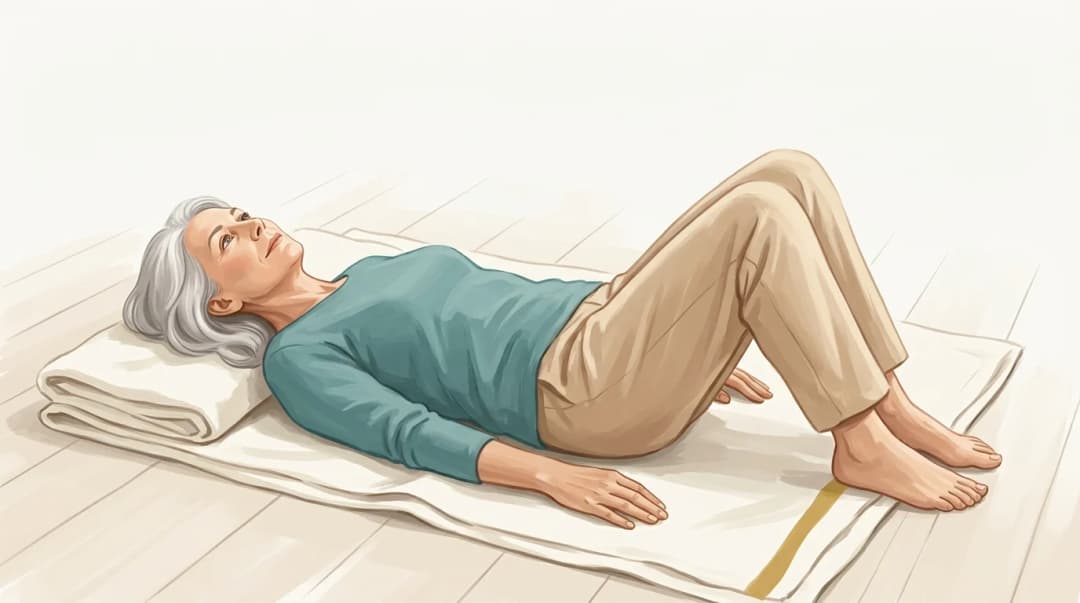
Settling into bed. Please lie on your back in bed, with a pillow under your head and, if you like, one under your knees. Arrange the covers so nothing about your position asks anything of you.
- 2
The weight of your head. Notice the weight of your head sinking into the pillow, and where your back, pelvis, and heels meet the mattress. Which parts rest most willingly?
- 3
Small turns of the head. Let your head roll a small way to one side and back, then to the other, far less than it could go. Keep your eyes soft, maybe closed, and let the pillow carry the weight the whole time.
- 4
A pause to rest. Leave your head wherever it settles and rest for a few breaths. Does the pillow feel any different under you now?
- 5
A heavy jaw, a resting tongue. Allow your jaw to be heavy, with the teeth slightly apart, and let your tongue lie soft in your mouth. Notice what your throat does when nothing there is working.
- 6
The ribs moving on their own. Without changing your breath in any way, notice where your ribs move as the air comes and goes. Front, sides, back: simply observe, there is nothing to improve.
- 7
What feels quieter now. Take a slow tour from your head to your heels, comparing this moment with when you began. What, if anything, feels heavier, softer, or quieter than at the start?
Let Feldy guide you, eyes closed
You just read these steps. In the Feldy program, a calm voice guides you through each gentle move, so your attention can stay in your body instead of on the screen.
Try Feldy Free for 7 daysNo credit card needed.
Vagus nerve exercises for sleep have become a popular search, so it is worth being straight with you from the first line: the phrase is an internet label, not a clinical category, and no one can promise that a particular movement switches on a particular nerve. What the label usually points to is real, though: slow breathing and gentle, attentive movement done to help the body settle, and the vagus nerve genuinely is part of how the body manages its resting state. The Feldenkrais Method® offers a kind way into that territory: instead of trying to force calm, you give your attention to small, easy movements and let quietness arrive on its own schedule. The short lesson above is built for exactly that, done lying in bed, with nothing to get up for afterward.
Why vagus nerve exercises for sleep are really about settling
Sleep rarely cooperates with effort. Lying in bed trying hard to relax is its own kind of work, and a body that is still braced, a tight jaw, held shoulders, eyes still busy behind the lids, tends to stay closer to waking. That is a common companion: under strict diagnostic criteria, chronic insomnia disorder affects between 6% and 10% of adults (StatPearls, NCBI, 2024), and many more people have stretches of restless nights without meeting any formal definition.
Being straight matters here. Gentle movement does not treat insomnia, and what is happening at the level of a single nerve is not something you can feel or measure at home. What you can observe directly is the part that counts: whether your head feels heavier on the pillow, whether your jaw has stopped working, whether the mattress seems to be carrying more of you. Many people find that slow, attentive movement and an unhurried exhale tend to bring exactly that kind of quieting, and it appears to be the attention, not the effort, that does the work.
What the small movements in this lesson are doing
Each step above trades effort for information. When your head rolls a small way from side to side with soft eyes, the neck gets to feel movement that asks nothing of it, and the pillow does the carrying. Letting the jaw and tongue be heavy is often surprising: many people discover the throat has been quietly busy all evening, and simply noticing that tends to let it soften. Watching the ribs move without changing the breath keeps you in the observer's seat, which is a much sleepier place to sit than the manager's.
None of it should feel like exercise in the usual sense. If any part is uncomfortable, shrink it, take it slower, or just picture the movement in your mind, because imagining still gives you something real to sense. The rests are part of the lesson, and falling asleep before the final step counts as a perfectly good ending.
Keeping vagus nerve exercises for sleep gentle and realistic
A few habits keep this practice kind. Keep every movement smaller than you think it should be, and let slowness, not range, be the interesting part. Skip anything that feels effortful or stimulating close to bedtime, and drop any step that asks you to concentrate hard; a wandering mind that keeps returning to the pillow is doing fine. If your neck objects to even small turns, stay with the noticing steps alone.
All of this sits alongside whatever your doctor advises for your sleep, never in place of it. Gentle movement is not a treatment for a sleep disorder. If sleep trouble has lasted more than a few weeks, if you snore loudly with pauses in your breathing, or if daytime sleepiness is affecting your driving, those belong in a medical conversation. For more on how bodily tension and rest get tangled together, our Feldypedia note on sleep disruption and physical tension looks at the picture in more depth, and a related piece on chronic shallow breathing may interest you if your breath tends to sit high in the chest.
More gentle movement in the same spirit
Once these movements start to feel like old friends, you might let the same quality spill into more of your evening. Our somatic exercises for sleep explore settling the whole body before bed, and these bedtime stretches in bed offer a slightly longer wind down in the same unhurried key. Feldy's guided lessons carry that thread through every night: small, slow, and easy, letting attention do what effort cannot. A free 7 day trial is the simplest way to feel how one of those evenings goes.
Find where to start
Restless nights have different flavors, and the lesson that suits you best may not be the one that suits someone else. If picking a starting point feels like one decision too many at this hour, a short quiz can make the choice simpler.
Want a place to begin? Take the Movement Match quiz, four short questions in about two minutes, for the movement method that suits you.
Landing on any lesson at all is enough, and an evening that ends a little quieter is already a good evening.
Common Questions about vagus nerve exercises for sleep (FAQ)
What are the best vagus nerve exercises for sleep?
There is no proven ranking, because the phrase is an internet label rather than a clinical category. What many people find helpful at bedtime is slow, attentive movement with an unhurried exhale: small head turns, a heavy jaw, quiet noticing of the ribs, as in the lesson above. The best choice is whatever feels genuinely easy enough that you can stay with it without effort.
Do these exercises really stimulate the vagus nerve?
That claim goes further than the evidence allows. The vagus nerve is genuinely part of how the body rests and digests, but what happens at the level of a single nerve during gentle movement is not something you can feel or measure at home. What you can observe is whether you feel calmer and heavier afterward, and that is the useful test.
What should I avoid when trying vagus nerve exercises for sleep?
Avoid anything effortful, forceful, or stimulating close to bedtime: vigorous stretching, cold plunges, or long breath holds that leave you strained. Also be wary of any routine that promises to cure insomnia, because chasing sleep hard tends to push it further away. If a movement feels unpleasant, make it smaller or simply imagine it.
Is this practice safe for everyone?
The movements are small and stay well inside comfort, so most people can do them. If you have a neck condition, recent injury, or dizziness with head movement, keep the turns tiny or leave them out and stay with the noticing steps. Anything that hurts is a signal to make it smaller, not to push through.
How often should I practice, and how long until I notice a difference?
A few quiet minutes in bed on most nights suits this practice better than occasional long sessions. Many people feel calmer the very first evening, while any change in how easily sleep comes tends to build gradually over weeks. Persistent insomnia does not disappear because of a bedtime routine, so let feeling settled be the aim rather than a guaranteed night of sleep.
How is this different from stretching or yoga before bed?
Stretching and yoga work with tissue length, strength, and posture, and both can have real value in an evening routine. This lesson does a different job: it uses very small movement and attention to let the body feel where it is resting, with no effort to hold or lengthen anything. The two approaches sit comfortably side by side, so there is no need to choose.
When should I see a doctor about my sleep?
If sleep trouble has lasted more than a few weeks, if you snore loudly with pauses in your breathing, or if daytime sleepiness affects your driving or concentration, please talk with a doctor. These can be signs of a treatable sleep disorder, and gentle movement sits alongside that care, never in place of it.
A calmer body, easier nights
See the programRelated resources
Before Bedtime Stretches: A Gentle Floor Wind Down
A short floor wind down of slow, gentle movement for the half hour before bed. Nothing to achieve, nothing to hold, just a quieter body to carry to sleep.
Box breathing for sleep: a gentler bedtime version
A calm bedtime lesson in box breathing for sleep: even in and out breaths, small optional pauses, and full permission to rest instead of chasing sleep.
Lying down is not the same as resting, and researchers have now measured the difference
Ready to start moving better?
Gentle, guided lessons for your body. Try your first one free, no credit card required.