
Why Is It Hard to Feel My Pelvis Tilting Forward?
In a lesson you are asked to tilt your pelvis forward and cannot tell if anything moved. That is common. Here is why, and a gentle way to sense it.
In short
Why is it hard to feel your pelvis tilting forward? The movement is small, it blends with your lower back, and long held habits make familiar positions feel neutral. This is common, and sensing it grows with slow, small, curious movement.

Prefer to ease in gently?
See a few gentle exercises for body awareness to try.
Before you begin. This page is about everyday sensing, not a medical assessment. Move gently and within comfort, and stop if anything hurts. Pain that travels down a leg, numbness or tingling, or back pain that is new or getting worse deserves a conversation with a doctor or physical therapist.
Why is it hard to feel your pelvis tilting forward? Almost always because the movement is small, it is tangled up with your lower back, and the sense of that area has had little practice. If a lesson asks you to tilt your pelvis and you cannot tell whether anything is moving, you are in very good company.
This page takes a Feldenkrais® view: it is about sensing, not posture. There is nothing to get right here. The aim is simply to feel more of what is already happening.
Why it is hard to feel your pelvis tilting forward
The movement is tiny. A tilt of the pelvis can be a few degrees. It is much smaller than bending an elbow or lifting a hand. A small change gives a small signal, and a small signal is easy to miss.
Your pelvis and lower back move together. When the pelvis tilts forward, the lower back usually arches a little at the same time. So the feeling often arrives as "my back is arching" rather than "my pelvis is tilting". Both descriptions are true. They are the same movement felt from two sides.
Long habits feel like neutral. We sense change more than we sense stillness. If you have sat, stood or walked in much the same way for years, that familiar position feels like "straight", even when it is only "usual". A new position then feels odd, and a small one can feel like nothing at all.
Effort and speed drown out sensation. When we try hard, we tighten. Tight muscles produce strong sensations that make the quiet ones harder to notice. Moving fast does the same. The softer and slower the movement, the more of it you can feel.
This area is rarely asked to be felt. Most of us have a clear picture of our hands and almost none of our pelvis. Nothing in daily life asks us to notice it. This is the same reason some people feel clumsy in places they never attend to, which our explainer on awareness of body position looks at more closely.
None of this is a sign that something is off. Many people meet the pelvic tilt because of back discomfort, which is very common: low back pain affected about 619 million people worldwide in 2020 (WHO, 2023). Sensing the pelvis is one gentle way some people get to know that area. It is not a treatment for any condition.
A small experiment to sense your pelvis tilting forward
Take your time with this. Go only as far as is comfortable, and stop if anything hurts.
Settle onto the floor, face up. Bend your knees, set your feet down, and let your arms rest. First, just notice. Where does the floor press against you? You may feel your tailbone, the back of your pelvis, your ribs and your head. Is there a gap between the floor and the small of your back? Do not change anything yet.
Now tilt your pelvis a very little, so your tailbone presses slightly more into the floor and your waist lifts a touch away from it. Make the movement as small as you can imagine. Then rest. Notice what changed. Did the pressure under the tailbone grow? Did the gap under your waist get bigger?
Do it again, slower and smaller. Let your breath carry on as usual. Rest between tries. Many people find that the smaller and slower they go, the clearer it gets. You are not trying to make a bigger tilt. You are making a clearer one.
If you want a second source of information, rest your fingertips on the front hip bones, the bony points at the front of your pelvis. As you tilt, notice whether they roll a little toward your feet, or toward your face. Your hands can often feel a movement your back cannot.
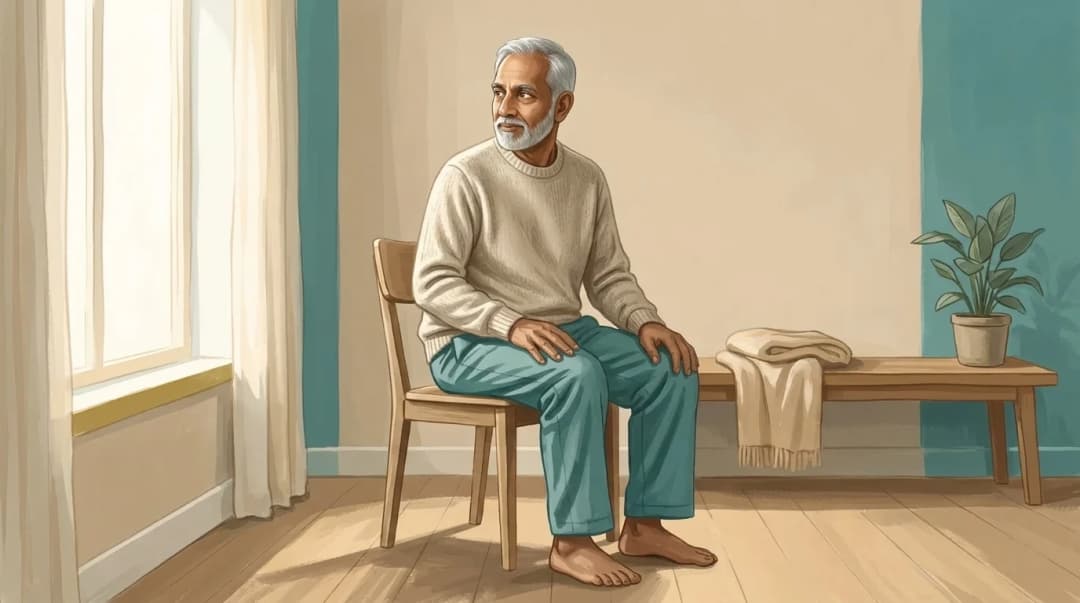
When you have rested, try the same idea sitting on a firm chair. Place your feet on the floor and feel your two sit bones on the seat. Let your weight roll slightly forward onto the front of the sit bones, then slightly back, a few times, very small. Which way does your chest go along? Where does your lower back come in? You may feel it more clearly here, because the chair gives your sit bones something firm to report against.
Our pelvic clock lesson takes this further by exploring the pelvis in many directions, and the supine pelvic tilt gives a slower, fuller version of the lying down movement. If you are new to this kind of attention, our somatic exercises for beginners are a friendly first door.
What helps sensing grow
Attention is the main ingredient, and it grows with repetition. A few minutes now and then works better than one long effort. A few things help:
- Move less than you think you need to.
- Go slowly enough that you could count each part of the movement.
- Rest often, and notice what the rest feels like too.
- Compare one side or one moment with another, rather than judging.
This is how the Feldenkrais Method approaches movement. It does not tell you what shape to make. It invites you to notice, and the clearer picture then gives you more choice. Our Feldypedia entry on the Feldenkrais Method explains why using less effort makes small differences easier to sense. You can also try this kind of attention in Feldy, where each lesson is voice guided.
Clinical care sits alongside this and does not get replaced by it. If you have pain, a physical therapist can assess it and guide you. Gentle sensing is a separate thing: it is about getting to know your own movement, not about treating a problem.
Find where to start
If sensing the pelvis still feels like a blank, that is a fine place to begin, and you do not need to sort out the next step alone. The Feldy body awareness program offers short, guided lessons that build this kind of feeling gradually.
Wondering which kind of movement suits you? Try the Movement Match quiz to see which movement method might fit the way you like to learn, in about a minute.
Learn to listen to your body
Now for the practice that trains it. The Feldy program sharpens your attention through slow, attentive Feldenkrais® lessons, so everyday movement feels lighter and more your own. Gentle, guided, and self-paced.
Start my free 7-day trialNo credit card needed.
Common Questions about feeling your pelvis tilt forward (FAQ)
Is it normal that I cannot feel my pelvis move?
Yes, very. The pelvis sits in the middle of the body, far from the hands and feet that give us most of our clear sensing. Many people feel nothing at first, or only a vague change in the lower back. That says nothing about your body being off. It simply means this area has had little attention so far.
Is it safe to practise tilting my pelvis?
For most people a small, slow tilt lying on the back is gentle. Keep it within comfort and stop if you feel pain, especially pain that travels into a leg, or any numbness or tingling. If you have a recent injury, a diagnosed back condition or a recent surgery, check with your clinician before you explore.
How often should I practise sensing it?
A few minutes, once or twice a day, is plenty. Short and regular beats long and rare, because sensing grows through repeated, relaxed attention. There is no need to push. Two quiet minutes with curiosity teach more than ten minutes of effort.
How long until I can feel my pelvis tilt?
Some people notice a difference within a single sitting, simply because attention brightens whatever it rests on. For others it takes a couple of weeks of short, easy sessions. Both are ordinary. Let the pace be set by comfort and interest, not by a deadline.
How is this different from a pelvic tilt exercise for strength?
A strengthening version asks a muscle group to work harder and counts repetitions. This page is about feeling: movement so small and slow that you can notice where the floor presses and how the weight shifts. The aims differ, and each has its place.
Is there a point where I should get this looked at?
Book a visit with a doctor or physical therapist if tilting brings pain, if you notice numbness, tingling or weakness in a leg, or if back pain is new, severe or getting worse. Difficulty sensing the movement on its own is not a reason for worry, but sharp or lasting symptoms deserve a proper assessment.
Learn to listen to your body
See the programRelated resources
Supine Pelvic Tilt: A Gentle Lying Down Lesson for Your Back
Lie on your back, knees bent, and let your pelvis rock a little. Your lower back rolls toward the floor and away again, slowly and with ease.
Body Awareness Exercises: A 5 Minute Feldenkrais® Lesson
A short lying or seated lesson that uses small movements to sense where you meet the floor or chair, one side compared with the other.
Shoulders turned further after a slow, varied lesson than after repeating one twist
Ready to start moving better?
Gentle, guided lessons for your body. Try your first one free, no credit card required.