
Top of Wrist Pain: Common Reasons and What Eases It
Why the back of the wrist aches after push ups, yoga or a long day at the keyboard, what tends to ease it, and how the shoulder and elbow quietly feed the load.
In short
Top of wrist pain usually comes from load on the back of the wrist: pushing up from the floor on a bent back hand, or hours of typing and gripping that tire the tendons there. A fluid filled lump, a sprain or arthritis explain most of the rest.

Prefer to ease in gently?
See a few gentle exercises for body awareness to try.
Before you begin. This page is general information about pain on the back of the wrist, not a diagnosis. See a doctor the same day if you fell onto the hand and the wrist hurts on the thumb side, since that can be a scaphoid fracture. Also see a doctor for numbness or tingling, a hot and swollen joint, a lump that grows or hurts, or a wrist you cannot put weight on.
Top of wrist pain is the ache or pinch you feel on the back of the wrist, the side with the knuckles. It usually has an ordinary cause. The back of the wrist carries your body weight when you push up from the floor with the hand bent back. It also carries the tendons that lift your fingers, and those tendons get tired after hours of typing and gripping. A soft lump, a sprain or arthritis explain most of the rest. This page goes through the usual reasons for pain on top of the wrist, what tends to ease it, how the whole arm feeds into it, and the signs that need a doctor.
What sits on the top of the wrist
Turn your hand palm down and look at the back of the wrist. Under the skin there is a band of tissue, a little like a watch strap. Beneath that band, the tendons from the back of the forearm pass through to the hand. They are the cords that lift the fingers and tip the hand backwards. Deeper still sit eight small bones in two rows, held together by short ligaments. One of those bones, the scaphoid, lies on the thumb side, just below where the thumb tendons stand out. All of this is packed into a small space. That is why so many different things can hurt in the same place.
Common reasons for top of wrist pain
Body weight on a bent back wrist. Push ups, planks, yoga poses on the hands and getting up from the floor all ask the wrist to bend back fully. Then they load it with your weight. The small bones and the soft tissue at the back of the joint get pressed together. Many people feel a sharp pinch at the centre of the back of the wrist, right at the top of the movement. It fades when the weight comes off. Doctors sometimes call this dorsal wrist impingement. Dorsal just means the back.
Tired tendons from typing, mouse work and gripping. The muscles that lift the fingers live on the back of the forearm. They are busy all day at a keyboard. They work even harder when the wrist rests bent back on a mouse. A firm grip calls on them too, because the wrist has to be held steady for the fingers to squeeze. Hours of that leaves the tendons on the back of the wrist sore and sometimes puffy. A few centimetres up the forearm, two groups of these tendons cross each other. Rowing, racquet sports and shovelling can irritate that crossing. It feels like a rubbing or creaking ache just above the wrist, on the thumb side of the back.
A ganglion cyst. A ganglion is a smooth, round lump filled with a jelly like fluid. The back of the wrist is the most common place for one to appear. It can be as small as a pea or a few centimetres across. Most are painless, though some ache after you use the hand. The NHS notes that these cysts usually settle without any treatment, and that this can take anywhere from several months to a year (NHS, 2025). Treatment is offered when a cyst hurts or gets in the way of movement.
A sprain. A sprain is a stretched or torn ligament. At the wrist, that usually means one of the short ligaments between the small bones. A fall onto the hand or a sudden twist is the usual story. The back of the wrist swells, may bruise, and hurts when you bend it either way. Mild sprains often settle over a few weeks. Any fall that leaves pain on the thumb side needs a check, for a reason I explain below.
Arthritis. Osteoarthritis is wear in the smooth surface of a joint. In the wrist it often follows an old fracture, or a sprain that did not fully heal. It aches with use and settles with rest. Rheumatoid arthritis is different. It is an immune condition, and it often picks the wrist. The joint feels warm and swollen, and the stiffness in the morning can last well over half an hour. Both kinds deserve a doctor's assessment, because the care for each is different.
What eases pain on top of the wrist
Give the bent back position a rest for a while. For push ups and floor work, make a fist and rest on the knuckles, or hold a pair of dumbbells so the wrist stays straight. In yoga, place the heels of the hands on a folded blanket or a wedge so the wrist bends less. Or come down onto the forearms. These are changes in how you load the wrist, not a stop to moving.
At a desk, let the forearm rest on the surface instead of holding it in the air. Lower the keyboard if the hands sit higher than the elbows. Loosen the grip on the mouse until it is barely held. Break long sessions into shorter ones. Warmth helps a tired wrist, and a short cool pack helps one that is puffy after activity.
Slow, easy movement in directions the day does not offer is useful as well. Our wrist stretches lesson treats stretching as exploration rather than positions to hold. If bending back is the part that feels stuck, our guide to wrist extension explains how much range daily life really asks for. A clinician may suggest a splint for a short spell. That is their call, and not something to decide alone.
How the whole arm feeds pain into the wrist
Here is what I see most often in my teaching. The wrist is the last joint in a long chain. It can only do what the shoulder and elbow leave it to do. When someone pushes up from the floor, I watch where the effort comes from. Often the shoulder is lifted toward the ear, the elbow is locked, and the whole body weight lands in a small patch at the back of the wrist. The wrist did not choose that. It simply got what was left.
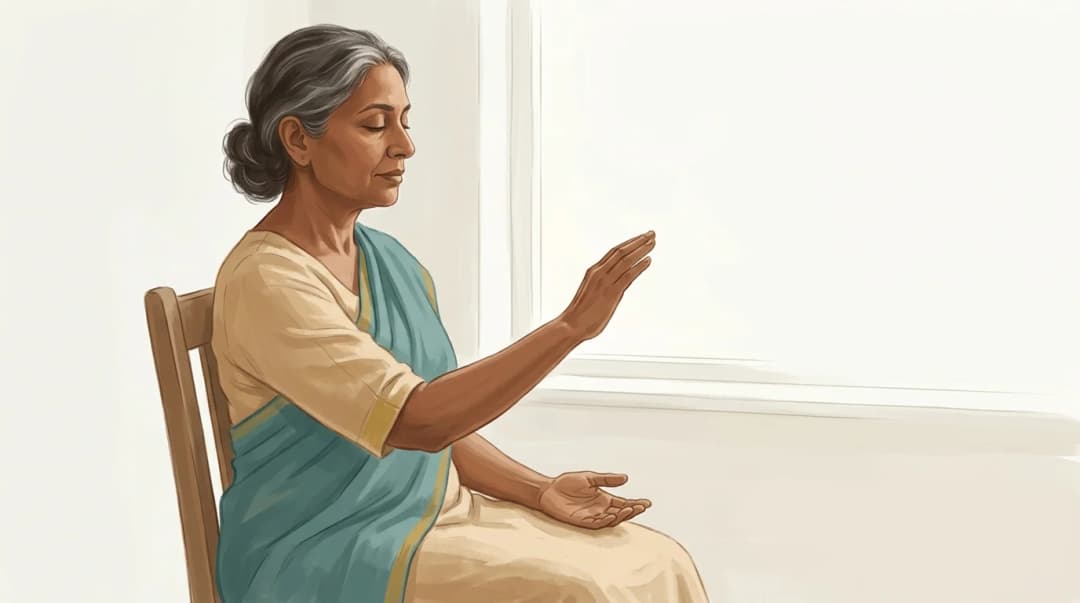
The Feldenkrais Method® is a way of learning to feel that chain. An Awareness Through Movement® lesson for the hands often begins lying down, with one hand opening and closing at a snail's pace. Then the elbow joins in. Then the shoulder blade slides on the ribs. Nothing is pushed. Over a few minutes, many people notice that the hand can rest on a surface with far less effort than before. Pressing into the floor starts to come from the whole arm and the chest, not from a bent wrist. The same learning carries over to the keyboard. A hand that types from a quiet shoulder asks less of the tendons on the back of the wrist.
Feldenkrais® lessons are movement education. They do not treat a cyst, a sprain or arthritis. What they may change is the load the wrist carries through an ordinary day. Our Feldypedia entry on repetitive strain from keyboard use explains how desk habits build up over years. The Feldy body awareness page describes how our short audio lessons are put together. If lying down and sensing is new to you, the somatic exercises for beginners lesson is the gentlest place to start. Feldy gives you a free 7 day trial to try a lesson, with no card asked for. Our explainer on the cause for wrist pain covers the whole wrist, not only the back of it.
Getting up from the floor with less on the wrist
Getting off the floor is the movement that catches many people with pain on top of the wrist. Here is a kinder way. Roll onto your side first. Let the lower forearm, not the hand, take the first push. Then bring the top hand down, make a soft fist, and press through the knuckles. Bring one foot under you and let the leg do the lifting. Done slowly, this spreads the work across the arm and the legs. The wrist gets a small share instead of all of it.
Alongside clinical care, and other methods
Nothing on this page replaces a doctor, a hand therapist or a physiotherapist. If one of them has given you a splint, a set of exercises or an injection, keep to that plan. A Feldenkrais® lesson sits alongside that care. It asks a different question, which is how the whole arm shares the work.
Other movement methods go their own way. Yoga and Pilates both place weight on the hands at times, so tell the teacher about the wrist and ask for fists or forearms instead. Tai Chi keeps the hands soft and the wrists mostly free of load. The Alexander Technique pays attention to how you carry the head and neck through ordinary tasks. Each has its own mechanism, and none ranks above the others.
When top of wrist pain needs a doctor
Please see a doctor the same day if you have fallen onto your hand and the wrist hurts on the thumb side, below the base of the thumb. The scaphoid bone sits there. A crack in it does not always show on the first x ray, so a repeat x ray or a scan is sometimes needed. Left alone, a scaphoid fracture can heal poorly.
Book a GP visit if the hand goes numb or tingles, if the wrist is hot, red and swollen, or if you cannot bear any weight on it. Get a lump checked if it grows, hurts, changes colour or feels hard. See a GP too if the pain has not eased after a few weeks of sensible care, or if it keeps you awake at night.
Find where to start
Several gentle methods exist, and they suit different people in different ways. Spending a minute to find yours beats another week of guessing.
Want a gentle place to begin with your hands and wrists? Take the 60-second Movement Match quiz: pick your answers and get one method, explained in plain words.
Learn to listen to your body
Now for the practice that trains it. The Feldy program sharpens your attention through slow, attentive Feldenkrais® lessons, so everyday movement feels lighter and more your own. Gentle, guided, and self-paced.
Start my free 7-day trialNo credit card needed.
Common Questions about top of wrist pain (FAQ)
What is the best way to do push ups with pain on top of the wrist?
Take the bend out of the wrist. Rest on your knuckles with a soft fist, or hold a pair of dumbbells as handles so the wrist stays straight. Push up against a wall or a worktop while the wrist settles, since a higher surface means less weight on the hands. Let the shoulder blades and chest do the pushing rather than the hands alone. If a push up still pinches at the back of the wrist, leave it for now and come back later.
Is gentle movement safe with top of wrist pain, and who should hold off?
Slow movement that stays small and comfortable is fine for most people with an ordinary ache on the back of the wrist. Hold off and see a doctor first if the pain began with a fall, if the wrist is hot, red and swollen, if the hand is numb or weak, or if a lump is growing. Anyone with a known fracture or recent wrist surgery should follow their clinician's plan.
How often should I practise noticing how the whole arm shares the work?
Little and often. A short lesson two or three times a week is plenty, with a few seconds of noticing at the desk each day. Check where the forearm rests, how hard the mouse is held, and whether the shoulder has crept up. If a session leaves the wrist more sore the next morning, do less next time and go slower.
How long does pain on top of the wrist take to settle?
It depends on the cause. A tired tendon from a heavy week at the keyboard often settles within a couple of weeks once the load changes. A mild sprain can take a few weeks. A ganglion cyst may take months to a year to shrink on its own. Arthritis comes and goes over the longer term. If a few weeks of sensible care have made no difference, book a GP visit.
How is this different from wrist stretches or a wrist brace?
A brace holds the wrist still so the tissue gets a rest. A stretch takes the wrist to the end of its range and holds it there. Both act on the wrist itself. A Feldenkrais lesson looks further up the arm. It asks how the shoulder, elbow and chest take part in pushing and gripping, so the wrist is given less to carry. You can wear a brace your clinician suggested and still do a lesson in the same week.
What should I avoid while the top of my wrist hurts?
Avoid loading a fully bent back wrist with your body weight, so no full push ups, planks or floor poses on flat hands for now. Avoid long spells with the wrist propped bent back on a mouse. Avoid a tight grip on anything you can hold more lightly. Avoid pressing or massaging a lump to make it go away. And avoid stretching into pain, because forcing the back of the wrist tends to stir it up.
When does top of wrist pain need a doctor?
The same day if you fell onto the hand and the pain sits on the thumb side of the wrist, since that may be a scaphoid fracture. Promptly if the joint is hot, red and swollen, if the hand is numb or tingling, or if you cannot put any weight on it. Get any lump checked if it grows, hurts or changes. Otherwise, see a GP when a few weeks of home care have not helped.
Is a lump on top of my wrist a ganglion cyst?
A smooth, round lump on the back of the wrist is often a ganglion cyst, which is a sac of jelly like fluid next to a joint or tendon. Only a clinician can tell you for certain, usually by feeling it and sometimes by shining a light through it. Most are harmless and many shrink on their own, but one that grows, hurts or looks different from the usual soft lump should be checked.
Learn to listen to your body
See the programRelated resources
Somatic Exercises for Beginners: A Simple First Lesson
New to somatic exercises for beginners? This gentle guide explains how slow, mindful movement works, with an easy first lesson you can do at home today.
Wrist Stretches That Invite the Whole Arm: A Gentle Lesson
A short guided lesson of wrist stretches done as exploration: small circles, easy forearm rolls, and a shoulder that joins in, instead of positions you hold.
Your balance got better, but did your sense of where your body is get better too
Ready to start moving better?
Gentle, guided lessons for your body. Try your first one free, no credit card required.