
Wrist Extension: What It Is and Why It Feels Limited
A plain guide to bending the hand back at the wrist: the range people usually have, what daily life actually asks for, and a kinder way to explore it.
In short
Wrist extension is the movement of tipping the back of your hand toward your forearm, the shape your wrist takes when you press up from a chair. Healthy range is commonly described as around 70 to 80 degrees, and most everyday tasks ask for meaningfully less.

Prefer to ease in gently?
See a few gentle exercises for body awareness to try.
Before you begin. Persistent numbness, tingling, pins and needles, waking at night with a dead feeling in the hand, or new weakness when gripping things deserve a clinician's assessment rather than more movement on its own.
Wrist extension is the name for bending the hand backward at the wrist, so the back of the hand travels toward the top of the forearm. It is the shape your wrist takes when you push up from the floor, press open a heavy door, or plant a palm on the kitchen counter to reach a high shelf. Because so much of modern life happens with the hands curled forward over keyboards and phones, this backward direction is often the first one to feel tight, and the least familiar. This guide explains what the movement is, roughly how much of it people have, why it can start to feel limited or achy, and a gentler way to invite it back.
What wrist extension actually is
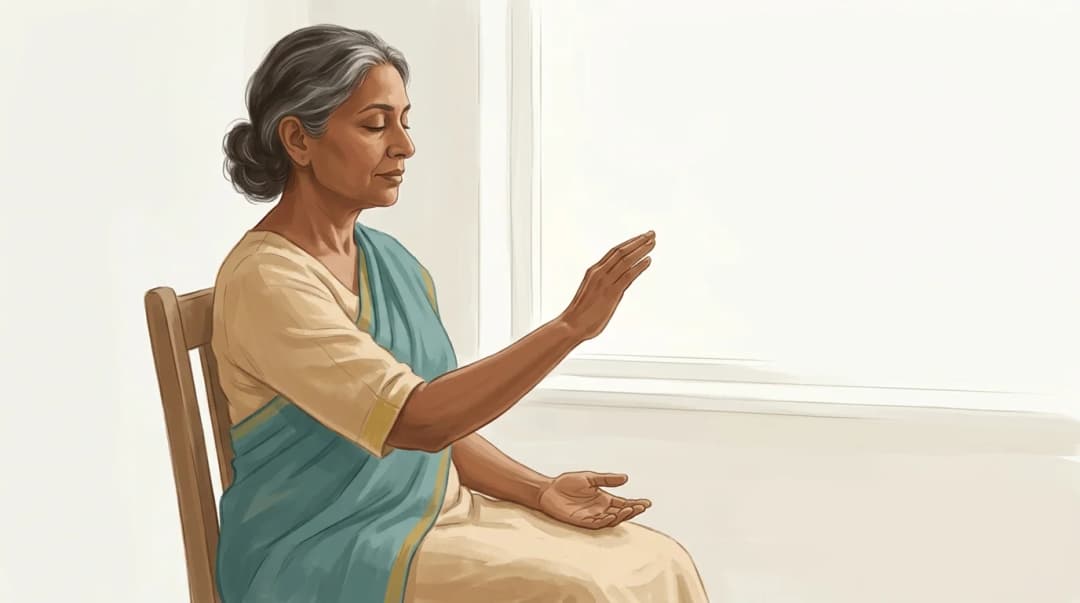
Hold your forearm still and tip your palm away from you, as if signalling someone to stop. That is extension. The opposite direction, curling the palm toward the forearm, is flexion. Between the forearm bones and the hand sit eight small carpal bones that glide and tilt against each other, which is part of why the wrist can feel so intricate: it is less a single hinge than a small committee.
Full extension is commonly described as somewhere around 70 to 80 degrees in healthy adults, though the figure varies a lot between people, and between your own two wrists. Age, anatomy, old injuries and habit all shape it. More interesting than the number is how little of it daily life actually requires. Typing uses a slight backward tilt. Pouring the kettle, buttoning a shirt, turning a doorknob: all of these live in the easy middle of the range. Only a handful of activities, like push ups, yoga poses on the hands, or catching yourself on an outstretched palm, ask for something near the full arc.
Why wrist extension gets limited or achy
For most people the story is habit rather than damage. Hands that spend hours in one shape, hovering over a keyboard or wrapped around a phone, give the nervous system very little variety to work with, and range that goes unvisited quietly becomes unfamiliar. There is more on this pattern in our Feldypedia note on repetitive strain from keyboard use. A wrist can also learn to guard itself after a sprain or a fall, staying tense long after the tissue has settled, and arthritis in the hand or wrist can make the end of the range genuinely tender, so the middle gets avoided too.
It helps to know how rarely an aching wrist is a named condition. Carpal tunnel syndrome, the diagnosis people most often worry about, is estimated to occur in roughly 1% to 5% of the general population (StatPearls, 2023). That is real and worth respecting, but it also means the great majority of tired, complaining wrists are simply overworked and undervaried, not a syndrome. To be clear, movement exploration is not a treatment for carpal tunnel syndrome; if the symptoms in the disclaimer below sound familiar, that is a conversation for a clinician.
A whole arm way to explore wrist extension
Here is the perspective the Feldenkrais Method® brings, and it is genuinely different from working the joint on its own. The wrist never acts alone. Every time your palm meets a surface, the forearm rotates, the elbow adjusts, the shoulder turns, and the shoulder blade slides on the ribs. When any link in that chain is held stiffly, the wrist inherits the leftover work, and a wrist that always arrives at a surface the same way will always meet its limit in the same place.
So instead of cranking the hand back further, you might rest your palm lightly on a table and explore how the movement changes when the elbow drifts a little in or out, when the shoulder rolls softly forward or back, when the whole arm rather than the hand alone creates the angle. Done slowly and inside comfort, this kind of attention gives the nervous system new options, and range often reappears without ever being forced. The wrist stops bracing because the rest of the arm has started participating. Our guide on how to relieve wrist pain takes this thinking further, and the short sequence on our wrist stretches page carries the same unhurried attitude into practice.
This is not a criticism of stretching, which builds tissue length by spending time near the end of range and does that job well. It is simply a different lever: one works on the tissue, the other on the coordination that decides how the tissue gets used.
Exploring kindly, without a program of drills
You do not need a regimen. What the wrist responds to is variety in small doses: a minute of slow, easy movement when you surface from a stretch of typing, a moment of noticing how your palm meets the counter, an occasional visit to the backward direction at half the effort you would normally use. Let comfort set the boundary every time. If a movement provokes sharpness, make it smaller or leave it for today; the useful learning all happens well inside the easy range.
If you would like company in this way of moving, our somatic exercises for beginners page is a friendly first door into the approach, and Feldy's 7 day free trial lets you hear how voice guided Feldenkrais lessons feel in your own body, wrists and all. You can also browse the wider body awareness path to see where this kind of attention can go.
One more word on care. If your wrist has been complaining for weeks, or the ache began with a fall or a sudden wrench, let a doctor or hand therapist tell you what is actually going on before you experiment further. Their assessment and this kind of gentle exploring answer different questions, and they combine easily.
Learn to listen to your body
Now for the practice that trains it. The Feldy program sharpens your attention through slow, attentive Feldenkrais® lessons, so everyday movement feels lighter and more your own. Gentle, guided, and self-paced.
Start my free 7-day trialNo credit card needed.
Common Questions about wrist extension (FAQ)
Is it safe to explore wrist extension if my wrist already aches?
Usually yes, provided you stay well inside comfort and treat any twinge as useful information rather than something to push through. Skip loaded positions like full push ups for now, keep the movements small and slow, and pause the exploration if a recent injury, a fracture that is still healing, or sharp pain is part of the picture until a clinician has taken a look.
How often should I spend time on wrist extension?
Small doses woven through the day tend to be more useful than one long block. A minute or two of easy, curious movement whenever you notice your hands have been in one shape for a while, perhaps three or four times a day, is plenty. Frequency and lightness matter more than duration or effort.
How long until my wrist extension feels easier?
Many people notice their wrists feel less guarded within a couple of weeks of brief, regular attention, though this varies a lot from person to person. Range that has been narrowing for years takes longer to invite back, and progress usually shows up first as less complaint during daily tasks rather than as a bigger number of degrees.
How is this different from wrist stretches or wearing a brace?
Stretching lengthens tissue by holding the wrist near its end of range, a valid approach with a long history. A brace rests the joint by limiting movement, which a clinician may recommend after injury. The exploration described here works a third way: it uses slow, easy movement of the whole arm to change how the nervous system organises the wrist, so the joint stops bracing against its own range.
How many degrees of wrist extension do I actually need?
Full range is commonly described as around 70 to 80 degrees, but most daily activities use far less. Typing hovers around a gentle backward tilt, turning a key or opening a jar needs a modest amount, and only floor work like push ups or yoga poses on the hands approaches the full arc. Comfort through the middle of the range matters more than the extremes.
When should I get an aching wrist looked at by a professional?
Book an appointment if the ache has hung around for more than a few weeks despite lighter use, if it followed a fall or a sudden wrench, or if numbness, tingling, night waking, or a weakening grip join the story. A doctor or hand therapist can tell you what is actually going on, and gentle awareness work slots in comfortably around whatever care they suggest.
Learn to listen to your body
See the programRelated resources
What Is the Cause of Wrist Pain? The Everyday Reasons
Most wrist pain has an ordinary cause: too much of the same small movement, a grip that never lets go, and a forearm doing a job the shoulder could share.
Wrist Stretches That Invite the Whole Arm: A Gentle Lesson
A short guided lesson of wrist stretches done as exploration: small circles, easy forearm rolls, and a shoulder that joins in, instead of positions you hold.
Your balance got better, but did your sense of where your body is get better too
Ready to start moving better?
Gentle, guided lessons for your body. Try your first one free, no credit card required.