
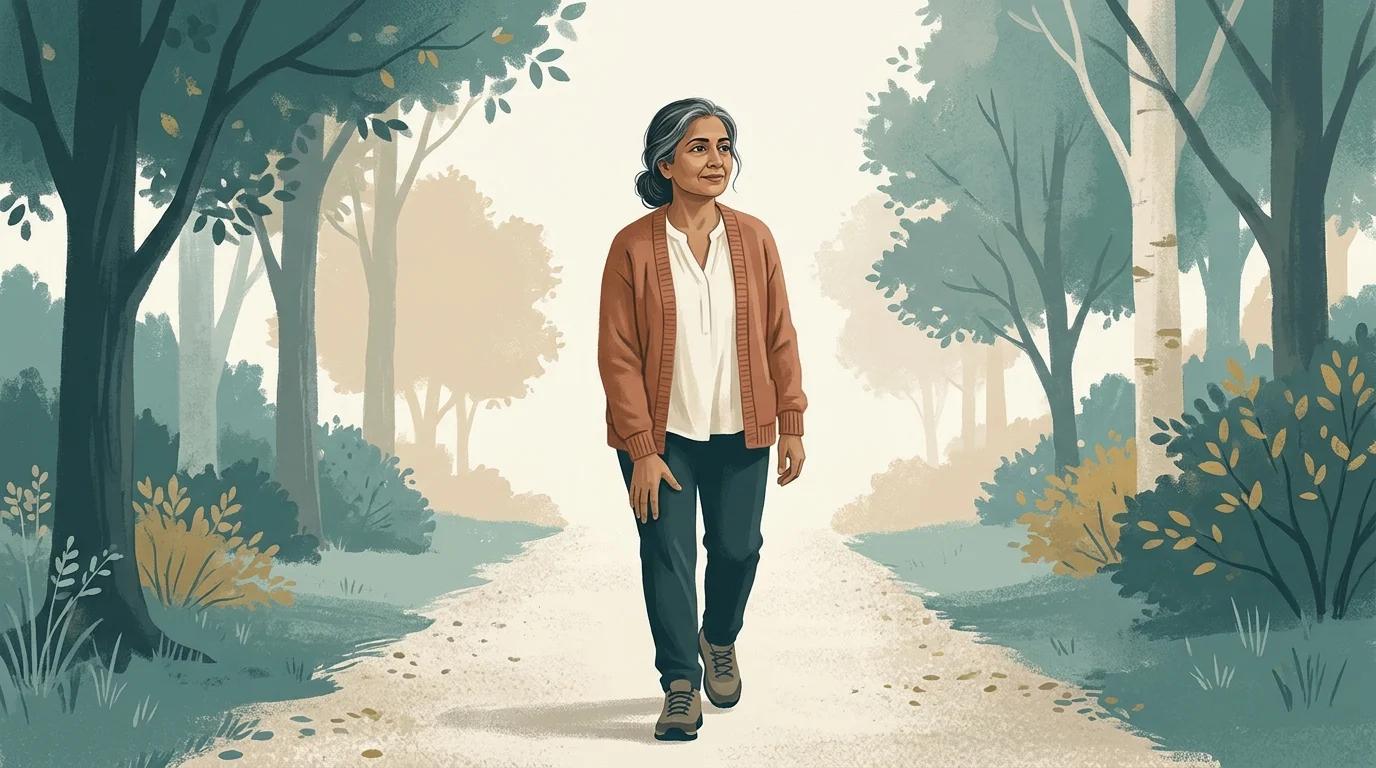
The adults with new arthritis who stayed independent four years later
The active ones were less likely to develop a disability. How much less varied between the surveys of people over 50.
When a doctor tells you the ache in your knee or your hands is arthritis, you may wonder whether to move less to protect the joint. So should you ease off, or keep moving? A new study of adults over 50 points one way: people who were active around that time were less likely to lose their independence later.
If the years before this went to work, to family or to caring for someone else, a diagnosis can feel like one more reason to put your own needs last. And so much exercise advice seems written for people who never had to stop and start again. You can begin from where you are today.
The study, published this month, followed more than ten thousand adults in long running aging surveys in the United States, Europe and Asia (Zhou and colleagues, Seminars in Arthritis and Rheumatism, 2026). Each person had just reported arthritis for the first time, and each was still managing daily life on their own.
Active at the start, more independent later
Compared with people who were not active when arthritis first appeared, fewer active people lost their independence. Over four years, depending on the survey, that came to between about 2 and 9 fewer people in every 100.
In all three main surveys the results pointed the same way, though more strongly in some than others. The findings were similar after the researchers took pain and an earlier stroke into account. Both can make people less active and more likely to have difficulties later.
For you, it means a new diagnosis doesn't have to be the moment you give things up. If you can still manage daily life on your own, the years ahead look like a good time to keep moving.
Kept up or taken up
The active group included people who took up activity around that time as well as those who kept it going, so this isn't only about people who always enjoyed sport. The study's short summary doesn't say whether the two did equally well.
The aim isn't to push yourself. It's to find a level of activity your joints accept, and build from there.
What the headline will miss
This was not a trial. Nobody was asked to exercise. These were people living their normal lives and answering survey questions, and the researchers analysed the answers with a method designed to mimic a trial. So it shows a link, not proof that being active protected anyone. People who stay active may differ in ways the surveys did not measure.
The strength of the link also differed between the surveys. In two of the three main surveys, the result on its own could have been chance. The combined result was clearer. Under a stricter check, though, it could also have been chance, and the authors say the numbers are not exact. The study's short summary doesn't explain what counted as active or as a disability. So from it we can't tell which kinds of movement, or how much, went with the better outcome, or how gentle it could be. And it did not test the Feldenkrais Method® or any awareness practice.
The habit underneath
After a diagnosis, many people start protecting a sore joint without noticing. A knee stays a little straighter on the stairs; a stiff hand stops reaching for the jar and lets the other one do it. Each change makes sense at the time, yet together they can quietly shrink what a body does in a day. In Feldenkrais® lessons a habit like this is a starting point for learning, not a fault. You explore how the whole body can share the work, through the joints and directions that still feel comfortable, so that the sore one takes part rather than being avoided and you only ever go where it feels easy, pleasant and comfortable. What I see again and again in my classes is that people move more once moving stops feeling like a risk.
Three questions for your next appointment
The authors suggest that low or falling activity around this time may be a reason to look more closely at how someone is managing. That makes the appointment where arthritis is named a useful moment to ask:
- "Which kinds of movement are fine for my joints now, and is there anything I should be careful with?" Knowing what you can do often makes staying active easier than being told to "exercise more".
- "If a joint aches after moving, how do I tell ordinary soreness from a sign to slow down?" Knowing this ahead of time can keep one sore evening from turning into weeks of sitting still.
- "Can we note how I'm managing everyday tasks today, so we can see if anything changes?" It gives you and your clinician something to compare with later. If you see a physiotherapist, gentle practice sits alongside what they give you.
If a joint suddenly becomes hot, red or very swollen, or you can't put weight on it, get it checked promptly rather than waiting for a routine visit.
In the meantime, one rule of thumb: keep one kind of movement you enjoy in your day, gentle enough that you'd happily do it again tomorrow.
Let Feldy guide you, eyes closed
A calm voice walks you through gentle moves so your attention stays in your body, not on the screen.
Try Feldy Free for 7 daysNo credit card needed.
Sources
- Maintaining or achieving physical activity around incident arthritis and subsequent disability: a multi-cohort target trial emulation— Seminars in Arthritis and Rheumatism, 2026
- PubMed record 43033617— PubMed, 2026
Movement Pulse is informational, not medical advice. See our editorial policy.
Move better with Feldy
See the programMovement Pulse Weekly
The week's best research, in your inbox Tuesday.
Movement science, gentle-practice ideas, and a practitioner's read on what's new. Free.
More from Movement Pulse
After 55, mood seemed to follow how much people moved, not how many hours they sat
1,190 adults in Western Australia, about 58 on average at the start, were checked three times over eleven years. As activity rose, signs of low mood tended to fall.
Oct 21, 2026
Wearables actually do nudge cardiac patients to move more
A 14-trial meta-analysis just out in JAHA found smartphone apps and wearable trackers added around 1,100 steps and 4 minutes of moderate activity per day. What that means for the rest of us.
Jun 19, 2026
What 70 older adults with memory concerns gained from a video program
Thinking scores rose, and about half the gain held six months later. Strength tests didn't pull ahead, and daily protein was included.
Nov 1, 2026Ready to start moving better?
Gentle, guided lessons for your body. Try your first one free, no credit card required.