
Older adults whose bladder leaks stopped were still likelier to fall
Mention leaks, past or present, when balance comes up. Across five ageing studies, they also went with daily tasks getting harder.
A little leak when you laugh, or a sudden rush to reach the bathroom in time. These things feel private, even embarrassing, and they rarely come up when someone asks how steady you feel on your feet. They probably should: for at least seventeen years, research on older adults has found leaks and falls turning up together, and the newest analysis found that people whose leaks had stopped were still more likely to report a fall than people who had no leaks at either check. This doesn't mean the leak causes the fall. It looks more like a signal, one worth saying out loud.
In that new analysis, which looked at five long running ageing studies from different countries in the same way, people who reported leaks at the start were more likely to report a fall later on, by about seven or eight people in every hundred (Xu and colleagues, International Urogynecology Journal, 2026). Men and women were both included.
Leaks in one drawer, falls in another
We tend to keep the two apart. Leaks go in the bladder drawer, or in the "that's just getting older" drawer, and many people only mention them to a doctor once they become hard to manage. Falls go to the drawer with legs, strength, eyesight and loose rugs.
The research keeps putting them in the same drawer. So if you have leaks, or had them, say so when balance or falls come up; and if you bring up leaks, ask whether your steadiness is worth a look too. Leaks are common, and there is no reason to feel ashamed or keep them to yourself. They may be one more clue about how steady you are on your feet.
Seventeen years of the same signal
In 2009 a team in Australia pooled earlier studies of older people living at home (Chiarelli and colleagues, Australian Journal of Physiotherapy, 2009). The link was modest, and clearest for urge leaks, the kind that come with a sudden, strong need to reach the bathroom right away; if yours are like that, this is the finding closest to your experience. Stress leaks (the ones that happen when you cough or sneeze) did not clearly go with falls in that review. Even then, the authors argued that falls prevention programmes should ask about incontinence.
In 2021 a larger review gathered 38 studies (Moon and colleagues, PLOS ONE, 2021). This time the link held for both urge and stress leaks, for men and for women, and among older participants. The same link, now in a much wider group of people.
What the newest analysis adds
Those reviews looked mainly at whether people leaked, not at whether that changed. The new analysis asked a different question: what happens when leaks change? It compared people's answers at a first and a later check and sorted them into four groups: no leaks either time, new leaks, leaks that stopped, and leaks that stayed.
All three leak groups went with more falls, more trouble with basic daily tasks such as dressing or washing, and more low mood later on, compared with people who had no leaks either time. New leaks and leaks that stayed went most strongly with daily tasks getting harder. This detail matters if your leaks came and went: leaks that had stopped still went with a higher risk than having no leaks either time. The authors' conclusion is a practical one: clinicians may learn more by asking about bladder control more than once, because a single question at one appointment may not give the full picture.
What the headline will miss
This is an observational analysis, so it shows what travels together, not what causes what. It did not test whether treating leaks lowers falls; nobody can tell you that from this paper. The leak may be a marker of something else going on in the body, and the summary does not say what. How often people reported leaks also varied widely between the five studies. I worked from the published summary, as the full paper was not open to me, and none of these studies looked at the Feldenkrais Method® or any movement practice.
One safety line: new leaks that arrive suddenly, especially with back pain, numbness between your legs or weakness in your legs, need a doctor the same day, or emergency care, rather than a wait for your next check up.
From the inside
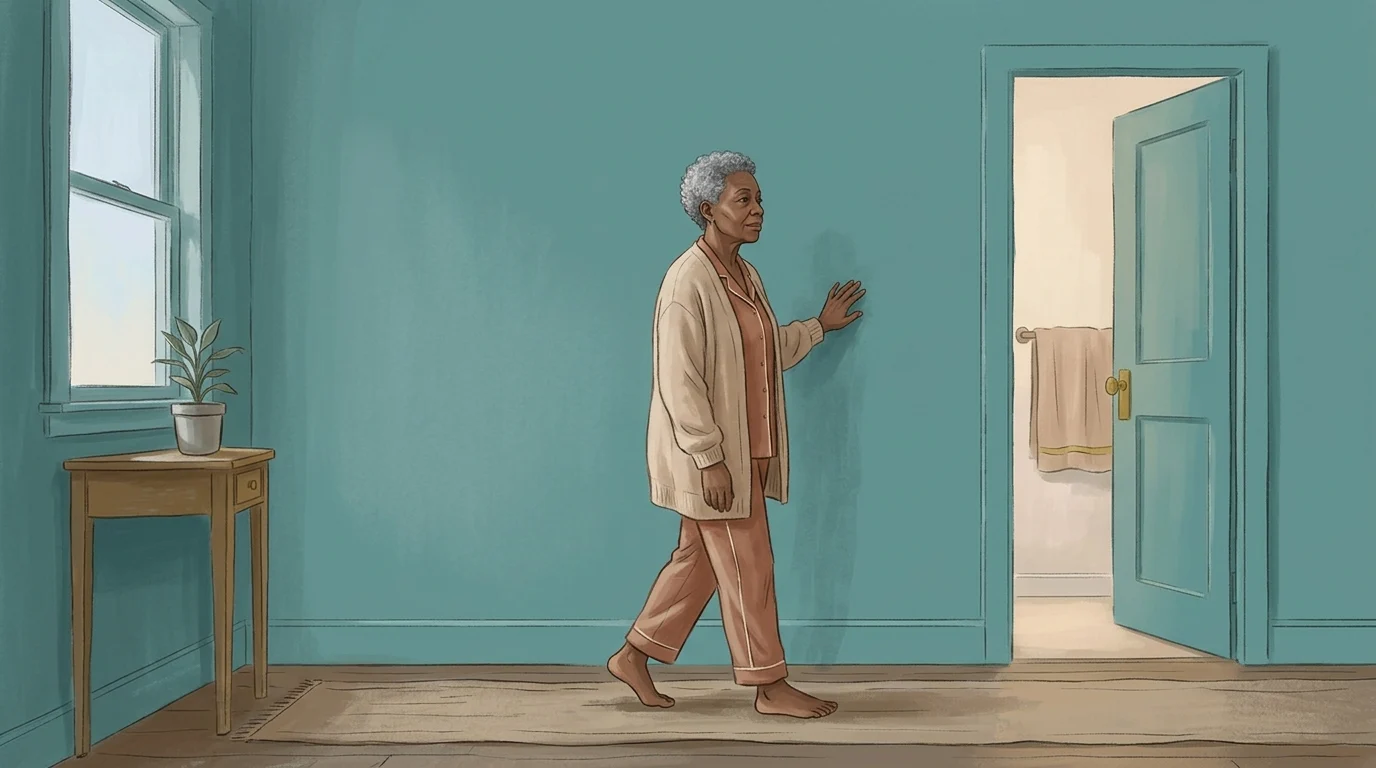
Think of the moment the urge arrives and you are still two rooms away. What I see again and again in my classes is that hurry changes how people stand: the breath stops, the shoulders lift, the eyes fix on the door, and the feet seem to stop feeling the floor. It's a very human response, and a habit, not a fault. I can't tell you it explains these findings. It's simply where the bladder and balance meet in an ordinary day. In a Feldenkrais® lesson, you might stand near a counter you can rest a hand on and notice how your breath holds as your weight shifts from one foot to the other, slowly, and only as far as feels easy and comfortable.
One thing to say out loud
Next time a doctor or nurse asks whether you've had any falls, add one sentence: whether you have leaks, or used to. You don't need to explain the connection.
Let Feldy guide you, eyes closed
A calm voice walks you through gentle moves so your attention stays in your body, not on the screen.
Try Feldy Free for 7 daysNo credit card needed.
Sources
- Changes in Urinary Incontinence Status and Subsequent Falls, Functional Decline, and Depressive Symptoms Across Five International Aging Cohorts— International Urogynecology Journal, 2026
- Changes in Urinary Incontinence Status and Subsequent Falls, Functional Decline, and Depressive Symptoms Across Five International Aging Cohorts (PubMed record)— PubMed, 2026
- The impact of urinary incontinence on falls: A systematic review and meta-analysis— PLOS ONE, 2021
- Urinary incontinence is associated with an increase in falls: a systematic review— Australian Journal of Physiotherapy, 2009
Movement Pulse is informational, not medical advice. See our editorial policy.
Move better with Feldy
See the programMovement Pulse Weekly
The week's best research, in your inbox Tuesday.
Movement science, gentle-practice ideas, and a practitioner's read on what's new. Free.
More from Movement Pulse
Why the balance exercise that works in a class may not be the one that works at home
A new analysis pooled 423 trials and nearly 34,000 older adults to compare 19 ways of training balance. The ranking changed depending on which kind of balance was being measured.
Aug 16, 2026
Even strong athletes wobble when the eyes close
A July 2026 study found even competitive weightlifters lost steadiness once the surface softened and the eyes closed. Balance is sensing, not strength.
Jul 6, 2026
For steadier balance after 60, balance games helped but never beat plain exercise
Steadiness is part of staying independent. Sixty trials with about 3,500 older adults suggest you can build it with a game, a screen, or neither.
Oct 30, 2026Ready to start moving better?
Gentle, guided lessons for your body. Try your first one free, no credit card required.