
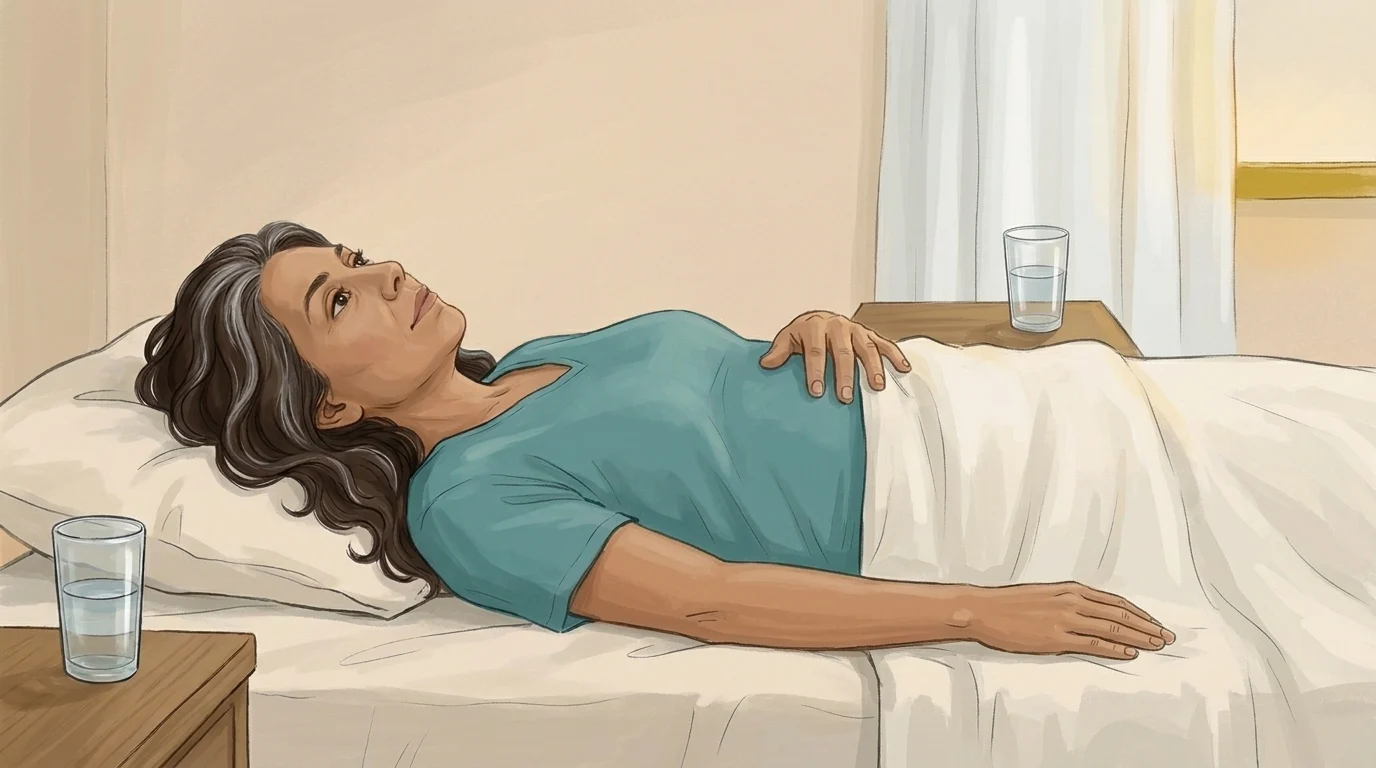
Women with menopause insomnia slept better after adding one gentle course
Sleep and mood eased together with a mindfulness course. The trial followed 82 women, and side effects were few.
You wake at three, hot or restless, and your mind starts its list: what you need to do, what worries you. By the time your thoughts settle, the birds are singing. If menopause has done this to your nights and you want something besides a pill to help you sleep and feel less on edge, a new trial points to a gentle option: a mindfulness course.
Women whose sleep problems came with menopause, and who added the course to their usual care, rated their sleep as better, and their anxiety and low mood scores fell more than those of women who had usual care alone (Climacteric, 2026).
Sleep and mood eased together
Women with insomnia linked to menopause were split into two groups by chance. Both groups got the routine health care usually offered. One group also did twelve weeks of mindfulness based stress reduction, a well known course that, in its usual form, practises resting your attention on your breath and on sensations in your body. The published summary doesn't describe this trial's sessions in detail.
By the end, the sleep questionnaires of the mindfulness group had improved more, and so had their scores for anxiety and low mood. Several areas of their quality of life also improved more, especially for how they felt physically, emotionally and socially.
So what's in it for you? If menopause has broken your sleep, learning to pay attention, the way a mindfulness course teaches, is a reasonable thing to try alongside what your doctor suggests. In this trial it went with calmer days as well as better nights, which matters when poor sleep affects not only your energy but how you feel through the day. If tiredness is the part that lingers, here is what is known about whether perimenopause fatigue goes away.
Few side effects, and most kept going
Fewer than 5% of women in either group reported a side effect, and none were serious. Most women kept up with the program, both its in person and its online parts. If you've started a sleep plan before and dropped it after a week, that part is worth noticing: it seems a course like this is something many women can stay with.
What the headline will miss
This is one trial of 82 women, a modest size. Sleep was measured with a questionnaire, so it tells us how women felt their sleep had been, not what a sleep lab would record. Because the comparison group got no extra sessions, and the women would have known whether they were taking a course, some of the benefit may come from the extra time and attention the course gave them, which is real help but not the same thing as proof that mindfulness itself did the work. The published summary doesn't say how large the differences were, or whether the gains lasted once the twelve weeks ended. It doesn't report on hot flashes either, and the trial didn't compare the course with hormone therapy or test the Feldenkrais Method®.
If poor sleep has gone on for weeks, if low mood isn't lifting, or if you're not sure menopause is the cause, talk to your doctor. There are well tested treatments for insomnia, and a practice like this can sit alongside them. More on the body changes of menopause is here.
Try it now
The women in the trial took a taught course over twelve weeks; this is a small taste of the idea, not the course itself. As you read, let your attention go to where your body is supported: the back of your head against a cushion, your shoulder blades against the chair, your heels on the floor. Don't try to relax them. Just notice which one feels heaviest.
What I see again and again in my classes is that when people stop trying to make a part soften and simply notice it, their breathing often slows by itself, sometimes within a few breaths. Many people also tell me that the harder they try to fall asleep, the more awake they feel. To me, Feldenkrais® work starts from a similar place, attention before effort, though it gets there through slow movement. You only go where it feels easy, pleasant and comfortable.
Three breaths at three
You don't have to win back every night at once. Next time you wake at three, before the list starts, find the heaviest part of you against the mattress and stay with it for three breaths. If your mind wanders back to the list, that's fine; gently come back to the weight. You aren't trying to force sleep. Start with the attention you can give tonight, then let it grow.
Let Feldy guide you, eyes closed
A calm voice walks you through gentle moves so your attention stays in your body, not on the screen.
Try Feldy Free for 7 daysNo credit card needed.
Sources
Movement Pulse is informational, not medical advice. See our editorial policy.
Move better with Feldy
See the programMovement Pulse Weekly
The week's best research, in your inbox Tuesday.
Movement science, gentle-practice ideas, and a practitioner's read on what's new. Free.
More from Movement Pulse
Walking or yoga for low mood in menopause? Twelve trials suggest each helps its own way
How you feel through the menopause years colours the decade after them. Brisk movement and slow mind body practice both pointed the right way, which leaves the choice with you.
Oct 19, 2026
Why the movement practice you keep through menopause is usually the one you enjoy
Eighteen women aged 40 to 60 describe building their own menopause toolkits, and what decided which parts they kept was not the evidence.
Sep 1, 2026
Menopause aches now have a name. What to ask your doctor
A growing wave of research is naming the joint aches and stiffness of perimenopause. A 93,000-woman analysis maps where it climbs, and what is worth asking.
Jun 24, 2026Ready to start moving better?
Gentle, guided lessons for your body. Try your first one free, no credit card required.