
Five years of vitamin D did not lower fracture risk, and that changes where to look
The Finnish vitamin D trial followed 2495 older adults for five years and counted every fracture in the national registers. Three questions worth taking to your next appointment.
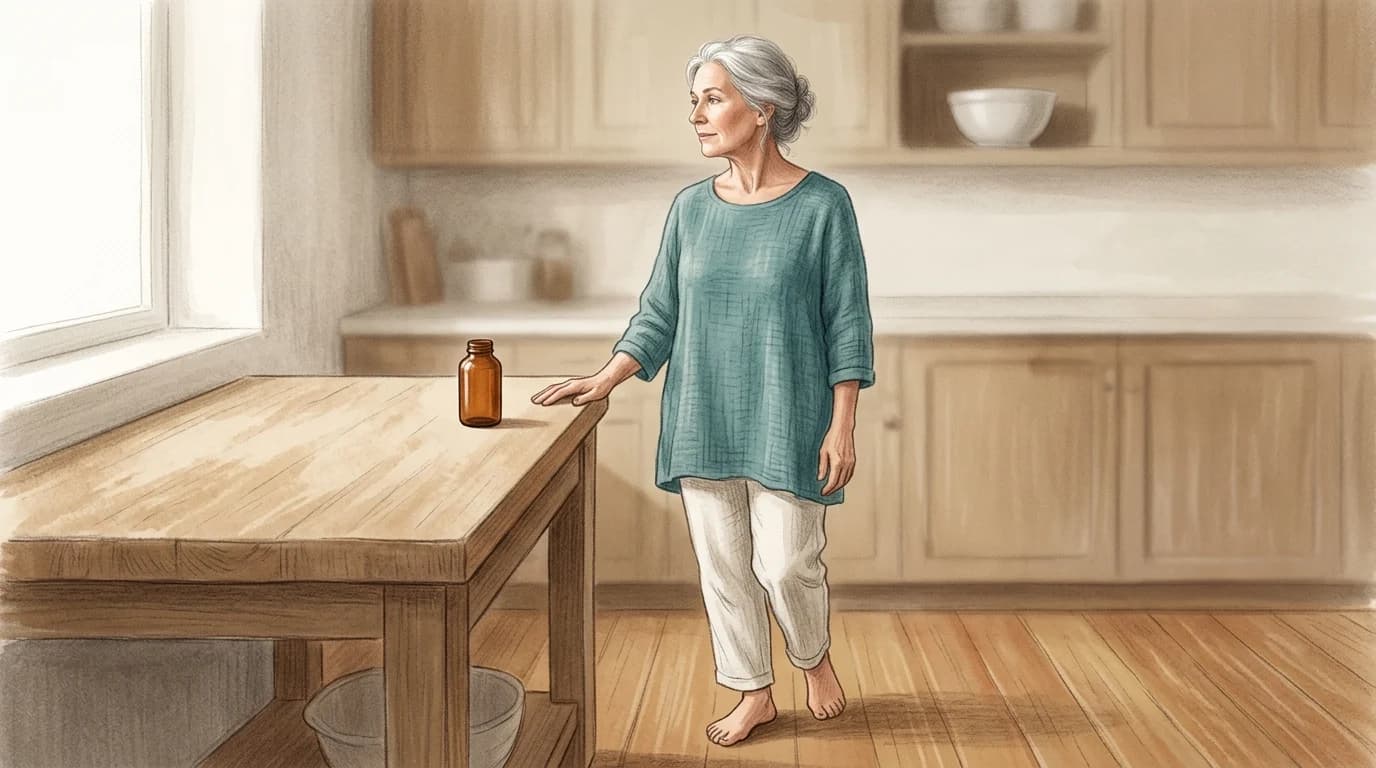
A woman I worked with last winter kept her vitamin D on the windowsill above the kitchen sink, next to the dish soap, because that was the only place she would reliably see it. Nine years of taking it, every morning, without missing many. Nobody had ever told her what it was supposed to prevent.
A trial published on 7 September in Bone gives her a partial answer, and it isn't the one most of us had assumed.
What the trial actually found
The Finnish Vitamin D Trial randomized 2495 people, men from age 60 and women from age 65, into three groups for five years: 1600 IU of vitamin D3 a day, 3200 IU a day, or a placebo. Fractures weren't self reported at the end, which is where a lot of supplement research quietly loses its footing. They were pulled from two national care notification registers, one of the quieter advantages of running a study in Finland (Bone, 2026).
Across the supplementation period, which averaged 4.1 years, there were 49 fractures in the placebo group, 73 in the lower dose group, and 52 in the higher dose group. Followed out to 7.3 years, the counts were 104, 139, and 111. Neither dose reduced fractures. No fracture subtype moved on its own either, and the things you would expect to matter made no difference: age, sex, body mass index, a previous fracture, a previous fall, an existing osteoporosis diagnosis, whether someone was also taking calcium. The answer held through all of it.
Then the caveat that matters more than the headline, and the one to hold before anybody reaches for their own bottle. This group was not short of vitamin D to begin with. In a subgroup of 550 participants the average blood level already sat comfortably inside the sufficient range, and over the following year the placebo group barely moved while the supplemented groups climbed well above it. So the question the trial actually asked was narrower than it first sounds: does adding more on top of enough prevent fractures? No. That's a genuinely different question from what happens to someone deficient, and the authors fenced their conclusion carefully to populations like the one they studied.
One oddity deserves naming rather than burying. The lower dose group recorded more fractures than placebo, by a margin wide enough that chance sits uneasily as an explanation. The higher dose group showed nothing of the kind. A real drug effect usually grows with the dose instead of vanishing at twice the dose, so a signal that appears at 1600 IU and evaporates at 3200 IU behaves far more like noise than like harm. Worth seeing. Not worth alarm. The author list includes JoAnn Manson, who ran the VITAL trial and has spent a decade delivering variations on this same unglamorous finding.
Three questions worth taking to your next appointment
I'm a Feldenkrais® practitioner and not a physician. Nothing here is a reason to change what you take, and a trial in Finnish adults who already had enough of something cannot tell you what your own blood work says. What it does hand you is three questions that a twelve minute appointment tends not to reach on its own.
"What was my last vitamin D level, and where did it sit?" The whole result rests on participants having started out sufficient, so it speaks directly to people topping up a tank that was already full, and much less clearly to anyone genuinely low. Most people I ask have no idea whether they've ever been tested. Which of the two you are changes how much of this trial is even about you.
"Is my fracture risk coming from my bones, or from my balance?" A fracture needs two things at once: a bone fragile enough to break, and an event forceful enough to break it. Scans measure the first. Almost nothing in a standard appointment measures the second. Both halves are real, and they answer to completely different kinds of attention.
"Who is looking at the falling half?" If the honest answer is nobody, that's the useful thing to have surfaced. Falls assessment, gait review, a physiotherapy referral, a medication review for anything causing dizziness on standing. Asking isn't diagnosing. It's making sure the second half got said out loud, once, by somebody in the room.
What this changes in my lane, and what it does not
The limit first, because everything else depends on it. Gentle movement work does not build bone density. Loading does, and the trial literature on progressive loading and bone is a separate body of evidence with a separate mechanism. If your scan is what worries you, that conversation belongs with your doctor and with whoever prescribes your exercise, and work based on the Feldenkrais Method® sits alongside what your physiotherapist gave you rather than in place of it. Yoga, Pilates, and tai chi each work through their own mechanism, and each has its own strengths.
What I do see, week after week, lives entirely on the other half. Someone stops trusting the ground. It starts small, usually after one stumble that frightened them more than it hurt, and then the walking changes: shorter steps, weight kept back over the heels, eyes down on the floor instead of out at the room, the whole body braced against a fall that hasn't happened yet. That bracing is itself destabilizing, which is the cruel part of it. A body held rigid has fewer ways to catch itself when the rug edge finally comes. We know already that fear of moving travels with thinner bones, though which one arrives first is still unsettled.
Learning to feel where your weight actually is, and how it travels from one foot to the other, is not a fracture prevention treatment and I won't dress it up as one. It may reach the part no supplement was ever going to. The fear of falling that follows people long after a stumble, and the slow narrowing of what movement feels available with age, are both things attention can get underneath. You can try that in the Feldy online movement program with a free 7 day trial, no credit card needed.
The bottle is still on her windowsill. Her doctor may well have good reasons for it that this trial doesn't touch. What has changed since the winter is the eleven centimetre step down from her kitchen into the garden, which she used to take sideways, holding the frame with both hands, and now mostly doesn't.
Let Feldy guide you, eyes closed
A calm voice walks you through gentle moves so your attention stays in your body, not on the screen.
Try Feldy Free for 7 daysNo credit card needed.
Sources
Movement Pulse is informational, not medical advice. See our editorial policy.
Move better with Feldy
See the programMovement Pulse Weekly
The week's best research, in your inbox Tuesday.
Movement science, gentle-practice ideas, and a practitioner's read on what's new. Free.
More from Movement Pulse
Tai chi was called too gentle to touch bone, yet 17 trials in women found a small gain
If you love a slow standing practice, it may be doing a little for your spine as well as your balance. Keep the walking and the strength work beside it.
Oct 17, 2026
The bone research kept saying load it harder. The largest review added a quieter line
124 trials and 18,429 adults over forty. Brisk walking led at two of the three sites measured. The one result the authors rated most confidently was not a walking result.
Sep 16, 2026
The clinic that watches your bones and the one that watches your balance rarely talk
Seven international organizations published a joint position paper on 10 September saying fall prevention and fracture prevention are still built as separate services. Three questions worth taking to your next appointment.
Sep 14, 2026Ready to start moving better?
Gentle, guided lessons for your body. Try your first one free, no credit card required.