
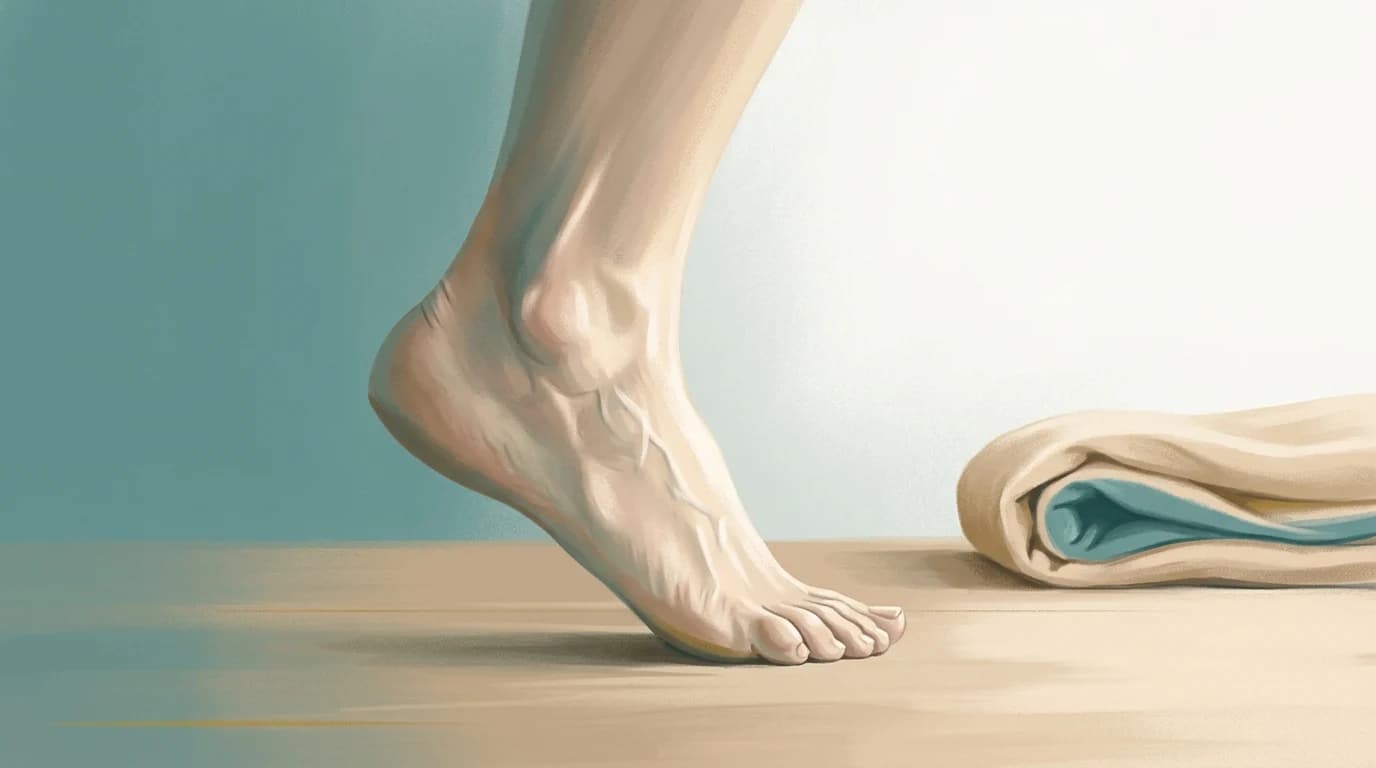
Why walking feels heavier at 70 than at 40 is not weaker calves, it is quiet gripping
A recent gait study across 107 adults ages 26 to 86 reveals a change in ankle coordination most people never notice, and points to attention as the intervention.
A recent gait study spanning ages 26 to 86 found that as people age, the calf muscle fires harder before the foot has left the ground, yet produces less actual push. The walk gets heavier not because the muscle is weaker, but because it is quietly gripping.
What the study actually measured
Researchers at Flinders University and the University of Canberra ran a secondary analysis of 107 healthy adults walking at their own pace, published in Gait and Posture (Lindsay et al., 2026). 3D motion capture, force platforms, and surface electromyography recorded every step. They then looked for continuous changes across the walking cycle as age went up, not just averages.
The pattern was clear. With increasing age, the tibialis anterior at the front of the shin and the gastrocnemius at the back of the calf started firing together more during early and midstance, the two muscles pulling in opposition rather than taking turns. At the same time, the plantarflexion moment (the calf's push at midstance) went down. In other words, older adults were spending more muscle energy earlier in the step and getting less mechanical output for it. Ground reaction forces at both braking and propulsion dropped. The push at the end of stance, the one that carries you into the next step, was noticeably smaller.
The authors are careful about what this means. In their words, the increased calf firing "reflect[s] a stabilising motor control strategy that compensates for reduced proprioceptive acuity". Put in ordinary language: as the fine sensing of where the ankle sits fades with age, the nervous system quietly locks the joint by firing muscles together that would normally alternate. It is not a strength problem. It is a sensing problem being answered with grip.
What I see in clients
As a practitioner, this is what shows up almost every week. Someone comes in saying the same walk they have done for years now feels heavier. They ask whether they need to strengthen their calves. When I watch them walk, the pattern is right there if you know where to look: the calf is already firing hard as the foot lands, not just at push off. The knee is a little cautious. The push at the back of the step is short. The heel comes up, but the ball of the foot does not press through.
What tends to shift the pattern is not calf raises. It is spending a few unhurried minutes with the sole of the foot, letting the ankle move slowly through its range, and letting the sensing of where the heel is, where the ball of the foot is, where the arch is, come back online. Awareness Through Movement® lessons are built around exactly this kind of attention, the Feldenkrais Method® handling of the same territory. When the sensing returns, the guarding tends to release on its own, and the push at the end of the step often comes back with less muscular effort than the client expects.
The insight that runs through Feldy's work fits here almost word for word: the older walker has not lost movement. They have lost trust that the muscles can push safely, so the nervous system compensates by holding. Slow attention is what rebuilds that trust.
Two related pieces in Feldypedia on proprioception decline with age and gait changes and walking difficulty unpack the mechanism and the felt experience.
What the study points to
The authors' own recommendation is that interventions should target "neuromuscular timing, phase specific coordination, proprioception and muscle tendon function". That is a mouthful, but it maps precisely onto the family of gentle movement approaches that use attention rather than load. Work based on the Feldenkrais Method is one member of that family. Tai chi, qigong, and Alexander Technique are others, each with its own mechanism and its own strengths. What they share, and what strength training alone will not replicate, is the sensing piece.
None of this replaces walking, and it certainly does not replace clinical care. This kind of gentle work sits alongside what a physiotherapist would offer, not in place of it. But if walking has started to feel like more work than it used to, and no one can point to an injury, this study is a nudge toward looking at how the ankle is being coordinated, not just how strong it is.
A quiet closing
A heavier walk is not always a weaker leg. Sometimes it is a calf that has been holding all day, waiting to be sensed again. The change is smaller than most fixes, and it usually starts with the foot.
Let Feldy guide you, eyes closed
A calm voice walks you through gentle moves so your attention stays in your body, not on the screen.
Try Feldy Free for 7 daysNo credit card needed.
Sources
Movement Pulse is informational, not medical advice. See our editorial policy.
Move better with Feldy
See the programMovement Pulse Weekly
The week's best research, in your inbox Tuesday.
Movement science, gentle-practice ideas, and a practitioner's read on what's new. Free.
More from Movement Pulse
Fifteen thousand people did the same digital knee program and went four different ways
A Lund University registry study tracked quality of life through a digital education and exercise program for knee and hip osteoarthritis. About half improved. A fifth got worse. The paper cannot say why, and says so.
Sep 22, 2026
The kind of exercise that helped attention most was the slowest one in the set
One hundred and ten trials, 8,130 people over sixty. No exercise type won across the board. The winner changed with the mental skill being measured.
Sep 10, 2026
What held up in two new reviews of yoga and qigong was not balance or strength
Twenty one yoga trials and twenty two qigong trials, published ten days apart. The physical scores wobbled once the missing studies were accounted for. Quality of life did not.
Sep 7, 2026Ready to start moving better?
Gentle, guided lessons for your body. Try your first one free, no credit card required.