
Micromovements: What They Are and How to Do Them
Micromovements are tiny, slow, easy movements done with attention. Here is a short lesson to try now, and why doing less helps you feel more.
The lesson
About 5 to 10 minutes. Move slowly, do less than you can, and stay well below any pain. Rest whenever you need to.
Prefer to listen than read?
Feldy voices gentle lessons like this for body awareness, so you can close your eyes and follow along.
- 1
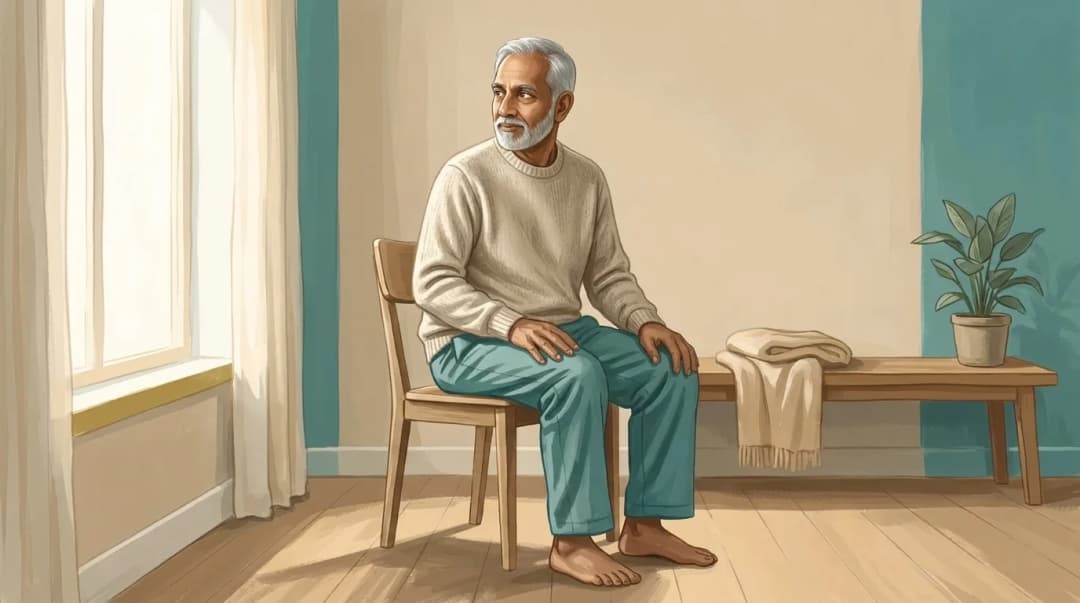
Settle. Lie down with your legs long, or sit in a chair. Let your hands rest and your arms feel heavy.
- 2
One finger. Lift one finger a tiny distance from your leg, then lower it. Move slowly. Rest your hand.
- 3
Even smaller. Lift the same finger again, half as far, slower than before. Notice what else in your hand takes part. Rest.
- 4
The other hand. Do the same with a finger of the other hand. Is one side easier to feel? Rest and breathe.
- 5
A tiny head turn. Turn your head a very little to the right and back, then to the left. Make it smaller if you notice effort.
- 6
Only imagine it. Imagine turning your head, without moving at all. Then rest and notice your breathing.
- 7
Compare. Lie or sit still. What do your hands and neck feel like now compared with the start?
Let Feldy guide you, eyes closed
You just read these steps. In the Feldy program, a calm voice guides you through each gentle move, so your attention can stay in your body instead of on the screen.
Try Feldy Free for 7 daysNo credit card needed.
Micromovements are very small, slow, easy movements done with attention, so you can feel more of what you are doing. If big movements feel hard, stiff, or tiring today, this is a kind way to begin. You do not need to be fit or flexible. You only need a few quiet minutes.
A micromovements lesson to try now
Why tiny movements help you feel more
Think about holding a heavy bag. If someone adds a feather, you will not notice. If you hold a feather and someone adds another, you will. The lighter the effort, the easier it is to feel a small change. Scientists describe this as the Weber Fechner idea, and it is simple to try with your own hands.
The Feldenkrais Method® builds on this. Moshe Feldenkrais taught that when you reduce effort, you notice more about how you move, and that lets you find easier choices. You are not training a muscle. You are paying attention to a movement you already know.
A review of 20 randomized trials found "promising evidence" that Feldenkrais lessons may help functions such as balance, though the studies had a high risk of bias and need more research (Hillier and Worley, 2015). That is encouraging, and it is also a reminder to stay curious and not expect a promise.
Where micromovements show up
You will meet them in Feldenkrais® lessons, where almost every movement is slow and gentle. They also appear in somatic movement, and in some rehab settings, where a therapist may ask for a tiny movement a person can do comfortably. For background, see our Feldypedia guide to the Feldenkrais Method.
When to try micromovements
Many people reach for them when the body feels stiff, tense, or tired. They can help when pain makes a big movement feel hard, because a tiny one stays comfortable. They also fit the end of the day. A few minutes before sleep gives your attention somewhere quiet to rest.
If you want more small, slow movements to try, our guide to somatic exercises for beginners is a natural next step. When you would like a teacher's voice with you, start your free Feldy week.
Who should check first
Please talk with a doctor or physical therapist before you start if you are recovering from an injury, a fracture, or surgery, or your pain keeps growing. Micromovements do not treat any condition. They are a way to practice paying attention. If something hurts, stop, make the movement smaller, or only imagine it.
Common Questions about micromovements (FAQ)
What are micromovements?
Micromovements are very small, slow, easy movements done with attention. The aim is not to build strength or range. The aim is to feel what you are doing, so your body can find lighter ways to move.
Are micromovements safe, and who should be careful?
They are gentle and stay well within an easy range, so they suit most people. Please ask your doctor or physical therapist first if you are recovering from an injury, a fracture, or surgery, or your pain keeps growing. If anything hurts, stop, or make the movement smaller.
How often should I do micromovements?
A few minutes a day is plenty, and short regular sessions work better than one long one. Many people like to practice at the same time each day, such as before bed.
How long until I notice anything?
Some people notice a quieter, easier feeling after one session. A clearer sense of how you move usually grows over a few weeks of regular, unhurried practice. There is no fixed timeline, and no result you need to reach.
How are micromovements different from stretching or regular exercise?
Stretching and exercise usually aim at a range, a shape, or a number of repetitions. Micromovements aim at how a movement feels while you do it. They stay small, slow, and nearly effortless, so there is nothing to achieve or push toward.
When should I see a professional?
If your pain or tension lasts, gets worse, or comes with numbness, weakness, or swelling, book a visit with a doctor or physical therapist. Micromovements are a way to practice awareness. They are not a treatment, and they do not replace care.
What are the best micromovements for beginners?
Start with one finger, one toe, or a tiny turn of the head, lying down or sitting. Each one is easy to make smaller, easy to rest after, and easy to compare from side to side.
What should I avoid when doing micromovements?
Avoid pushing, speeding up, and holding your breath. If you notice effort, make the movement smaller, slow down, and let your breath flow. Going less far is part of the practice, not a shortcut.
Learn to listen to your body
See the programRelated resources
What Does Feldenkrais® Feel Like? A Practitioner Explains
A sensory tour of your first lesson: the floor, the voice, the tiny movements, the long rests, and the light, tall feeling many people stand up with.
Somatic Movement Classes: What They Are and How to Choose
What actually happens in somatic movement classes, the main lineages you will meet, and how to choose between in person and online sessions.
Shoulders turned further after a slow, varied lesson than after repeating one twist
Ready to start moving better?
Gentle, guided lessons for your body. Try your first one free, no credit card required.